All Shows

Apr/24 · Langhorne Slim: The Dreamin’ Kind Tour
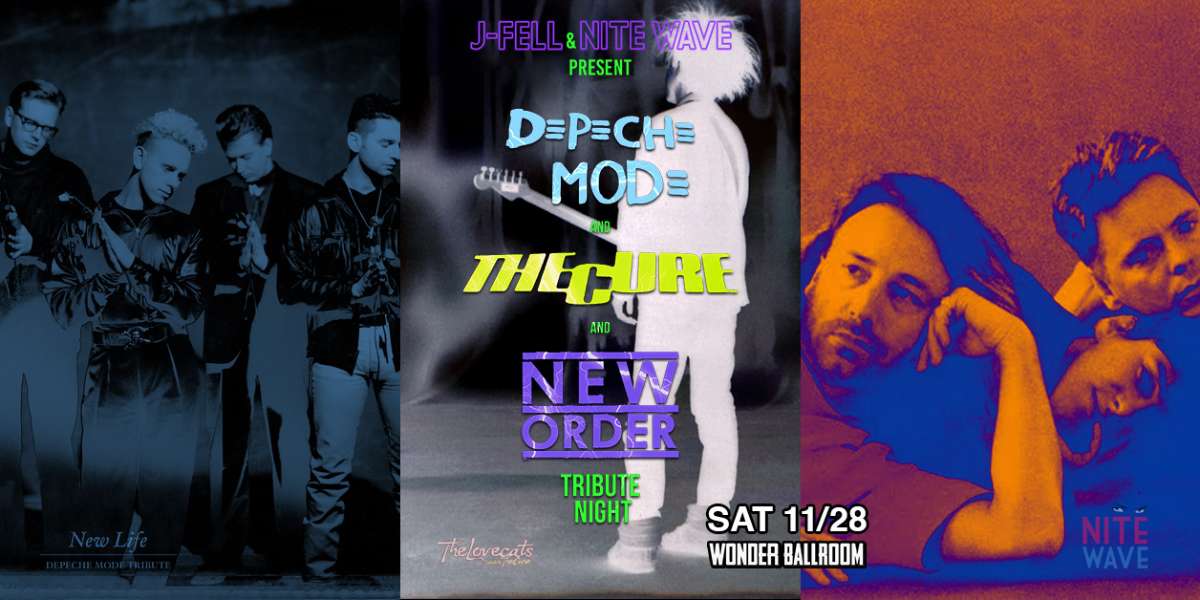
Apr/25 · Talking Heads, Blondie & Devo Tribute Night
Apr/27 · The Brook & The Bluff: The Werewolf Tour
Apr/28 · Patrick Watson – Uh Oh Tour
Apr/30 · JENSEN MCRAE – God Has A Hitman Tour
May/1 · The Red Pears and Together Pangea
May/2 · José González – Against The Dying Of The Light Tour
May/3 · GOLDEN: A K-Pop Kids Party!
May/5 · Joy Crookes
May/7 · Snail Mail
May/8 · Powfu Presents: The Lofi Library Tour
May/9 · Earlybirds Club
May/17 · Dry Cleaning
May/22 · hemlocke springs: the apple tree under the sea tour
May/24 · Inner Wave & Los Mesoneros – North America Tour ’26
May/27 · Josiah and the Bonnevilles – The Redline North American Tour
May/29 · Kes – Roots, Rock, Soca Tour
May/30 · Clara La San – Chosen Silences Tour 2026
May/31 · Yot Club – Simpleton Tour
Jun/2 · RESCHEDULED Claire Rosinkranz – My Lover Tour
Jun/6 · Jeff Rosenstock
Jun/7 · Jeff Rosenstock
Jun/10 · 3BALLMTY – CLUB CONEXIÓN TOUR – Phase 2
Jun/18 · The Crane Wives – ACT II
Jun/19 · The Crane Wives – ACT II
Jun/20 · Bôa
Jun/23 · Pomplamoose
Jun/24 · MOVED TO THE CRYSTAL BALLROOM: underscores Galleria – North American Chapter
Jun/27 · Searows – Death in the Business of Whaling
Jun/28 · Searows – Death in the Business of Whaling
Jul/7 · 3QUENCY – GIRLS TALK TOUR
Jul/9 · Aaron Hibell
Jul/10 · Have A Nice Life
Jul/27 · of Montreal
Jul/28 · Black Moth Super Rainbow
Aug/11 · Kingfishr
Aug/25 · Diggy Graves – The No Vacancy Tour
Aug/27 · Eagles of Death Metal – Death By Sexy Anniversary Tour
Sep/5 · MOVED TO THE CRYSTAL BALLROOM: Slayyyter – WOR$T GIRL IN THE WORLD TOUR
Sep/10 · The Charlatans UK – North American Tour 2026
Sep/11 · Eihwar – “Nordic Ritual Nights” USA Tour 2026
Sep/12 · Haute & Freddy’s Big Disgrace Tour
Sep/14 · Public Image Ltd – This Is Not The Last Tour
Sep/23 · ARLO PARKS – DESIRE TOUR
Sep/26 · deca joins
Oct/2 · EMEI – Night at the Opera Tour
Oct/9 · Kishi Bashi: Sonderlust 10th Anniversary Tour
Oct/20 · MOVED TO ROSELAND THEATER: Julia Wolf – Deep End World Tour
Oct/21 · SLIFT
Jan/11 · Anna von Hausswolff: Iconoclasts Tour
Jan/31 · *POSTPONED until TBD* The Residents – Eskimo Live! Tour

All Shows

Upcoming Events

Monqui Presents

With guest Laney Jones and the Spirits

Friday, April 24
Doors : 7 pm, Show : 8 pm
all ages
$29 to $56.25

About Langhorne Slim:

For more than two decades, Langhorne Slim has been a fearless voice in modern Americana, known for his raw emotion and rule-breaking spirit. On his ninth album, The Dreamin’ Kind, the Nashville-based songwriter plugs in his electric guitar and dives headfirst into big-hearted, 1970s-style rock & roll. Produced by Greta Van Fleet’s Sam F. Kiszka, the record pairs power chords and soaring hooks with the vulnerable storytelling that’s long defined Slim’s work. “It felt like I was blowing some old shit up so I could plant some new flowers,” he says. “I love folk music, but rock & roll tickles the same part of my soul. I wanted to explore that.” The collaboration began after Slim opened for Greta Van Fleet, leading to loose, inspired sessions with Kiszka and drummer Danny Wagner. Together they built songs that move from the propulsive rush of “Rock N Roll” and the swagger of “Haunted Man” to the tender sweep of “Dream Come True” and “Stealin’ Time.” Recorded over a year in Nashville, The Dreamin’ Kind bridges Slim’s rootsy past with a louder, more expansive present. It’s a record of freedom and discovery, equally at home in rock clubs and around campfires—proof that Langhorne Slim, ever the dreamer, still finds new ground to break with every song.

Monqui Presents

With guest Laney Jones and the Spirits

Friday, April 24
Doors : 7 pm, Show : 8 pm
all ages
$29 to $56.25

About Margo Price:

            Nearly a decade ago, Margo Price turned Nashville on its head with her breakthrough, beloved debut solo album, Midwest Farmer’s Daughter. Released in the throes of bro-country and before pop stars were crossing over into the genre left and right, it showcased an artist completely unafraid to double down not only on herself, but what she’d always loved: classic country songs written from the intellect and the gut, hell-bent on truth-telling and both timeless and urgent all at once. Respected by her peers, praised by critics and beloved by her fans, Price created a lane where independent-minded, insurgent country music can exist and thrive alongside the mainstream, and became an ardent fighter for her beliefs in a genre where the norm is to shut up and sing. A trailblazer and a champion for the craft, Price redefined what it meant to be a modern country artist.

            And now she’s back with an exquisite, truly timeless album that reconnects with her roots and pays tribute to the art of the country song, inspired in part by the legends whom she now calls colleagues and friends. Hard Headed Woman is both a look forward and a look back: a way to march forward while staying true to yourself when the path of less resistance is right there in front of us, and short cuts are around every corner. And a way to look back when we need to trim what is no longer working, and to stay connected with where we’re from. It is a promise and a manifesto, a love song to both a city and a genre, and a defiant cry for individuality.

In creating Hard Headed Woman, Price brought all of her power as one of  our most beloved and respected songwriters to craft a deep exploration of love and America in a time of unprecedented uncertainty. Featuring appearances from Tyler Childers, co-writes with Rodney Crowell and a Waylon Jennings song that his widow, Jessi Colter, urged her to sing, it is country music as only Price can make it: free of rules, cherishing tradition, hard headed to the core but with a delicate, beating heart.

Since releasing Midwest Farmer’s Daughter, Price has barely slowed down. She’s made four records, played Saturday Night Live, been nominated for a Grammy, toured the world alongside artists like Chris Stapleton and Willie Nelson, released a lauded memoir (Maybe We’ll Make It, due on paperback September 2nd), became an in-demand producer and was appointed as the first female board member of Nelson’s Farm Aid. And she’s been fearless when it came to genre, venturing into psychedelic rock on her most recent, Jonathan Wilson-produced record, Strays. It would have been easiest to just stay that course, and keep running. But Price doesn’t follow success or comfort. She follows the art.

            It took a whole lot of hard work and honesty with herself and others to get there, but that’s never stopped Price before.  “I made the decision that I had to rebuild everything from the ground up,” Price says. “There’s all this pressure to be pumping out content, and I felt the opposite in the way I wanted to approach this record and my life in general.”

            Price had also established herself as one of the most passionate, vocal artists in country music and beyond when it came to standing up for political and personal causes, from the presidential election, to abortion to gun control: happily hard headed when it came to the fight for equality and justice, especially for the working class and underserved in our society. Price has always brilliantly woven her activism into her songs, but her role as a spokesperson had started to overtake, on occasion, her role as a songwriter. She wanted to focus on using her written word to deliver the most potent punch of all.

            “I always hope to do like Johnny Cash did,” Price says, “which is speak up for the common man and woman. But there have been so many threats and anger and vitriol over the years, when I am only coming from a place of love.”

Price realized she just needed a break from everything outside of the bubble of family life and her art. She started spending more time at home, writing songs alone and with her husband, Jeremey Ivey. She started popping up in the dive bars and tiny venues around Nashville where she got her start, sometimes just to play a country cover or two or dance with the crowd. She refused guidance to write for pop stars or compromise her values for a quick buck. Most of all, she turned the emphasis in her music back to songwriting, exactly where she began.        

“So much of Strays was leaning into this psychedelic, textural territory,” says Price. The music lent itself to vibrant, heavy stage jams, with Price often hopping behind the drumkit and bruising her thigh from a tambourine beat. She found herself longing for the days when it was just her and her guitar, playing at an East Nashville dive bar. “I always knew,” she adds, “I would come back to this more rooted sound.”

            Hard Headed Woman is rooted to its core. Rooted in Price’s history and struggle to make it as a musician for so many years in a town that prizes uniformity and the bottom line, rooted in the country and folk sounds that have become her signature, rooted in the simplicity of a few key collaborators instead of songs-by-committee. At the heart of Price’s work is her creative partnership with Ivey, with whom she describes as having a “soul connection.” “I’m a songwriter,” Price says. “I’m not somebody who goes out and needs five people to craft a song, and then tack my name on it. That’s never been my style. I have something to say.”

Something to say, nothing to prove. The first song they wrote for the album that would become Hard Headed Woman was “Close to You,” a simple, pining call for a lover that is infused with the sounds of the desert. It’s unfettered and truth-telling, accented by some flamenco guitar and Price’s gorgeous, urgent vocals. “We played the jukebox while democracy fell,” Price sings, never letting her songs fall out of the context in which they exist. It’s the kind of thing that only she could write, carrying both love and fear in one single line.

As more songs started to form, an early boost of confidence came from her friends Rodney Crowell and Emmylou Harris, who heard some of the work at a political fundraiser and encouraged Price to keep going.  “I have both of them to thank for building me up and making me believe in the songs I am writing in this season of my life,” Price says. Crowell remained not only an inspiration and supporter of the album but a contributor: he co-wrote two songs with Price and Ivey.

            The album that unfolded from there is drenched in Price’s unique story and unshakeable instincts: while Midwest Farmer’s Daughter was about her journey from childhood to Nashville, Hard Headed Woman is very much her battle since from dive bars to tour buses, through parenthood and marriage, through scrutiny and sacrifice all while fighting constantly for what she believes in, and the music she loves. It begins with a proclamation on the prelude, which serves as the album’s mission statement: or, Price puts it, “a disclaimer and reminder that I don’t owe you fucking shit.”

            Songs like the album’s lead single, “Don’t Let the Bastards Get you Down,” speak for the downtrodden and the forgotten, an “anthem for people who are being overlooked in society and need to be lifted up,” Price says, “because we are up against so much right now.” As so many of Price’s songs do, it speaks both for the personal and the political all at once. Price was inspired by the message Kris Kristofferson whispered to Sinead O’Connor when she was booed on stage at a Bob Dylan 30th Anniversary show, and even got Kristofferson’s widow’s blessing to include his name on the credits. “I always admired Kris for how he stood by her in that moment, instead of pulling her off the stage like they told him,” Price says. It serves as a reminder to anyone who encounters resistance in the face of fighting for justice to keep going, especially when it would be so much easier to capitulate and cower.

“The song was originally written for a movie that never happened, but it feels so timely with everything that’s going on in the world,” Price explains. “The phrase, ‘Don’t Let The Bastards Get You Down’ originates from Margaret Atwood’s brilliant 1985 piece of literature, The Handmaid’s Tale. It’s referred to in Latin and used as a rallying cry for resistance against the oppressive regime that symbolizes resilience and hope in the face of adversity. Nolite te Bastardes Caborundorum.”

            That spirit resonates all across the songs of Hard Headed Woman. The blistering “Don’t Wake Me Up” was based around some writings that Ivey stumbled upon in one of Price’s notebooks, inspired in part by her deep readings of Frank Stanford, one of her favorite poets due to his freewheeling work free of boundaries. They spun it all into song in minutes that chugs with the essence of Dylan’s “Subterranean Homesick Blues”: “The way this world is going, ain’t where I’m at,” Price howls in her powerful, unmistakable voice. “Nowhere is Where,” turns slow and contemplative, road-worn but never broken, the call of someone who has been to the mountain but never forgets the prairie below. And “Losing Streak” whirls in with an organ and out with a weary, world-worn defiance: our worst times don’t define us, but they’re always part of who we are.

There are songs that go back to the beginning of Price’s early grind, like the western-tinged “Wild at Heart,” reflecting on how much her life and the city of Nashville has changed over the years – and how important it is to stay true to exactly who you are despite it all. Another, called “Red Eye Flight,” is about both leaving a lover and also leaving her longtime band the Pricetags. “I’ve been with those players for ten, thirteen years,” she says. “But I could feel that I needed to make a change, and to change texturally what’s going on with the band. But it’s a familial bond, different than a friendship.”

There are a few choice covers and cuts, too: “Love Me Like You Used To Do” is by Price’s friend Steven Knudson, an unsung Nashville writer on whom she hopes to shine a spotlight (helping to elevate the town’s incredibly talented but buried voices is one of Price’s favorite pastimes). Friend Tyler Childers joins Price on that waltzing country ballad, while “I Just Don’t Give a Damn” is Price’s “Jolene goes to Memphis” take on the Jimmy Peppers and George Jones classic. And showcasing how Price has been trusted by the greats to lead the next generation of country music renegades, “Kissin You Goodbye” was given to Price by Jessi Colter, Waylon Jennings’ widow, when Price was producing her record. They’re songs chosen to appreciate the past and the present as she sees it – not as Music Row or the algorithm might dictate – and place Price squarely amongst her heroes as a living and breathing part of the new country tradition.

            When it came time to record Hard Headed Woman, it was important for Price to keep that ethos alive, decamping to Nashville’s RCA Studio A and reuniting with producer Matt Ross-Spang, with whom she made her first two solo albums. Though she has worked with everyone from Sturgill Simpson to Jonathan Wilson since, it was Spang’s vocal rebuke of easy studio shortcuts that made her eager to reunite again. “He’s so unpretentious,” Price says. “He fully believes in me, he fully believes in my songs. He got us back to feeling it in your gut and not needing everything to be so perfect.”

            It felt truly significant for Price to make the album in Nashville, a city where she’s lived for over two decades and played a seminal role in its transformation, yet somehow never recorded an album in the place she’s called home. The historic RCA Studio A helped connect Price even closer to the legacy of songwriting she holds so dear, a place where everyone from Dolly Parton to John Prine to Loretta Lynn have made albums. “It felt like there were ghosts and spirits just hanging out,” Price says. In perfect kismet, she also launched her own signature Gibson J-45 guitar, inspired by her 1960’s Gibson she’s had by her side for years as her career took off. It’s all part of the continuity that she wishes to create with her art, not just with timeless songs but inspiring future generations of women, mothers and artists in general who don’t want to sacrifice their vision, moral compass or family life in favor of mainstream success.

At its core, Hard Headed Woman is about that furious instinct to never waver, especially when ourselves, our values and our future is so clearly on the line. As she sings on the title track, “I ain’t ashamed, I just am what I am.”

            “I hope this album inspires people to be fearless and take chances and just be unabashedly themselves,” Price says, “in a culture that tries as hard as it can to beat us into all being the same.”


J-Fell Presents

Saturday, April 25
Doors : 7 pm, Show : 8 pm
all ages
$34

About Margo Price:

            Nearly a decade ago, Margo Price turned Nashville on its head with her breakthrough, beloved debut solo album, Midwest Farmer’s Daughter. Released in the throes of bro-country and before pop stars were crossing over into the genre left and right, it showcased an artist completely unafraid to double down not only on herself, but what she’d always loved: classic country songs written from the intellect and the gut, hell-bent on truth-telling and both timeless and urgent all at once. Respected by her peers, praised by critics and beloved by her fans, Price created a lane where independent-minded, insurgent country music can exist and thrive alongside the mainstream, and became an ardent fighter for her beliefs in a genre where the norm is to shut up and sing. A trailblazer and a champion for the craft, Price redefined what it meant to be a modern country artist.

            And now she’s back with an exquisite, truly timeless album that reconnects with her roots and pays tribute to the art of the country song, inspired in part by the legends whom she now calls colleagues and friends. Hard Headed Woman is both a look forward and a look back: a way to march forward while staying true to yourself when the path of less resistance is right there in front of us, and short cuts are around every corner. And a way to look back when we need to trim what is no longer working, and to stay connected with where we’re from. It is a promise and a manifesto, a love song to both a city and a genre, and a defiant cry for individuality.

In creating Hard Headed Woman, Price brought all of her power as one of  our most beloved and respected songwriters to craft a deep exploration of love and America in a time of unprecedented uncertainty. Featuring appearances from Tyler Childers, co-writes with Rodney Crowell and a Waylon Jennings song that his widow, Jessi Colter, urged her to sing, it is country music as only Price can make it: free of rules, cherishing tradition, hard headed to the core but with a delicate, beating heart.

Since releasing Midwest Farmer’s Daughter, Price has barely slowed down. She’s made four records, played Saturday Night Live, been nominated for a Grammy, toured the world alongside artists like Chris Stapleton and Willie Nelson, released a lauded memoir (Maybe We’ll Make It, due on paperback September 2nd), became an in-demand producer and was appointed as the first female board member of Nelson’s Farm Aid. And she’s been fearless when it came to genre, venturing into psychedelic rock on her most recent, Jonathan Wilson-produced record, Strays. It would have been easiest to just stay that course, and keep running. But Price doesn’t follow success or comfort. She follows the art.

            It took a whole lot of hard work and honesty with herself and others to get there, but that’s never stopped Price before.  “I made the decision that I had to rebuild everything from the ground up,” Price says. “There’s all this pressure to be pumping out content, and I felt the opposite in the way I wanted to approach this record and my life in general.”

            Price had also established herself as one of the most passionate, vocal artists in country music and beyond when it came to standing up for political and personal causes, from the presidential election, to abortion to gun control: happily hard headed when it came to the fight for equality and justice, especially for the working class and underserved in our society. Price has always brilliantly woven her activism into her songs, but her role as a spokesperson had started to overtake, on occasion, her role as a songwriter. She wanted to focus on using her written word to deliver the most potent punch of all.

            “I always hope to do like Johnny Cash did,” Price says, “which is speak up for the common man and woman. But there have been so many threats and anger and vitriol over the years, when I am only coming from a place of love.”

Price realized she just needed a break from everything outside of the bubble of family life and her art. She started spending more time at home, writing songs alone and with her husband, Jeremey Ivey. She started popping up in the dive bars and tiny venues around Nashville where she got her start, sometimes just to play a country cover or two or dance with the crowd. She refused guidance to write for pop stars or compromise her values for a quick buck. Most of all, she turned the emphasis in her music back to songwriting, exactly where she began.        

“So much of Strays was leaning into this psychedelic, textural territory,” says Price. The music lent itself to vibrant, heavy stage jams, with Price often hopping behind the drumkit and bruising her thigh from a tambourine beat. She found herself longing for the days when it was just her and her guitar, playing at an East Nashville dive bar. “I always knew,” she adds, “I would come back to this more rooted sound.”

            Hard Headed Woman is rooted to its core. Rooted in Price’s history and struggle to make it as a musician for so many years in a town that prizes uniformity and the bottom line, rooted in the country and folk sounds that have become her signature, rooted in the simplicity of a few key collaborators instead of songs-by-committee. At the heart of Price’s work is her creative partnership with Ivey, with whom she describes as having a “soul connection.” “I’m a songwriter,” Price says. “I’m not somebody who goes out and needs five people to craft a song, and then tack my name on it. That’s never been my style. I have something to say.”

Something to say, nothing to prove. The first song they wrote for the album that would become Hard Headed Woman was “Close to You,” a simple, pining call for a lover that is infused with the sounds of the desert. It’s unfettered and truth-telling, accented by some flamenco guitar and Price’s gorgeous, urgent vocals. “We played the jukebox while democracy fell,” Price sings, never letting her songs fall out of the context in which they exist. It’s the kind of thing that only she could write, carrying both love and fear in one single line.

As more songs started to form, an early boost of confidence came from her friends Rodney Crowell and Emmylou Harris, who heard some of the work at a political fundraiser and encouraged Price to keep going.  “I have both of them to thank for building me up and making me believe in the songs I am writing in this season of my life,” Price says. Crowell remained not only an inspiration and supporter of the album but a contributor: he co-wrote two songs with Price and Ivey.

            The album that unfolded from there is drenched in Price’s unique story and unshakeable instincts: while Midwest Farmer’s Daughter was about her journey from childhood to Nashville, Hard Headed Woman is very much her battle since from dive bars to tour buses, through parenthood and marriage, through scrutiny and sacrifice all while fighting constantly for what she believes in, and the music she loves. It begins with a proclamation on the prelude, which serves as the album’s mission statement: or, Price puts it, “a disclaimer and reminder that I don’t owe you fucking shit.”

            Songs like the album’s lead single, “Don’t Let the Bastards Get you Down,” speak for the downtrodden and the forgotten, an “anthem for people who are being overlooked in society and need to be lifted up,” Price says, “because we are up against so much right now.” As so many of Price’s songs do, it speaks both for the personal and the political all at once. Price was inspired by the message Kris Kristofferson whispered to Sinead O’Connor when she was booed on stage at a Bob Dylan 30th Anniversary show, and even got Kristofferson’s widow’s blessing to include his name on the credits. “I always admired Kris for how he stood by her in that moment, instead of pulling her off the stage like they told him,” Price says. It serves as a reminder to anyone who encounters resistance in the face of fighting for justice to keep going, especially when it would be so much easier to capitulate and cower.

“The song was originally written for a movie that never happened, but it feels so timely with everything that’s going on in the world,” Price explains. “The phrase, ‘Don’t Let The Bastards Get You Down’ originates from Margaret Atwood’s brilliant 1985 piece of literature, The Handmaid’s Tale. It’s referred to in Latin and used as a rallying cry for resistance against the oppressive regime that symbolizes resilience and hope in the face of adversity. Nolite te Bastardes Caborundorum.”

            That spirit resonates all across the songs of Hard Headed Woman. The blistering “Don’t Wake Me Up” was based around some writings that Ivey stumbled upon in one of Price’s notebooks, inspired in part by her deep readings of Frank Stanford, one of her favorite poets due to his freewheeling work free of boundaries. They spun it all into song in minutes that chugs with the essence of Dylan’s “Subterranean Homesick Blues”: “The way this world is going, ain’t where I’m at,” Price howls in her powerful, unmistakable voice. “Nowhere is Where,” turns slow and contemplative, road-worn but never broken, the call of someone who has been to the mountain but never forgets the prairie below. And “Losing Streak” whirls in with an organ and out with a weary, world-worn defiance: our worst times don’t define us, but they’re always part of who we are.

There are songs that go back to the beginning of Price’s early grind, like the western-tinged “Wild at Heart,” reflecting on how much her life and the city of Nashville has changed over the years – and how important it is to stay true to exactly who you are despite it all. Another, called “Red Eye Flight,” is about both leaving a lover and also leaving her longtime band the Pricetags. “I’ve been with those players for ten, thirteen years,” she says. “But I could feel that I needed to make a change, and to change texturally what’s going on with the band. But it’s a familial bond, different than a friendship.”

There are a few choice covers and cuts, too: “Love Me Like You Used To Do” is by Price’s friend Steven Knudson, an unsung Nashville writer on whom she hopes to shine a spotlight (helping to elevate the town’s incredibly talented but buried voices is one of Price’s favorite pastimes). Friend Tyler Childers joins Price on that waltzing country ballad, while “I Just Don’t Give a Damn” is Price’s “Jolene goes to Memphis” take on the Jimmy Peppers and George Jones classic. And showcasing how Price has been trusted by the greats to lead the next generation of country music renegades, “Kissin You Goodbye” was given to Price by Jessi Colter, Waylon Jennings’ widow, when Price was producing her record. They’re songs chosen to appreciate the past and the present as she sees it – not as Music Row or the algorithm might dictate – and place Price squarely amongst her heroes as a living and breathing part of the new country tradition.

            When it came time to record Hard Headed Woman, it was important for Price to keep that ethos alive, decamping to Nashville’s RCA Studio A and reuniting with producer Matt Ross-Spang, with whom she made her first two solo albums. Though she has worked with everyone from Sturgill Simpson to Jonathan Wilson since, it was Spang’s vocal rebuke of easy studio shortcuts that made her eager to reunite again. “He’s so unpretentious,” Price says. “He fully believes in me, he fully believes in my songs. He got us back to feeling it in your gut and not needing everything to be so perfect.”

            It felt truly significant for Price to make the album in Nashville, a city where she’s lived for over two decades and played a seminal role in its transformation, yet somehow never recorded an album in the place she’s called home. The historic RCA Studio A helped connect Price even closer to the legacy of songwriting she holds so dear, a place where everyone from Dolly Parton to John Prine to Loretta Lynn have made albums. “It felt like there were ghosts and spirits just hanging out,” Price says. In perfect kismet, she also launched her own signature Gibson J-45 guitar, inspired by her 1960’s Gibson she’s had by her side for years as her career took off. It’s all part of the continuity that she wishes to create with her art, not just with timeless songs but inspiring future generations of women, mothers and artists in general who don’t want to sacrifice their vision, moral compass or family life in favor of mainstream success.

At its core, Hard Headed Woman is about that furious instinct to never waver, especially when ourselves, our values and our future is so clearly on the line. As she sings on the title track, “I ain’t ashamed, I just am what I am.”

            “I hope this album inspires people to be fearless and take chances and just be unabashedly themselves,” Price says, “in a culture that tries as hard as it can to beat us into all being the same.”


Monqui Presents

With guest Ethan Tasch

Monday, April 27
Doors : 7 pm, Show : 8 pm
all ages
$29 to $50

About Margo Price:

            Nearly a decade ago, Margo Price turned Nashville on its head with her breakthrough, beloved debut solo album, Midwest Farmer’s Daughter. Released in the throes of bro-country and before pop stars were crossing over into the genre left and right, it showcased an artist completely unafraid to double down not only on herself, but what she’d always loved: classic country songs written from the intellect and the gut, hell-bent on truth-telling and both timeless and urgent all at once. Respected by her peers, praised by critics and beloved by her fans, Price created a lane where independent-minded, insurgent country music can exist and thrive alongside the mainstream, and became an ardent fighter for her beliefs in a genre where the norm is to shut up and sing. A trailblazer and a champion for the craft, Price redefined what it meant to be a modern country artist.

            And now she’s back with an exquisite, truly timeless album that reconnects with her roots and pays tribute to the art of the country song, inspired in part by the legends whom she now calls colleagues and friends. Hard Headed Woman is both a look forward and a look back: a way to march forward while staying true to yourself when the path of less resistance is right there in front of us, and short cuts are around every corner. And a way to look back when we need to trim what is no longer working, and to stay connected with where we’re from. It is a promise and a manifesto, a love song to both a city and a genre, and a defiant cry for individuality.

In creating Hard Headed Woman, Price brought all of her power as one of  our most beloved and respected songwriters to craft a deep exploration of love and America in a time of unprecedented uncertainty. Featuring appearances from Tyler Childers, co-writes with Rodney Crowell and a Waylon Jennings song that his widow, Jessi Colter, urged her to sing, it is country music as only Price can make it: free of rules, cherishing tradition, hard headed to the core but with a delicate, beating heart.

Since releasing Midwest Farmer’s Daughter, Price has barely slowed down. She’s made four records, played Saturday Night Live, been nominated for a Grammy, toured the world alongside artists like Chris Stapleton and Willie Nelson, released a lauded memoir (Maybe We’ll Make It, due on paperback September 2nd), became an in-demand producer and was appointed as the first female board member of Nelson’s Farm Aid. And she’s been fearless when it came to genre, venturing into psychedelic rock on her most recent, Jonathan Wilson-produced record, Strays. It would have been easiest to just stay that course, and keep running. But Price doesn’t follow success or comfort. She follows the art.

            It took a whole lot of hard work and honesty with herself and others to get there, but that’s never stopped Price before.  “I made the decision that I had to rebuild everything from the ground up,” Price says. “There’s all this pressure to be pumping out content, and I felt the opposite in the way I wanted to approach this record and my life in general.”

            Price had also established herself as one of the most passionate, vocal artists in country music and beyond when it came to standing up for political and personal causes, from the presidential election, to abortion to gun control: happily hard headed when it came to the fight for equality and justice, especially for the working class and underserved in our society. Price has always brilliantly woven her activism into her songs, but her role as a spokesperson had started to overtake, on occasion, her role as a songwriter. She wanted to focus on using her written word to deliver the most potent punch of all.

            “I always hope to do like Johnny Cash did,” Price says, “which is speak up for the common man and woman. But there have been so many threats and anger and vitriol over the years, when I am only coming from a place of love.”

Price realized she just needed a break from everything outside of the bubble of family life and her art. She started spending more time at home, writing songs alone and with her husband, Jeremey Ivey. She started popping up in the dive bars and tiny venues around Nashville where she got her start, sometimes just to play a country cover or two or dance with the crowd. She refused guidance to write for pop stars or compromise her values for a quick buck. Most of all, she turned the emphasis in her music back to songwriting, exactly where she began.        

“So much of Strays was leaning into this psychedelic, textural territory,” says Price. The music lent itself to vibrant, heavy stage jams, with Price often hopping behind the drumkit and bruising her thigh from a tambourine beat. She found herself longing for the days when it was just her and her guitar, playing at an East Nashville dive bar. “I always knew,” she adds, “I would come back to this more rooted sound.”

            Hard Headed Woman is rooted to its core. Rooted in Price’s history and struggle to make it as a musician for so many years in a town that prizes uniformity and the bottom line, rooted in the country and folk sounds that have become her signature, rooted in the simplicity of a few key collaborators instead of songs-by-committee. At the heart of Price’s work is her creative partnership with Ivey, with whom she describes as having a “soul connection.” “I’m a songwriter,” Price says. “I’m not somebody who goes out and needs five people to craft a song, and then tack my name on it. That’s never been my style. I have something to say.”

Something to say, nothing to prove. The first song they wrote for the album that would become Hard Headed Woman was “Close to You,” a simple, pining call for a lover that is infused with the sounds of the desert. It’s unfettered and truth-telling, accented by some flamenco guitar and Price’s gorgeous, urgent vocals. “We played the jukebox while democracy fell,” Price sings, never letting her songs fall out of the context in which they exist. It’s the kind of thing that only she could write, carrying both love and fear in one single line.

As more songs started to form, an early boost of confidence came from her friends Rodney Crowell and Emmylou Harris, who heard some of the work at a political fundraiser and encouraged Price to keep going.  “I have both of them to thank for building me up and making me believe in the songs I am writing in this season of my life,” Price says. Crowell remained not only an inspiration and supporter of the album but a contributor: he co-wrote two songs with Price and Ivey.

            The album that unfolded from there is drenched in Price’s unique story and unshakeable instincts: while Midwest Farmer’s Daughter was about her journey from childhood to Nashville, Hard Headed Woman is very much her battle since from dive bars to tour buses, through parenthood and marriage, through scrutiny and sacrifice all while fighting constantly for what she believes in, and the music she loves. It begins with a proclamation on the prelude, which serves as the album’s mission statement: or, Price puts it, “a disclaimer and reminder that I don’t owe you fucking shit.”

            Songs like the album’s lead single, “Don’t Let the Bastards Get you Down,” speak for the downtrodden and the forgotten, an “anthem for people who are being overlooked in society and need to be lifted up,” Price says, “because we are up against so much right now.” As so many of Price’s songs do, it speaks both for the personal and the political all at once. Price was inspired by the message Kris Kristofferson whispered to Sinead O’Connor when she was booed on stage at a Bob Dylan 30th Anniversary show, and even got Kristofferson’s widow’s blessing to include his name on the credits. “I always admired Kris for how he stood by her in that moment, instead of pulling her off the stage like they told him,” Price says. It serves as a reminder to anyone who encounters resistance in the face of fighting for justice to keep going, especially when it would be so much easier to capitulate and cower.

“The song was originally written for a movie that never happened, but it feels so timely with everything that’s going on in the world,” Price explains. “The phrase, ‘Don’t Let The Bastards Get You Down’ originates from Margaret Atwood’s brilliant 1985 piece of literature, The Handmaid’s Tale. It’s referred to in Latin and used as a rallying cry for resistance against the oppressive regime that symbolizes resilience and hope in the face of adversity. Nolite te Bastardes Caborundorum.”

            That spirit resonates all across the songs of Hard Headed Woman. The blistering “Don’t Wake Me Up” was based around some writings that Ivey stumbled upon in one of Price’s notebooks, inspired in part by her deep readings of Frank Stanford, one of her favorite poets due to his freewheeling work free of boundaries. They spun it all into song in minutes that chugs with the essence of Dylan’s “Subterranean Homesick Blues”: “The way this world is going, ain’t where I’m at,” Price howls in her powerful, unmistakable voice. “Nowhere is Where,” turns slow and contemplative, road-worn but never broken, the call of someone who has been to the mountain but never forgets the prairie below. And “Losing Streak” whirls in with an organ and out with a weary, world-worn defiance: our worst times don’t define us, but they’re always part of who we are.

There are songs that go back to the beginning of Price’s early grind, like the western-tinged “Wild at Heart,” reflecting on how much her life and the city of Nashville has changed over the years – and how important it is to stay true to exactly who you are despite it all. Another, called “Red Eye Flight,” is about both leaving a lover and also leaving her longtime band the Pricetags. “I’ve been with those players for ten, thirteen years,” she says. “But I could feel that I needed to make a change, and to change texturally what’s going on with the band. But it’s a familial bond, different than a friendship.”

There are a few choice covers and cuts, too: “Love Me Like You Used To Do” is by Price’s friend Steven Knudson, an unsung Nashville writer on whom she hopes to shine a spotlight (helping to elevate the town’s incredibly talented but buried voices is one of Price’s favorite pastimes). Friend Tyler Childers joins Price on that waltzing country ballad, while “I Just Don’t Give a Damn” is Price’s “Jolene goes to Memphis” take on the Jimmy Peppers and George Jones classic. And showcasing how Price has been trusted by the greats to lead the next generation of country music renegades, “Kissin You Goodbye” was given to Price by Jessi Colter, Waylon Jennings’ widow, when Price was producing her record. They’re songs chosen to appreciate the past and the present as she sees it – not as Music Row or the algorithm might dictate – and place Price squarely amongst her heroes as a living and breathing part of the new country tradition.

            When it came time to record Hard Headed Woman, it was important for Price to keep that ethos alive, decamping to Nashville’s RCA Studio A and reuniting with producer Matt Ross-Spang, with whom she made her first two solo albums. Though she has worked with everyone from Sturgill Simpson to Jonathan Wilson since, it was Spang’s vocal rebuke of easy studio shortcuts that made her eager to reunite again. “He’s so unpretentious,” Price says. “He fully believes in me, he fully believes in my songs. He got us back to feeling it in your gut and not needing everything to be so perfect.”

            It felt truly significant for Price to make the album in Nashville, a city where she’s lived for over two decades and played a seminal role in its transformation, yet somehow never recorded an album in the place she’s called home. The historic RCA Studio A helped connect Price even closer to the legacy of songwriting she holds so dear, a place where everyone from Dolly Parton to John Prine to Loretta Lynn have made albums. “It felt like there were ghosts and spirits just hanging out,” Price says. In perfect kismet, she also launched her own signature Gibson J-45 guitar, inspired by her 1960’s Gibson she’s had by her side for years as her career took off. It’s all part of the continuity that she wishes to create with her art, not just with timeless songs but inspiring future generations of women, mothers and artists in general who don’t want to sacrifice their vision, moral compass or family life in favor of mainstream success.

At its core, Hard Headed Woman is about that furious instinct to never waver, especially when ourselves, our values and our future is so clearly on the line. As she sings on the title track, “I ain’t ashamed, I just am what I am.”

            “I hope this album inspires people to be fearless and take chances and just be unabashedly themselves,” Price says, “in a culture that tries as hard as it can to beat us into all being the same.”


Monqui Presents

With guest La Force

Tuesday, April 28
Doors : 7 pm, Show : 8 pm
all ages
$41.50 to $68.25

About Margo Price:

            Nearly a decade ago, Margo Price turned Nashville on its head with her breakthrough, beloved debut solo album, Midwest Farmer’s Daughter. Released in the throes of bro-country and before pop stars were crossing over into the genre left and right, it showcased an artist completely unafraid to double down not only on herself, but what she’d always loved: classic country songs written from the intellect and the gut, hell-bent on truth-telling and both timeless and urgent all at once. Respected by her peers, praised by critics and beloved by her fans, Price created a lane where independent-minded, insurgent country music can exist and thrive alongside the mainstream, and became an ardent fighter for her beliefs in a genre where the norm is to shut up and sing. A trailblazer and a champion for the craft, Price redefined what it meant to be a modern country artist.

            And now she’s back with an exquisite, truly timeless album that reconnects with her roots and pays tribute to the art of the country song, inspired in part by the legends whom she now calls colleagues and friends. Hard Headed Woman is both a look forward and a look back: a way to march forward while staying true to yourself when the path of less resistance is right there in front of us, and short cuts are around every corner. And a way to look back when we need to trim what is no longer working, and to stay connected with where we’re from. It is a promise and a manifesto, a love song to both a city and a genre, and a defiant cry for individuality.

In creating Hard Headed Woman, Price brought all of her power as one of  our most beloved and respected songwriters to craft a deep exploration of love and America in a time of unprecedented uncertainty. Featuring appearances from Tyler Childers, co-writes with Rodney Crowell and a Waylon Jennings song that his widow, Jessi Colter, urged her to sing, it is country music as only Price can make it: free of rules, cherishing tradition, hard headed to the core but with a delicate, beating heart.

Since releasing Midwest Farmer’s Daughter, Price has barely slowed down. She’s made four records, played Saturday Night Live, been nominated for a Grammy, toured the world alongside artists like Chris Stapleton and Willie Nelson, released a lauded memoir (Maybe We’ll Make It, due on paperback September 2nd), became an in-demand producer and was appointed as the first female board member of Nelson’s Farm Aid. And she’s been fearless when it came to genre, venturing into psychedelic rock on her most recent, Jonathan Wilson-produced record, Strays. It would have been easiest to just stay that course, and keep running. But Price doesn’t follow success or comfort. She follows the art.

            It took a whole lot of hard work and honesty with herself and others to get there, but that’s never stopped Price before.  “I made the decision that I had to rebuild everything from the ground up,” Price says. “There’s all this pressure to be pumping out content, and I felt the opposite in the way I wanted to approach this record and my life in general.”

            Price had also established herself as one of the most passionate, vocal artists in country music and beyond when it came to standing up for political and personal causes, from the presidential election, to abortion to gun control: happily hard headed when it came to the fight for equality and justice, especially for the working class and underserved in our society. Price has always brilliantly woven her activism into her songs, but her role as a spokesperson had started to overtake, on occasion, her role as a songwriter. She wanted to focus on using her written word to deliver the most potent punch of all.

            “I always hope to do like Johnny Cash did,” Price says, “which is speak up for the common man and woman. But there have been so many threats and anger and vitriol over the years, when I am only coming from a place of love.”

Price realized she just needed a break from everything outside of the bubble of family life and her art. She started spending more time at home, writing songs alone and with her husband, Jeremey Ivey. She started popping up in the dive bars and tiny venues around Nashville where she got her start, sometimes just to play a country cover or two or dance with the crowd. She refused guidance to write for pop stars or compromise her values for a quick buck. Most of all, she turned the emphasis in her music back to songwriting, exactly where she began.        

“So much of Strays was leaning into this psychedelic, textural territory,” says Price. The music lent itself to vibrant, heavy stage jams, with Price often hopping behind the drumkit and bruising her thigh from a tambourine beat. She found herself longing for the days when it was just her and her guitar, playing at an East Nashville dive bar. “I always knew,” she adds, “I would come back to this more rooted sound.”

            Hard Headed Woman is rooted to its core. Rooted in Price’s history and struggle to make it as a musician for so many years in a town that prizes uniformity and the bottom line, rooted in the country and folk sounds that have become her signature, rooted in the simplicity of a few key collaborators instead of songs-by-committee. At the heart of Price’s work is her creative partnership with Ivey, with whom she describes as having a “soul connection.” “I’m a songwriter,” Price says. “I’m not somebody who goes out and needs five people to craft a song, and then tack my name on it. That’s never been my style. I have something to say.”

Something to say, nothing to prove. The first song they wrote for the album that would become Hard Headed Woman was “Close to You,” a simple, pining call for a lover that is infused with the sounds of the desert. It’s unfettered and truth-telling, accented by some flamenco guitar and Price’s gorgeous, urgent vocals. “We played the jukebox while democracy fell,” Price sings, never letting her songs fall out of the context in which they exist. It’s the kind of thing that only she could write, carrying both love and fear in one single line.

As more songs started to form, an early boost of confidence came from her friends Rodney Crowell and Emmylou Harris, who heard some of the work at a political fundraiser and encouraged Price to keep going.  “I have both of them to thank for building me up and making me believe in the songs I am writing in this season of my life,” Price says. Crowell remained not only an inspiration and supporter of the album but a contributor: he co-wrote two songs with Price and Ivey.

            The album that unfolded from there is drenched in Price’s unique story and unshakeable instincts: while Midwest Farmer’s Daughter was about her journey from childhood to Nashville, Hard Headed Woman is very much her battle since from dive bars to tour buses, through parenthood and marriage, through scrutiny and sacrifice all while fighting constantly for what she believes in, and the music she loves. It begins with a proclamation on the prelude, which serves as the album’s mission statement: or, Price puts it, “a disclaimer and reminder that I don’t owe you fucking shit.”

            Songs like the album’s lead single, “Don’t Let the Bastards Get you Down,” speak for the downtrodden and the forgotten, an “anthem for people who are being overlooked in society and need to be lifted up,” Price says, “because we are up against so much right now.” As so many of Price’s songs do, it speaks both for the personal and the political all at once. Price was inspired by the message Kris Kristofferson whispered to Sinead O’Connor when she was booed on stage at a Bob Dylan 30th Anniversary show, and even got Kristofferson’s widow’s blessing to include his name on the credits. “I always admired Kris for how he stood by her in that moment, instead of pulling her off the stage like they told him,” Price says. It serves as a reminder to anyone who encounters resistance in the face of fighting for justice to keep going, especially when it would be so much easier to capitulate and cower.

“The song was originally written for a movie that never happened, but it feels so timely with everything that’s going on in the world,” Price explains. “The phrase, ‘Don’t Let The Bastards Get You Down’ originates from Margaret Atwood’s brilliant 1985 piece of literature, The Handmaid’s Tale. It’s referred to in Latin and used as a rallying cry for resistance against the oppressive regime that symbolizes resilience and hope in the face of adversity. Nolite te Bastardes Caborundorum.”

            That spirit resonates all across the songs of Hard Headed Woman. The blistering “Don’t Wake Me Up” was based around some writings that Ivey stumbled upon in one of Price’s notebooks, inspired in part by her deep readings of Frank Stanford, one of her favorite poets due to his freewheeling work free of boundaries. They spun it all into song in minutes that chugs with the essence of Dylan’s “Subterranean Homesick Blues”: “The way this world is going, ain’t where I’m at,” Price howls in her powerful, unmistakable voice. “Nowhere is Where,” turns slow and contemplative, road-worn but never broken, the call of someone who has been to the mountain but never forgets the prairie below. And “Losing Streak” whirls in with an organ and out with a weary, world-worn defiance: our worst times don’t define us, but they’re always part of who we are.

There are songs that go back to the beginning of Price’s early grind, like the western-tinged “Wild at Heart,” reflecting on how much her life and the city of Nashville has changed over the years – and how important it is to stay true to exactly who you are despite it all. Another, called “Red Eye Flight,” is about both leaving a lover and also leaving her longtime band the Pricetags. “I’ve been with those players for ten, thirteen years,” she says. “But I could feel that I needed to make a change, and to change texturally what’s going on with the band. But it’s a familial bond, different than a friendship.”

There are a few choice covers and cuts, too: “Love Me Like You Used To Do” is by Price’s friend Steven Knudson, an unsung Nashville writer on whom she hopes to shine a spotlight (helping to elevate the town’s incredibly talented but buried voices is one of Price’s favorite pastimes). Friend Tyler Childers joins Price on that waltzing country ballad, while “I Just Don’t Give a Damn” is Price’s “Jolene goes to Memphis” take on the Jimmy Peppers and George Jones classic. And showcasing how Price has been trusted by the greats to lead the next generation of country music renegades, “Kissin You Goodbye” was given to Price by Jessi Colter, Waylon Jennings’ widow, when Price was producing her record. They’re songs chosen to appreciate the past and the present as she sees it – not as Music Row or the algorithm might dictate – and place Price squarely amongst her heroes as a living and breathing part of the new country tradition.

            When it came time to record Hard Headed Woman, it was important for Price to keep that ethos alive, decamping to Nashville’s RCA Studio A and reuniting with producer Matt Ross-Spang, with whom she made her first two solo albums. Though she has worked with everyone from Sturgill Simpson to Jonathan Wilson since, it was Spang’s vocal rebuke of easy studio shortcuts that made her eager to reunite again. “He’s so unpretentious,” Price says. “He fully believes in me, he fully believes in my songs. He got us back to feeling it in your gut and not needing everything to be so perfect.”

            It felt truly significant for Price to make the album in Nashville, a city where she’s lived for over two decades and played a seminal role in its transformation, yet somehow never recorded an album in the place she’s called home. The historic RCA Studio A helped connect Price even closer to the legacy of songwriting she holds so dear, a place where everyone from Dolly Parton to John Prine to Loretta Lynn have made albums. “It felt like there were ghosts and spirits just hanging out,” Price says. In perfect kismet, she also launched her own signature Gibson J-45 guitar, inspired by her 1960’s Gibson she’s had by her side for years as her career took off. It’s all part of the continuity that she wishes to create with her art, not just with timeless songs but inspiring future generations of women, mothers and artists in general who don’t want to sacrifice their vision, moral compass or family life in favor of mainstream success.

At its core, Hard Headed Woman is about that furious instinct to never waver, especially when ourselves, our values and our future is so clearly on the line. As she sings on the title track, “I ain’t ashamed, I just am what I am.”

            “I hope this album inspires people to be fearless and take chances and just be unabashedly themselves,” Price says, “in a culture that tries as hard as it can to beat us into all being the same.”


Monqui Presents

With guest Marie Dresselhuis

Thursday, April 30
Doors : 7 pm, Show : 8 pm
all ages
$34 to $56.25

About Margo Price:

            Nearly a decade ago, Margo Price turned Nashville on its head with her breakthrough, beloved debut solo album, Midwest Farmer’s Daughter. Released in the throes of bro-country and before pop stars were crossing over into the genre left and right, it showcased an artist completely unafraid to double down not only on herself, but what she’d always loved: classic country songs written from the intellect and the gut, hell-bent on truth-telling and both timeless and urgent all at once. Respected by her peers, praised by critics and beloved by her fans, Price created a lane where independent-minded, insurgent country music can exist and thrive alongside the mainstream, and became an ardent fighter for her beliefs in a genre where the norm is to shut up and sing. A trailblazer and a champion for the craft, Price redefined what it meant to be a modern country artist.

            And now she’s back with an exquisite, truly timeless album that reconnects with her roots and pays tribute to the art of the country song, inspired in part by the legends whom she now calls colleagues and friends. Hard Headed Woman is both a look forward and a look back: a way to march forward while staying true to yourself when the path of less resistance is right there in front of us, and short cuts are around every corner. And a way to look back when we need to trim what is no longer working, and to stay connected with where we’re from. It is a promise and a manifesto, a love song to both a city and a genre, and a defiant cry for individuality.

In creating Hard Headed Woman, Price brought all of her power as one of  our most beloved and respected songwriters to craft a deep exploration of love and America in a time of unprecedented uncertainty. Featuring appearances from Tyler Childers, co-writes with Rodney Crowell and a Waylon Jennings song that his widow, Jessi Colter, urged her to sing, it is country music as only Price can make it: free of rules, cherishing tradition, hard headed to the core but with a delicate, beating heart.

Since releasing Midwest Farmer’s Daughter, Price has barely slowed down. She’s made four records, played Saturday Night Live, been nominated for a Grammy, toured the world alongside artists like Chris Stapleton and Willie Nelson, released a lauded memoir (Maybe We’ll Make It, due on paperback September 2nd), became an in-demand producer and was appointed as the first female board member of Nelson’s Farm Aid. And she’s been fearless when it came to genre, venturing into psychedelic rock on her most recent, Jonathan Wilson-produced record, Strays. It would have been easiest to just stay that course, and keep running. But Price doesn’t follow success or comfort. She follows the art.

            It took a whole lot of hard work and honesty with herself and others to get there, but that’s never stopped Price before.  “I made the decision that I had to rebuild everything from the ground up,” Price says. “There’s all this pressure to be pumping out content, and I felt the opposite in the way I wanted to approach this record and my life in general.”

            Price had also established herself as one of the most passionate, vocal artists in country music and beyond when it came to standing up for political and personal causes, from the presidential election, to abortion to gun control: happily hard headed when it came to the fight for equality and justice, especially for the working class and underserved in our society. Price has always brilliantly woven her activism into her songs, but her role as a spokesperson had started to overtake, on occasion, her role as a songwriter. She wanted to focus on using her written word to deliver the most potent punch of all.

            “I always hope to do like Johnny Cash did,” Price says, “which is speak up for the common man and woman. But there have been so many threats and anger and vitriol over the years, when I am only coming from a place of love.”

Price realized she just needed a break from everything outside of the bubble of family life and her art. She started spending more time at home, writing songs alone and with her husband, Jeremey Ivey. She started popping up in the dive bars and tiny venues around Nashville where she got her start, sometimes just to play a country cover or two or dance with the crowd. She refused guidance to write for pop stars or compromise her values for a quick buck. Most of all, she turned the emphasis in her music back to songwriting, exactly where she began.        

“So much of Strays was leaning into this psychedelic, textural territory,” says Price. The music lent itself to vibrant, heavy stage jams, with Price often hopping behind the drumkit and bruising her thigh from a tambourine beat. She found herself longing for the days when it was just her and her guitar, playing at an East Nashville dive bar. “I always knew,” she adds, “I would come back to this more rooted sound.”

            Hard Headed Woman is rooted to its core. Rooted in Price’s history and struggle to make it as a musician for so many years in a town that prizes uniformity and the bottom line, rooted in the country and folk sounds that have become her signature, rooted in the simplicity of a few key collaborators instead of songs-by-committee. At the heart of Price’s work is her creative partnership with Ivey, with whom she describes as having a “soul connection.” “I’m a songwriter,” Price says. “I’m not somebody who goes out and needs five people to craft a song, and then tack my name on it. That’s never been my style. I have something to say.”

Something to say, nothing to prove. The first song they wrote for the album that would become Hard Headed Woman was “Close to You,” a simple, pining call for a lover that is infused with the sounds of the desert. It’s unfettered and truth-telling, accented by some flamenco guitar and Price’s gorgeous, urgent vocals. “We played the jukebox while democracy fell,” Price sings, never letting her songs fall out of the context in which they exist. It’s the kind of thing that only she could write, carrying both love and fear in one single line.

As more songs started to form, an early boost of confidence came from her friends Rodney Crowell and Emmylou Harris, who heard some of the work at a political fundraiser and encouraged Price to keep going.  “I have both of them to thank for building me up and making me believe in the songs I am writing in this season of my life,” Price says. Crowell remained not only an inspiration and supporter of the album but a contributor: he co-wrote two songs with Price and Ivey.

            The album that unfolded from there is drenched in Price’s unique story and unshakeable instincts: while Midwest Farmer’s Daughter was about her journey from childhood to Nashville, Hard Headed Woman is very much her battle since from dive bars to tour buses, through parenthood and marriage, through scrutiny and sacrifice all while fighting constantly for what she believes in, and the music she loves. It begins with a proclamation on the prelude, which serves as the album’s mission statement: or, Price puts it, “a disclaimer and reminder that I don’t owe you fucking shit.”

            Songs like the album’s lead single, “Don’t Let the Bastards Get you Down,” speak for the downtrodden and the forgotten, an “anthem for people who are being overlooked in society and need to be lifted up,” Price says, “because we are up against so much right now.” As so many of Price’s songs do, it speaks both for the personal and the political all at once. Price was inspired by the message Kris Kristofferson whispered to Sinead O’Connor when she was booed on stage at a Bob Dylan 30th Anniversary show, and even got Kristofferson’s widow’s blessing to include his name on the credits. “I always admired Kris for how he stood by her in that moment, instead of pulling her off the stage like they told him,” Price says. It serves as a reminder to anyone who encounters resistance in the face of fighting for justice to keep going, especially when it would be so much easier to capitulate and cower.

“The song was originally written for a movie that never happened, but it feels so timely with everything that’s going on in the world,” Price explains. “The phrase, ‘Don’t Let The Bastards Get You Down’ originates from Margaret Atwood’s brilliant 1985 piece of literature, The Handmaid’s Tale. It’s referred to in Latin and used as a rallying cry for resistance against the oppressive regime that symbolizes resilience and hope in the face of adversity. Nolite te Bastardes Caborundorum.”

            That spirit resonates all across the songs of Hard Headed Woman. The blistering “Don’t Wake Me Up” was based around some writings that Ivey stumbled upon in one of Price’s notebooks, inspired in part by her deep readings of Frank Stanford, one of her favorite poets due to his freewheeling work free of boundaries. They spun it all into song in minutes that chugs with the essence of Dylan’s “Subterranean Homesick Blues”: “The way this world is going, ain’t where I’m at,” Price howls in her powerful, unmistakable voice. “Nowhere is Where,” turns slow and contemplative, road-worn but never broken, the call of someone who has been to the mountain but never forgets the prairie below. And “Losing Streak” whirls in with an organ and out with a weary, world-worn defiance: our worst times don’t define us, but they’re always part of who we are.

There are songs that go back to the beginning of Price’s early grind, like the western-tinged “Wild at Heart,” reflecting on how much her life and the city of Nashville has changed over the years – and how important it is to stay true to exactly who you are despite it all. Another, called “Red Eye Flight,” is about both leaving a lover and also leaving her longtime band the Pricetags. “I’ve been with those players for ten, thirteen years,” she says. “But I could feel that I needed to make a change, and to change texturally what’s going on with the band. But it’s a familial bond, different than a friendship.”

There are a few choice covers and cuts, too: “Love Me Like You Used To Do” is by Price’s friend Steven Knudson, an unsung Nashville writer on whom she hopes to shine a spotlight (helping to elevate the town’s incredibly talented but buried voices is one of Price’s favorite pastimes). Friend Tyler Childers joins Price on that waltzing country ballad, while “I Just Don’t Give a Damn” is Price’s “Jolene goes to Memphis” take on the Jimmy Peppers and George Jones classic. And showcasing how Price has been trusted by the greats to lead the next generation of country music renegades, “Kissin You Goodbye” was given to Price by Jessi Colter, Waylon Jennings’ widow, when Price was producing her record. They’re songs chosen to appreciate the past and the present as she sees it – not as Music Row or the algorithm might dictate – and place Price squarely amongst her heroes as a living and breathing part of the new country tradition.

            When it came time to record Hard Headed Woman, it was important for Price to keep that ethos alive, decamping to Nashville’s RCA Studio A and reuniting with producer Matt Ross-Spang, with whom she made her first two solo albums. Though she has worked with everyone from Sturgill Simpson to Jonathan Wilson since, it was Spang’s vocal rebuke of easy studio shortcuts that made her eager to reunite again. “He’s so unpretentious,” Price says. “He fully believes in me, he fully believes in my songs. He got us back to feeling it in your gut and not needing everything to be so perfect.”

            It felt truly significant for Price to make the album in Nashville, a city where she’s lived for over two decades and played a seminal role in its transformation, yet somehow never recorded an album in the place she’s called home. The historic RCA Studio A helped connect Price even closer to the legacy of songwriting she holds so dear, a place where everyone from Dolly Parton to John Prine to Loretta Lynn have made albums. “It felt like there were ghosts and spirits just hanging out,” Price says. In perfect kismet, she also launched her own signature Gibson J-45 guitar, inspired by her 1960’s Gibson she’s had by her side for years as her career took off. It’s all part of the continuity that she wishes to create with her art, not just with timeless songs but inspiring future generations of women, mothers and artists in general who don’t want to sacrifice their vision, moral compass or family life in favor of mainstream success.

At its core, Hard Headed Woman is about that furious instinct to never waver, especially when ourselves, our values and our future is so clearly on the line. As she sings on the title track, “I ain’t ashamed, I just am what I am.”

            “I hope this album inspires people to be fearless and take chances and just be unabashedly themselves,” Price says, “in a culture that tries as hard as it can to beat us into all being the same.”


Monqui Presents

With The High Curbs

Friday, May 1
Doors : 7:30 pm, Show : 8:30 pm
all ages
$34 to $45

About Margo Price:

            Nearly a decade ago, Margo Price turned Nashville on its head with her breakthrough, beloved debut solo album, Midwest Farmer’s Daughter. Released in the throes of bro-country and before pop stars were crossing over into the genre left and right, it showcased an artist completely unafraid to double down not only on herself, but what she’d always loved: classic country songs written from the intellect and the gut, hell-bent on truth-telling and both timeless and urgent all at once. Respected by her peers, praised by critics and beloved by her fans, Price created a lane where independent-minded, insurgent country music can exist and thrive alongside the mainstream, and became an ardent fighter for her beliefs in a genre where the norm is to shut up and sing. A trailblazer and a champion for the craft, Price redefined what it meant to be a modern country artist.

            And now she’s back with an exquisite, truly timeless album that reconnects with her roots and pays tribute to the art of the country song, inspired in part by the legends whom she now calls colleagues and friends. Hard Headed Woman is both a look forward and a look back: a way to march forward while staying true to yourself when the path of less resistance is right there in front of us, and short cuts are around every corner. And a way to look back when we need to trim what is no longer working, and to stay connected with where we’re from. It is a promise and a manifesto, a love song to both a city and a genre, and a defiant cry for individuality.

In creating Hard Headed Woman, Price brought all of her power as one of  our most beloved and respected songwriters to craft a deep exploration of love and America in a time of unprecedented uncertainty. Featuring appearances from Tyler Childers, co-writes with Rodney Crowell and a Waylon Jennings song that his widow, Jessi Colter, urged her to sing, it is country music as only Price can make it: free of rules, cherishing tradition, hard headed to the core but with a delicate, beating heart.

Since releasing Midwest Farmer’s Daughter, Price has barely slowed down. She’s made four records, played Saturday Night Live, been nominated for a Grammy, toured the world alongside artists like Chris Stapleton and Willie Nelson, released a lauded memoir (Maybe We’ll Make It, due on paperback September 2nd), became an in-demand producer and was appointed as the first female board member of Nelson’s Farm Aid. And she’s been fearless when it came to genre, venturing into psychedelic rock on her most recent, Jonathan Wilson-produced record, Strays. It would have been easiest to just stay that course, and keep running. But Price doesn’t follow success or comfort. She follows the art.

            It took a whole lot of hard work and honesty with herself and others to get there, but that’s never stopped Price before.  “I made the decision that I had to rebuild everything from the ground up,” Price says. “There’s all this pressure to be pumping out content, and I felt the opposite in the way I wanted to approach this record and my life in general.”

            Price had also established herself as one of the most passionate, vocal artists in country music and beyond when it came to standing up for political and personal causes, from the presidential election, to abortion to gun control: happily hard headed when it came to the fight for equality and justice, especially for the working class and underserved in our society. Price has always brilliantly woven her activism into her songs, but her role as a spokesperson had started to overtake, on occasion, her role as a songwriter. She wanted to focus on using her written word to deliver the most potent punch of all.

            “I always hope to do like Johnny Cash did,” Price says, “which is speak up for the common man and woman. But there have been so many threats and anger and vitriol over the years, when I am only coming from a place of love.”

Price realized she just needed a break from everything outside of the bubble of family life and her art. She started spending more time at home, writing songs alone and with her husband, Jeremey Ivey. She started popping up in the dive bars and tiny venues around Nashville where she got her start, sometimes just to play a country cover or two or dance with the crowd. She refused guidance to write for pop stars or compromise her values for a quick buck. Most of all, she turned the emphasis in her music back to songwriting, exactly where she began.        

“So much of Strays was leaning into this psychedelic, textural territory,” says Price. The music lent itself to vibrant, heavy stage jams, with Price often hopping behind the drumkit and bruising her thigh from a tambourine beat. She found herself longing for the days when it was just her and her guitar, playing at an East Nashville dive bar. “I always knew,” she adds, “I would come back to this more rooted sound.”

            Hard Headed Woman is rooted to its core. Rooted in Price’s history and struggle to make it as a musician for so many years in a town that prizes uniformity and the bottom line, rooted in the country and folk sounds that have become her signature, rooted in the simplicity of a few key collaborators instead of songs-by-committee. At the heart of Price’s work is her creative partnership with Ivey, with whom she describes as having a “soul connection.” “I’m a songwriter,” Price says. “I’m not somebody who goes out and needs five people to craft a song, and then tack my name on it. That’s never been my style. I have something to say.”

Something to say, nothing to prove. The first song they wrote for the album that would become Hard Headed Woman was “Close to You,” a simple, pining call for a lover that is infused with the sounds of the desert. It’s unfettered and truth-telling, accented by some flamenco guitar and Price’s gorgeous, urgent vocals. “We played the jukebox while democracy fell,” Price sings, never letting her songs fall out of the context in which they exist. It’s the kind of thing that only she could write, carrying both love and fear in one single line.

As more songs started to form, an early boost of confidence came from her friends Rodney Crowell and Emmylou Harris, who heard some of the work at a political fundraiser and encouraged Price to keep going.  “I have both of them to thank for building me up and making me believe in the songs I am writing in this season of my life,” Price says. Crowell remained not only an inspiration and supporter of the album but a contributor: he co-wrote two songs with Price and Ivey.

            The album that unfolded from there is drenched in Price’s unique story and unshakeable instincts: while Midwest Farmer’s Daughter was about her journey from childhood to Nashville, Hard Headed Woman is very much her battle since from dive bars to tour buses, through parenthood and marriage, through scrutiny and sacrifice all while fighting constantly for what she believes in, and the music she loves. It begins with a proclamation on the prelude, which serves as the album’s mission statement: or, Price puts it, “a disclaimer and reminder that I don’t owe you fucking shit.”

            Songs like the album’s lead single, “Don’t Let the Bastards Get you Down,” speak for the downtrodden and the forgotten, an “anthem for people who are being overlooked in society and need to be lifted up,” Price says, “because we are up against so much right now.” As so many of Price’s songs do, it speaks both for the personal and the political all at once. Price was inspired by the message Kris Kristofferson whispered to Sinead O’Connor when she was booed on stage at a Bob Dylan 30th Anniversary show, and even got Kristofferson’s widow’s blessing to include his name on the credits. “I always admired Kris for how he stood by her in that moment, instead of pulling her off the stage like they told him,” Price says. It serves as a reminder to anyone who encounters resistance in the face of fighting for justice to keep going, especially when it would be so much easier to capitulate and cower.

“The song was originally written for a movie that never happened, but it feels so timely with everything that’s going on in the world,” Price explains. “The phrase, ‘Don’t Let The Bastards Get You Down’ originates from Margaret Atwood’s brilliant 1985 piece of literature, The Handmaid’s Tale. It’s referred to in Latin and used as a rallying cry for resistance against the oppressive regime that symbolizes resilience and hope in the face of adversity. Nolite te Bastardes Caborundorum.”

            That spirit resonates all across the songs of Hard Headed Woman. The blistering “Don’t Wake Me Up” was based around some writings that Ivey stumbled upon in one of Price’s notebooks, inspired in part by her deep readings of Frank Stanford, one of her favorite poets due to his freewheeling work free of boundaries. They spun it all into song in minutes that chugs with the essence of Dylan’s “Subterranean Homesick Blues”: “The way this world is going, ain’t where I’m at,” Price howls in her powerful, unmistakable voice. “Nowhere is Where,” turns slow and contemplative, road-worn but never broken, the call of someone who has been to the mountain but never forgets the prairie below. And “Losing Streak” whirls in with an organ and out with a weary, world-worn defiance: our worst times don’t define us, but they’re always part of who we are.

There are songs that go back to the beginning of Price’s early grind, like the western-tinged “Wild at Heart,” reflecting on how much her life and the city of Nashville has changed over the years – and how important it is to stay true to exactly who you are despite it all. Another, called “Red Eye Flight,” is about both leaving a lover and also leaving her longtime band the Pricetags. “I’ve been with those players for ten, thirteen years,” she says. “But I could feel that I needed to make a change, and to change texturally what’s going on with the band. But it’s a familial bond, different than a friendship.”

There are a few choice covers and cuts, too: “Love Me Like You Used To Do” is by Price’s friend Steven Knudson, an unsung Nashville writer on whom she hopes to shine a spotlight (helping to elevate the town’s incredibly talented but buried voices is one of Price’s favorite pastimes). Friend Tyler Childers joins Price on that waltzing country ballad, while “I Just Don’t Give a Damn” is Price’s “Jolene goes to Memphis” take on the Jimmy Peppers and George Jones classic. And showcasing how Price has been trusted by the greats to lead the next generation of country music renegades, “Kissin You Goodbye” was given to Price by Jessi Colter, Waylon Jennings’ widow, when Price was producing her record. They’re songs chosen to appreciate the past and the present as she sees it – not as Music Row or the algorithm might dictate – and place Price squarely amongst her heroes as a living and breathing part of the new country tradition.

            When it came time to record Hard Headed Woman, it was important for Price to keep that ethos alive, decamping to Nashville’s RCA Studio A and reuniting with producer Matt Ross-Spang, with whom she made her first two solo albums. Though she has worked with everyone from Sturgill Simpson to Jonathan Wilson since, it was Spang’s vocal rebuke of easy studio shortcuts that made her eager to reunite again. “He’s so unpretentious,” Price says. “He fully believes in me, he fully believes in my songs. He got us back to feeling it in your gut and not needing everything to be so perfect.”

            It felt truly significant for Price to make the album in Nashville, a city where she’s lived for over two decades and played a seminal role in its transformation, yet somehow never recorded an album in the place she’s called home. The historic RCA Studio A helped connect Price even closer to the legacy of songwriting she holds so dear, a place where everyone from Dolly Parton to John Prine to Loretta Lynn have made albums. “It felt like there were ghosts and spirits just hanging out,” Price says. In perfect kismet, she also launched her own signature Gibson J-45 guitar, inspired by her 1960’s Gibson she’s had by her side for years as her career took off. It’s all part of the continuity that she wishes to create with her art, not just with timeless songs but inspiring future generations of women, mothers and artists in general who don’t want to sacrifice their vision, moral compass or family life in favor of mainstream success.

At its core, Hard Headed Woman is about that furious instinct to never waver, especially when ourselves, our values and our future is so clearly on the line. As she sings on the title track, “I ain’t ashamed, I just am what I am.”

            “I hope this album inspires people to be fearless and take chances and just be unabashedly themselves,” Price says, “in a culture that tries as hard as it can to beat us into all being the same.”


Monqui Presents

Saturday, May 2
Doors : 7 pm, Show : 8 pm
all ages
$56.25 to $158.68

About Margo Price:

            Nearly a decade ago, Margo Price turned Nashville on its head with her breakthrough, beloved debut solo album, Midwest Farmer’s Daughter. Released in the throes of bro-country and before pop stars were crossing over into the genre left and right, it showcased an artist completely unafraid to double down not only on herself, but what she’d always loved: classic country songs written from the intellect and the gut, hell-bent on truth-telling and both timeless and urgent all at once. Respected by her peers, praised by critics and beloved by her fans, Price created a lane where independent-minded, insurgent country music can exist and thrive alongside the mainstream, and became an ardent fighter for her beliefs in a genre where the norm is to shut up and sing. A trailblazer and a champion for the craft, Price redefined what it meant to be a modern country artist.

            And now she’s back with an exquisite, truly timeless album that reconnects with her roots and pays tribute to the art of the country song, inspired in part by the legends whom she now calls colleagues and friends. Hard Headed Woman is both a look forward and a look back: a way to march forward while staying true to yourself when the path of less resistance is right there in front of us, and short cuts are around every corner. And a way to look back when we need to trim what is no longer working, and to stay connected with where we’re from. It is a promise and a manifesto, a love song to both a city and a genre, and a defiant cry for individuality.

In creating Hard Headed Woman, Price brought all of her power as one of  our most beloved and respected songwriters to craft a deep exploration of love and America in a time of unprecedented uncertainty. Featuring appearances from Tyler Childers, co-writes with Rodney Crowell and a Waylon Jennings song that his widow, Jessi Colter, urged her to sing, it is country music as only Price can make it: free of rules, cherishing tradition, hard headed to the core but with a delicate, beating heart.

Since releasing Midwest Farmer’s Daughter, Price has barely slowed down. She’s made four records, played Saturday Night Live, been nominated for a Grammy, toured the world alongside artists like Chris Stapleton and Willie Nelson, released a lauded memoir (Maybe We’ll Make It, due on paperback September 2nd), became an in-demand producer and was appointed as the first female board member of Nelson’s Farm Aid. And she’s been fearless when it came to genre, venturing into psychedelic rock on her most recent, Jonathan Wilson-produced record, Strays. It would have been easiest to just stay that course, and keep running. But Price doesn’t follow success or comfort. She follows the art.

            It took a whole lot of hard work and honesty with herself and others to get there, but that’s never stopped Price before.  “I made the decision that I had to rebuild everything from the ground up,” Price says. “There’s all this pressure to be pumping out content, and I felt the opposite in the way I wanted to approach this record and my life in general.”

            Price had also established herself as one of the most passionate, vocal artists in country music and beyond when it came to standing up for political and personal causes, from the presidential election, to abortion to gun control: happily hard headed when it came to the fight for equality and justice, especially for the working class and underserved in our society. Price has always brilliantly woven her activism into her songs, but her role as a spokesperson had started to overtake, on occasion, her role as a songwriter. She wanted to focus on using her written word to deliver the most potent punch of all.

            “I always hope to do like Johnny Cash did,” Price says, “which is speak up for the common man and woman. But there have been so many threats and anger and vitriol over the years, when I am only coming from a place of love.”

Price realized she just needed a break from everything outside of the bubble of family life and her art. She started spending more time at home, writing songs alone and with her husband, Jeremey Ivey. She started popping up in the dive bars and tiny venues around Nashville where she got her start, sometimes just to play a country cover or two or dance with the crowd. She refused guidance to write for pop stars or compromise her values for a quick buck. Most of all, she turned the emphasis in her music back to songwriting, exactly where she began.        

“So much of Strays was leaning into this psychedelic, textural territory,” says Price. The music lent itself to vibrant, heavy stage jams, with Price often hopping behind the drumkit and bruising her thigh from a tambourine beat. She found herself longing for the days when it was just her and her guitar, playing at an East Nashville dive bar. “I always knew,” she adds, “I would come back to this more rooted sound.”

            Hard Headed Woman is rooted to its core. Rooted in Price’s history and struggle to make it as a musician for so many years in a town that prizes uniformity and the bottom line, rooted in the country and folk sounds that have become her signature, rooted in the simplicity of a few key collaborators instead of songs-by-committee. At the heart of Price’s work is her creative partnership with Ivey, with whom she describes as having a “soul connection.” “I’m a songwriter,” Price says. “I’m not somebody who goes out and needs five people to craft a song, and then tack my name on it. That’s never been my style. I have something to say.”

Something to say, nothing to prove. The first song they wrote for the album that would become Hard Headed Woman was “Close to You,” a simple, pining call for a lover that is infused with the sounds of the desert. It’s unfettered and truth-telling, accented by some flamenco guitar and Price’s gorgeous, urgent vocals. “We played the jukebox while democracy fell,” Price sings, never letting her songs fall out of the context in which they exist. It’s the kind of thing that only she could write, carrying both love and fear in one single line.

As more songs started to form, an early boost of confidence came from her friends Rodney Crowell and Emmylou Harris, who heard some of the work at a political fundraiser and encouraged Price to keep going.  “I have both of them to thank for building me up and making me believe in the songs I am writing in this season of my life,” Price says. Crowell remained not only an inspiration and supporter of the album but a contributor: he co-wrote two songs with Price and Ivey.

            The album that unfolded from there is drenched in Price’s unique story and unshakeable instincts: while Midwest Farmer’s Daughter was about her journey from childhood to Nashville, Hard Headed Woman is very much her battle since from dive bars to tour buses, through parenthood and marriage, through scrutiny and sacrifice all while fighting constantly for what she believes in, and the music she loves. It begins with a proclamation on the prelude, which serves as the album’s mission statement: or, Price puts it, “a disclaimer and reminder that I don’t owe you fucking shit.”

            Songs like the album’s lead single, “Don’t Let the Bastards Get you Down,” speak for the downtrodden and the forgotten, an “anthem for people who are being overlooked in society and need to be lifted up,” Price says, “because we are up against so much right now.” As so many of Price’s songs do, it speaks both for the personal and the political all at once. Price was inspired by the message Kris Kristofferson whispered to Sinead O’Connor when she was booed on stage at a Bob Dylan 30th Anniversary show, and even got Kristofferson’s widow’s blessing to include his name on the credits. “I always admired Kris for how he stood by her in that moment, instead of pulling her off the stage like they told him,” Price says. It serves as a reminder to anyone who encounters resistance in the face of fighting for justice to keep going, especially when it would be so much easier to capitulate and cower.

“The song was originally written for a movie that never happened, but it feels so timely with everything that’s going on in the world,” Price explains. “The phrase, ‘Don’t Let The Bastards Get You Down’ originates from Margaret Atwood’s brilliant 1985 piece of literature, The Handmaid’s Tale. It’s referred to in Latin and used as a rallying cry for resistance against the oppressive regime that symbolizes resilience and hope in the face of adversity. Nolite te Bastardes Caborundorum.”

            That spirit resonates all across the songs of Hard Headed Woman. The blistering “Don’t Wake Me Up” was based around some writings that Ivey stumbled upon in one of Price’s notebooks, inspired in part by her deep readings of Frank Stanford, one of her favorite poets due to his freewheeling work free of boundaries. They spun it all into song in minutes that chugs with the essence of Dylan’s “Subterranean Homesick Blues”: “The way this world is going, ain’t where I’m at,” Price howls in her powerful, unmistakable voice. “Nowhere is Where,” turns slow and contemplative, road-worn but never broken, the call of someone who has been to the mountain but never forgets the prairie below. And “Losing Streak” whirls in with an organ and out with a weary, world-worn defiance: our worst times don’t define us, but they’re always part of who we are.

There are songs that go back to the beginning of Price’s early grind, like the western-tinged “Wild at Heart,” reflecting on how much her life and the city of Nashville has changed over the years – and how important it is to stay true to exactly who you are despite it all. Another, called “Red Eye Flight,” is about both leaving a lover and also leaving her longtime band the Pricetags. “I’ve been with those players for ten, thirteen years,” she says. “But I could feel that I needed to make a change, and to change texturally what’s going on with the band. But it’s a familial bond, different than a friendship.”

There are a few choice covers and cuts, too: “Love Me Like You Used To Do” is by Price’s friend Steven Knudson, an unsung Nashville writer on whom she hopes to shine a spotlight (helping to elevate the town’s incredibly talented but buried voices is one of Price’s favorite pastimes). Friend Tyler Childers joins Price on that waltzing country ballad, while “I Just Don’t Give a Damn” is Price’s “Jolene goes to Memphis” take on the Jimmy Peppers and George Jones classic. And showcasing how Price has been trusted by the greats to lead the next generation of country music renegades, “Kissin You Goodbye” was given to Price by Jessi Colter, Waylon Jennings’ widow, when Price was producing her record. They’re songs chosen to appreciate the past and the present as she sees it – not as Music Row or the algorithm might dictate – and place Price squarely amongst her heroes as a living and breathing part of the new country tradition.

            When it came time to record Hard Headed Woman, it was important for Price to keep that ethos alive, decamping to Nashville’s RCA Studio A and reuniting with producer Matt Ross-Spang, with whom she made her first two solo albums. Though she has worked with everyone from Sturgill Simpson to Jonathan Wilson since, it was Spang’s vocal rebuke of easy studio shortcuts that made her eager to reunite again. “He’s so unpretentious,” Price says. “He fully believes in me, he fully believes in my songs. He got us back to feeling it in your gut and not needing everything to be so perfect.”

            It felt truly significant for Price to make the album in Nashville, a city where she’s lived for over two decades and played a seminal role in its transformation, yet somehow never recorded an album in the place she’s called home. The historic RCA Studio A helped connect Price even closer to the legacy of songwriting she holds so dear, a place where everyone from Dolly Parton to John Prine to Loretta Lynn have made albums. “It felt like there were ghosts and spirits just hanging out,” Price says. In perfect kismet, she also launched her own signature Gibson J-45 guitar, inspired by her 1960’s Gibson she’s had by her side for years as her career took off. It’s all part of the continuity that she wishes to create with her art, not just with timeless songs but inspiring future generations of women, mothers and artists in general who don’t want to sacrifice their vision, moral compass or family life in favor of mainstream success.

At its core, Hard Headed Woman is about that furious instinct to never waver, especially when ourselves, our values and our future is so clearly on the line. As she sings on the title track, “I ain’t ashamed, I just am what I am.”

            “I hope this album inspires people to be fearless and take chances and just be unabashedly themselves,” Price says, “in a culture that tries as hard as it can to beat us into all being the same.”


Monqui Presents

Sunday, May 3
Doors : 10:30 am, Show : 11 am
all ages
$28.75 to $47

About Margo Price:

            Nearly a decade ago, Margo Price turned Nashville on its head with her breakthrough, beloved debut solo album, Midwest Farmer’s Daughter. Released in the throes of bro-country and before pop stars were crossing over into the genre left and right, it showcased an artist completely unafraid to double down not only on herself, but what she’d always loved: classic country songs written from the intellect and the gut, hell-bent on truth-telling and both timeless and urgent all at once. Respected by her peers, praised by critics and beloved by her fans, Price created a lane where independent-minded, insurgent country music can exist and thrive alongside the mainstream, and became an ardent fighter for her beliefs in a genre where the norm is to shut up and sing. A trailblazer and a champion for the craft, Price redefined what it meant to be a modern country artist.

            And now she’s back with an exquisite, truly timeless album that reconnects with her roots and pays tribute to the art of the country song, inspired in part by the legends whom she now calls colleagues and friends. Hard Headed Woman is both a look forward and a look back: a way to march forward while staying true to yourself when the path of less resistance is right there in front of us, and short cuts are around every corner. And a way to look back when we need to trim what is no longer working, and to stay connected with where we’re from. It is a promise and a manifesto, a love song to both a city and a genre, and a defiant cry for individuality.

In creating Hard Headed Woman, Price brought all of her power as one of  our most beloved and respected songwriters to craft a deep exploration of love and America in a time of unprecedented uncertainty. Featuring appearances from Tyler Childers, co-writes with Rodney Crowell and a Waylon Jennings song that his widow, Jessi Colter, urged her to sing, it is country music as only Price can make it: free of rules, cherishing tradition, hard headed to the core but with a delicate, beating heart.

Since releasing Midwest Farmer’s Daughter, Price has barely slowed down. She’s made four records, played Saturday Night Live, been nominated for a Grammy, toured the world alongside artists like Chris Stapleton and Willie Nelson, released a lauded memoir (Maybe We’ll Make It, due on paperback September 2nd), became an in-demand producer and was appointed as the first female board member of Nelson’s Farm Aid. And she’s been fearless when it came to genre, venturing into psychedelic rock on her most recent, Jonathan Wilson-produced record, Strays. It would have been easiest to just stay that course, and keep running. But Price doesn’t follow success or comfort. She follows the art.

            It took a whole lot of hard work and honesty with herself and others to get there, but that’s never stopped Price before.  “I made the decision that I had to rebuild everything from the ground up,” Price says. “There’s all this pressure to be pumping out content, and I felt the opposite in the way I wanted to approach this record and my life in general.”

            Price had also established herself as one of the most passionate, vocal artists in country music and beyond when it came to standing up for political and personal causes, from the presidential election, to abortion to gun control: happily hard headed when it came to the fight for equality and justice, especially for the working class and underserved in our society. Price has always brilliantly woven her activism into her songs, but her role as a spokesperson had started to overtake, on occasion, her role as a songwriter. She wanted to focus on using her written word to deliver the most potent punch of all.

            “I always hope to do like Johnny Cash did,” Price says, “which is speak up for the common man and woman. But there have been so many threats and anger and vitriol over the years, when I am only coming from a place of love.”

Price realized she just needed a break from everything outside of the bubble of family life and her art. She started spending more time at home, writing songs alone and with her husband, Jeremey Ivey. She started popping up in the dive bars and tiny venues around Nashville where she got her start, sometimes just to play a country cover or two or dance with the crowd. She refused guidance to write for pop stars or compromise her values for a quick buck. Most of all, she turned the emphasis in her music back to songwriting, exactly where she began.        

“So much of Strays was leaning into this psychedelic, textural territory,” says Price. The music lent itself to vibrant, heavy stage jams, with Price often hopping behind the drumkit and bruising her thigh from a tambourine beat. She found herself longing for the days when it was just her and her guitar, playing at an East Nashville dive bar. “I always knew,” she adds, “I would come back to this more rooted sound.”

            Hard Headed Woman is rooted to its core. Rooted in Price’s history and struggle to make it as a musician for so many years in a town that prizes uniformity and the bottom line, rooted in the country and folk sounds that have become her signature, rooted in the simplicity of a few key collaborators instead of songs-by-committee. At the heart of Price’s work is her creative partnership with Ivey, with whom she describes as having a “soul connection.” “I’m a songwriter,” Price says. “I’m not somebody who goes out and needs five people to craft a song, and then tack my name on it. That’s never been my style. I have something to say.”

Something to say, nothing to prove. The first song they wrote for the album that would become Hard Headed Woman was “Close to You,” a simple, pining call for a lover that is infused with the sounds of the desert. It’s unfettered and truth-telling, accented by some flamenco guitar and Price’s gorgeous, urgent vocals. “We played the jukebox while democracy fell,” Price sings, never letting her songs fall out of the context in which they exist. It’s the kind of thing that only she could write, carrying both love and fear in one single line.

As more songs started to form, an early boost of confidence came from her friends Rodney Crowell and Emmylou Harris, who heard some of the work at a political fundraiser and encouraged Price to keep going.  “I have both of them to thank for building me up and making me believe in the songs I am writing in this season of my life,” Price says. Crowell remained not only an inspiration and supporter of the album but a contributor: he co-wrote two songs with Price and Ivey.

            The album that unfolded from there is drenched in Price’s unique story and unshakeable instincts: while Midwest Farmer’s Daughter was about her journey from childhood to Nashville, Hard Headed Woman is very much her battle since from dive bars to tour buses, through parenthood and marriage, through scrutiny and sacrifice all while fighting constantly for what she believes in, and the music she loves. It begins with a proclamation on the prelude, which serves as the album’s mission statement: or, Price puts it, “a disclaimer and reminder that I don’t owe you fucking shit.”

            Songs like the album’s lead single, “Don’t Let the Bastards Get you Down,” speak for the downtrodden and the forgotten, an “anthem for people who are being overlooked in society and need to be lifted up,” Price says, “because we are up against so much right now.” As so many of Price’s songs do, it speaks both for the personal and the political all at once. Price was inspired by the message Kris Kristofferson whispered to Sinead O’Connor when she was booed on stage at a Bob Dylan 30th Anniversary show, and even got Kristofferson’s widow’s blessing to include his name on the credits. “I always admired Kris for how he stood by her in that moment, instead of pulling her off the stage like they told him,” Price says. It serves as a reminder to anyone who encounters resistance in the face of fighting for justice to keep going, especially when it would be so much easier to capitulate and cower.

“The song was originally written for a movie that never happened, but it feels so timely with everything that’s going on in the world,” Price explains. “The phrase, ‘Don’t Let The Bastards Get You Down’ originates from Margaret Atwood’s brilliant 1985 piece of literature, The Handmaid’s Tale. It’s referred to in Latin and used as a rallying cry for resistance against the oppressive regime that symbolizes resilience and hope in the face of adversity. Nolite te Bastardes Caborundorum.”

            That spirit resonates all across the songs of Hard Headed Woman. The blistering “Don’t Wake Me Up” was based around some writings that Ivey stumbled upon in one of Price’s notebooks, inspired in part by her deep readings of Frank Stanford, one of her favorite poets due to his freewheeling work free of boundaries. They spun it all into song in minutes that chugs with the essence of Dylan’s “Subterranean Homesick Blues”: “The way this world is going, ain’t where I’m at,” Price howls in her powerful, unmistakable voice. “Nowhere is Where,” turns slow and contemplative, road-worn but never broken, the call of someone who has been to the mountain but never forgets the prairie below. And “Losing Streak” whirls in with an organ and out with a weary, world-worn defiance: our worst times don’t define us, but they’re always part of who we are.

There are songs that go back to the beginning of Price’s early grind, like the western-tinged “Wild at Heart,” reflecting on how much her life and the city of Nashville has changed over the years – and how important it is to stay true to exactly who you are despite it all. Another, called “Red Eye Flight,” is about both leaving a lover and also leaving her longtime band the Pricetags. “I’ve been with those players for ten, thirteen years,” she says. “But I could feel that I needed to make a change, and to change texturally what’s going on with the band. But it’s a familial bond, different than a friendship.”

There are a few choice covers and cuts, too: “Love Me Like You Used To Do” is by Price’s friend Steven Knudson, an unsung Nashville writer on whom she hopes to shine a spotlight (helping to elevate the town’s incredibly talented but buried voices is one of Price’s favorite pastimes). Friend Tyler Childers joins Price on that waltzing country ballad, while “I Just Don’t Give a Damn” is Price’s “Jolene goes to Memphis” take on the Jimmy Peppers and George Jones classic. And showcasing how Price has been trusted by the greats to lead the next generation of country music renegades, “Kissin You Goodbye” was given to Price by Jessi Colter, Waylon Jennings’ widow, when Price was producing her record. They’re songs chosen to appreciate the past and the present as she sees it – not as Music Row or the algorithm might dictate – and place Price squarely amongst her heroes as a living and breathing part of the new country tradition.

            When it came time to record Hard Headed Woman, it was important for Price to keep that ethos alive, decamping to Nashville’s RCA Studio A and reuniting with producer Matt Ross-Spang, with whom she made her first two solo albums. Though she has worked with everyone from Sturgill Simpson to Jonathan Wilson since, it was Spang’s vocal rebuke of easy studio shortcuts that made her eager to reunite again. “He’s so unpretentious,” Price says. “He fully believes in me, he fully believes in my songs. He got us back to feeling it in your gut and not needing everything to be so perfect.”

            It felt truly significant for Price to make the album in Nashville, a city where she’s lived for over two decades and played a seminal role in its transformation, yet somehow never recorded an album in the place she’s called home. The historic RCA Studio A helped connect Price even closer to the legacy of songwriting she holds so dear, a place where everyone from Dolly Parton to John Prine to Loretta Lynn have made albums. “It felt like there were ghosts and spirits just hanging out,” Price says. In perfect kismet, she also launched her own signature Gibson J-45 guitar, inspired by her 1960’s Gibson she’s had by her side for years as her career took off. It’s all part of the continuity that she wishes to create with her art, not just with timeless songs but inspiring future generations of women, mothers and artists in general who don’t want to sacrifice their vision, moral compass or family life in favor of mainstream success.

At its core, Hard Headed Woman is about that furious instinct to never waver, especially when ourselves, our values and our future is so clearly on the line. As she sings on the title track, “I ain’t ashamed, I just am what I am.”

            “I hope this album inspires people to be fearless and take chances and just be unabashedly themselves,” Price says, “in a culture that tries as hard as it can to beat us into all being the same.”


Monqui Presents

Tuesday, May 5
Doors : 7 pm, Show : 8 pm
all ages
$34 to $56.25

About Margo Price:

            Nearly a decade ago, Margo Price turned Nashville on its head with her breakthrough, beloved debut solo album, Midwest Farmer’s Daughter. Released in the throes of bro-country and before pop stars were crossing over into the genre left and right, it showcased an artist completely unafraid to double down not only on herself, but what she’d always loved: classic country songs written from the intellect and the gut, hell-bent on truth-telling and both timeless and urgent all at once. Respected by her peers, praised by critics and beloved by her fans, Price created a lane where independent-minded, insurgent country music can exist and thrive alongside the mainstream, and became an ardent fighter for her beliefs in a genre where the norm is to shut up and sing. A trailblazer and a champion for the craft, Price redefined what it meant to be a modern country artist.

            And now she’s back with an exquisite, truly timeless album that reconnects with her roots and pays tribute to the art of the country song, inspired in part by the legends whom she now calls colleagues and friends. Hard Headed Woman is both a look forward and a look back: a way to march forward while staying true to yourself when the path of less resistance is right there in front of us, and short cuts are around every corner. And a way to look back when we need to trim what is no longer working, and to stay connected with where we’re from. It is a promise and a manifesto, a love song to both a city and a genre, and a defiant cry for individuality.

In creating Hard Headed Woman, Price brought all of her power as one of  our most beloved and respected songwriters to craft a deep exploration of love and America in a time of unprecedented uncertainty. Featuring appearances from Tyler Childers, co-writes with Rodney Crowell and a Waylon Jennings song that his widow, Jessi Colter, urged her to sing, it is country music as only Price can make it: free of rules, cherishing tradition, hard headed to the core but with a delicate, beating heart.

Since releasing Midwest Farmer’s Daughter, Price has barely slowed down. She’s made four records, played Saturday Night Live, been nominated for a Grammy, toured the world alongside artists like Chris Stapleton and Willie Nelson, released a lauded memoir (Maybe We’ll Make It, due on paperback September 2nd), became an in-demand producer and was appointed as the first female board member of Nelson’s Farm Aid. And she’s been fearless when it came to genre, venturing into psychedelic rock on her most recent, Jonathan Wilson-produced record, Strays. It would have been easiest to just stay that course, and keep running. But Price doesn’t follow success or comfort. She follows the art.

            It took a whole lot of hard work and honesty with herself and others to get there, but that’s never stopped Price before.  “I made the decision that I had to rebuild everything from the ground up,” Price says. “There’s all this pressure to be pumping out content, and I felt the opposite in the way I wanted to approach this record and my life in general.”

            Price had also established herself as one of the most passionate, vocal artists in country music and beyond when it came to standing up for political and personal causes, from the presidential election, to abortion to gun control: happily hard headed when it came to the fight for equality and justice, especially for the working class and underserved in our society. Price has always brilliantly woven her activism into her songs, but her role as a spokesperson had started to overtake, on occasion, her role as a songwriter. She wanted to focus on using her written word to deliver the most potent punch of all.

            “I always hope to do like Johnny Cash did,” Price says, “which is speak up for the common man and woman. But there have been so many threats and anger and vitriol over the years, when I am only coming from a place of love.”

Price realized she just needed a break from everything outside of the bubble of family life and her art. She started spending more time at home, writing songs alone and with her husband, Jeremey Ivey. She started popping up in the dive bars and tiny venues around Nashville where she got her start, sometimes just to play a country cover or two or dance with the crowd. She refused guidance to write for pop stars or compromise her values for a quick buck. Most of all, she turned the emphasis in her music back to songwriting, exactly where she began.        

“So much of Strays was leaning into this psychedelic, textural territory,” says Price. The music lent itself to vibrant, heavy stage jams, with Price often hopping behind the drumkit and bruising her thigh from a tambourine beat. She found herself longing for the days when it was just her and her guitar, playing at an East Nashville dive bar. “I always knew,” she adds, “I would come back to this more rooted sound.”

            Hard Headed Woman is rooted to its core. Rooted in Price’s history and struggle to make it as a musician for so many years in a town that prizes uniformity and the bottom line, rooted in the country and folk sounds that have become her signature, rooted in the simplicity of a few key collaborators instead of songs-by-committee. At the heart of Price’s work is her creative partnership with Ivey, with whom she describes as having a “soul connection.” “I’m a songwriter,” Price says. “I’m not somebody who goes out and needs five people to craft a song, and then tack my name on it. That’s never been my style. I have something to say.”

Something to say, nothing to prove. The first song they wrote for the album that would become Hard Headed Woman was “Close to You,” a simple, pining call for a lover that is infused with the sounds of the desert. It’s unfettered and truth-telling, accented by some flamenco guitar and Price’s gorgeous, urgent vocals. “We played the jukebox while democracy fell,” Price sings, never letting her songs fall out of the context in which they exist. It’s the kind of thing that only she could write, carrying both love and fear in one single line.

As more songs started to form, an early boost of confidence came from her friends Rodney Crowell and Emmylou Harris, who heard some of the work at a political fundraiser and encouraged Price to keep going.  “I have both of them to thank for building me up and making me believe in the songs I am writing in this season of my life,” Price says. Crowell remained not only an inspiration and supporter of the album but a contributor: he co-wrote two songs with Price and Ivey.

            The album that unfolded from there is drenched in Price’s unique story and unshakeable instincts: while Midwest Farmer’s Daughter was about her journey from childhood to Nashville, Hard Headed Woman is very much her battle since from dive bars to tour buses, through parenthood and marriage, through scrutiny and sacrifice all while fighting constantly for what she believes in, and the music she loves. It begins with a proclamation on the prelude, which serves as the album’s mission statement: or, Price puts it, “a disclaimer and reminder that I don’t owe you fucking shit.”

            Songs like the album’s lead single, “Don’t Let the Bastards Get you Down,” speak for the downtrodden and the forgotten, an “anthem for people who are being overlooked in society and need to be lifted up,” Price says, “because we are up against so much right now.” As so many of Price’s songs do, it speaks both for the personal and the political all at once. Price was inspired by the message Kris Kristofferson whispered to Sinead O’Connor when she was booed on stage at a Bob Dylan 30th Anniversary show, and even got Kristofferson’s widow’s blessing to include his name on the credits. “I always admired Kris for how he stood by her in that moment, instead of pulling her off the stage like they told him,” Price says. It serves as a reminder to anyone who encounters resistance in the face of fighting for justice to keep going, especially when it would be so much easier to capitulate and cower.

“The song was originally written for a movie that never happened, but it feels so timely with everything that’s going on in the world,” Price explains. “The phrase, ‘Don’t Let The Bastards Get You Down’ originates from Margaret Atwood’s brilliant 1985 piece of literature, The Handmaid’s Tale. It’s referred to in Latin and used as a rallying cry for resistance against the oppressive regime that symbolizes resilience and hope in the face of adversity. Nolite te Bastardes Caborundorum.”

            That spirit resonates all across the songs of Hard Headed Woman. The blistering “Don’t Wake Me Up” was based around some writings that Ivey stumbled upon in one of Price’s notebooks, inspired in part by her deep readings of Frank Stanford, one of her favorite poets due to his freewheeling work free of boundaries. They spun it all into song in minutes that chugs with the essence of Dylan’s “Subterranean Homesick Blues”: “The way this world is going, ain’t where I’m at,” Price howls in her powerful, unmistakable voice. “Nowhere is Where,” turns slow and contemplative, road-worn but never broken, the call of someone who has been to the mountain but never forgets the prairie below. And “Losing Streak” whirls in with an organ and out with a weary, world-worn defiance: our worst times don’t define us, but they’re always part of who we are.

There are songs that go back to the beginning of Price’s early grind, like the western-tinged “Wild at Heart,” reflecting on how much her life and the city of Nashville has changed over the years – and how important it is to stay true to exactly who you are despite it all. Another, called “Red Eye Flight,” is about both leaving a lover and also leaving her longtime band the Pricetags. “I’ve been with those players for ten, thirteen years,” she says. “But I could feel that I needed to make a change, and to change texturally what’s going on with the band. But it’s a familial bond, different than a friendship.”

There are a few choice covers and cuts, too: “Love Me Like You Used To Do” is by Price’s friend Steven Knudson, an unsung Nashville writer on whom she hopes to shine a spotlight (helping to elevate the town’s incredibly talented but buried voices is one of Price’s favorite pastimes). Friend Tyler Childers joins Price on that waltzing country ballad, while “I Just Don’t Give a Damn” is Price’s “Jolene goes to Memphis” take on the Jimmy Peppers and George Jones classic. And showcasing how Price has been trusted by the greats to lead the next generation of country music renegades, “Kissin You Goodbye” was given to Price by Jessi Colter, Waylon Jennings’ widow, when Price was producing her record. They’re songs chosen to appreciate the past and the present as she sees it – not as Music Row or the algorithm might dictate – and place Price squarely amongst her heroes as a living and breathing part of the new country tradition.

            When it came time to record Hard Headed Woman, it was important for Price to keep that ethos alive, decamping to Nashville’s RCA Studio A and reuniting with producer Matt Ross-Spang, with whom she made her first two solo albums. Though she has worked with everyone from Sturgill Simpson to Jonathan Wilson since, it was Spang’s vocal rebuke of easy studio shortcuts that made her eager to reunite again. “He’s so unpretentious,” Price says. “He fully believes in me, he fully believes in my songs. He got us back to feeling it in your gut and not needing everything to be so perfect.”

            It felt truly significant for Price to make the album in Nashville, a city where she’s lived for over two decades and played a seminal role in its transformation, yet somehow never recorded an album in the place she’s called home. The historic RCA Studio A helped connect Price even closer to the legacy of songwriting she holds so dear, a place where everyone from Dolly Parton to John Prine to Loretta Lynn have made albums. “It felt like there were ghosts and spirits just hanging out,” Price says. In perfect kismet, she also launched her own signature Gibson J-45 guitar, inspired by her 1960’s Gibson she’s had by her side for years as her career took off. It’s all part of the continuity that she wishes to create with her art, not just with timeless songs but inspiring future generations of women, mothers and artists in general who don’t want to sacrifice their vision, moral compass or family life in favor of mainstream success.

At its core, Hard Headed Woman is about that furious instinct to never waver, especially when ourselves, our values and our future is so clearly on the line. As she sings on the title track, “I ain’t ashamed, I just am what I am.”

            “I hope this album inspires people to be fearless and take chances and just be unabashedly themselves,” Price says, “in a culture that tries as hard as it can to beat us into all being the same.”


Monqui Presents

Thursday, May 7
Doors : 6:30 pm, Show : 7:30 pm
all ages
$45 to $61.75

About Margo Price:

            Nearly a decade ago, Margo Price turned Nashville on its head with her breakthrough, beloved debut solo album, Midwest Farmer’s Daughter. Released in the throes of bro-country and before pop stars were crossing over into the genre left and right, it showcased an artist completely unafraid to double down not only on herself, but what she’d always loved: classic country songs written from the intellect and the gut, hell-bent on truth-telling and both timeless and urgent all at once. Respected by her peers, praised by critics and beloved by her fans, Price created a lane where independent-minded, insurgent country music can exist and thrive alongside the mainstream, and became an ardent fighter for her beliefs in a genre where the norm is to shut up and sing. A trailblazer and a champion for the craft, Price redefined what it meant to be a modern country artist.

            And now she’s back with an exquisite, truly timeless album that reconnects with her roots and pays tribute to the art of the country song, inspired in part by the legends whom she now calls colleagues and friends. Hard Headed Woman is both a look forward and a look back: a way to march forward while staying true to yourself when the path of less resistance is right there in front of us, and short cuts are around every corner. And a way to look back when we need to trim what is no longer working, and to stay connected with where we’re from. It is a promise and a manifesto, a love song to both a city and a genre, and a defiant cry for individuality.

In creating Hard Headed Woman, Price brought all of her power as one of  our most beloved and respected songwriters to craft a deep exploration of love and America in a time of unprecedented uncertainty. Featuring appearances from Tyler Childers, co-writes with Rodney Crowell and a Waylon Jennings song that his widow, Jessi Colter, urged her to sing, it is country music as only Price can make it: free of rules, cherishing tradition, hard headed to the core but with a delicate, beating heart.

Since releasing Midwest Farmer’s Daughter, Price has barely slowed down. She’s made four records, played Saturday Night Live, been nominated for a Grammy, toured the world alongside artists like Chris Stapleton and Willie Nelson, released a lauded memoir (Maybe We’ll Make It, due on paperback September 2nd), became an in-demand producer and was appointed as the first female board member of Nelson’s Farm Aid. And she’s been fearless when it came to genre, venturing into psychedelic rock on her most recent, Jonathan Wilson-produced record, Strays. It would have been easiest to just stay that course, and keep running. But Price doesn’t follow success or comfort. She follows the art.

            It took a whole lot of hard work and honesty with herself and others to get there, but that’s never stopped Price before.  “I made the decision that I had to rebuild everything from the ground up,” Price says. “There’s all this pressure to be pumping out content, and I felt the opposite in the way I wanted to approach this record and my life in general.”

            Price had also established herself as one of the most passionate, vocal artists in country music and beyond when it came to standing up for political and personal causes, from the presidential election, to abortion to gun control: happily hard headed when it came to the fight for equality and justice, especially for the working class and underserved in our society. Price has always brilliantly woven her activism into her songs, but her role as a spokesperson had started to overtake, on occasion, her role as a songwriter. She wanted to focus on using her written word to deliver the most potent punch of all.

            “I always hope to do like Johnny Cash did,” Price says, “which is speak up for the common man and woman. But there have been so many threats and anger and vitriol over the years, when I am only coming from a place of love.”

Price realized she just needed a break from everything outside of the bubble of family life and her art. She started spending more time at home, writing songs alone and with her husband, Jeremey Ivey. She started popping up in the dive bars and tiny venues around Nashville where she got her start, sometimes just to play a country cover or two or dance with the crowd. She refused guidance to write for pop stars or compromise her values for a quick buck. Most of all, she turned the emphasis in her music back to songwriting, exactly where she began.        

“So much of Strays was leaning into this psychedelic, textural territory,” says Price. The music lent itself to vibrant, heavy stage jams, with Price often hopping behind the drumkit and bruising her thigh from a tambourine beat. She found herself longing for the days when it was just her and her guitar, playing at an East Nashville dive bar. “I always knew,” she adds, “I would come back to this more rooted sound.”

            Hard Headed Woman is rooted to its core. Rooted in Price’s history and struggle to make it as a musician for so many years in a town that prizes uniformity and the bottom line, rooted in the country and folk sounds that have become her signature, rooted in the simplicity of a few key collaborators instead of songs-by-committee. At the heart of Price’s work is her creative partnership with Ivey, with whom she describes as having a “soul connection.” “I’m a songwriter,” Price says. “I’m not somebody who goes out and needs five people to craft a song, and then tack my name on it. That’s never been my style. I have something to say.”

Something to say, nothing to prove. The first song they wrote for the album that would become Hard Headed Woman was “Close to You,” a simple, pining call for a lover that is infused with the sounds of the desert. It’s unfettered and truth-telling, accented by some flamenco guitar and Price’s gorgeous, urgent vocals. “We played the jukebox while democracy fell,” Price sings, never letting her songs fall out of the context in which they exist. It’s the kind of thing that only she could write, carrying both love and fear in one single line.

As more songs started to form, an early boost of confidence came from her friends Rodney Crowell and Emmylou Harris, who heard some of the work at a political fundraiser and encouraged Price to keep going.  “I have both of them to thank for building me up and making me believe in the songs I am writing in this season of my life,” Price says. Crowell remained not only an inspiration and supporter of the album but a contributor: he co-wrote two songs with Price and Ivey.

            The album that unfolded from there is drenched in Price’s unique story and unshakeable instincts: while Midwest Farmer’s Daughter was about her journey from childhood to Nashville, Hard Headed Woman is very much her battle since from dive bars to tour buses, through parenthood and marriage, through scrutiny and sacrifice all while fighting constantly for what she believes in, and the music she loves. It begins with a proclamation on the prelude, which serves as the album’s mission statement: or, Price puts it, “a disclaimer and reminder that I don’t owe you fucking shit.”

            Songs like the album’s lead single, “Don’t Let the Bastards Get you Down,” speak for the downtrodden and the forgotten, an “anthem for people who are being overlooked in society and need to be lifted up,” Price says, “because we are up against so much right now.” As so many of Price’s songs do, it speaks both for the personal and the political all at once. Price was inspired by the message Kris Kristofferson whispered to Sinead O’Connor when she was booed on stage at a Bob Dylan 30th Anniversary show, and even got Kristofferson’s widow’s blessing to include his name on the credits. “I always admired Kris for how he stood by her in that moment, instead of pulling her off the stage like they told him,” Price says. It serves as a reminder to anyone who encounters resistance in the face of fighting for justice to keep going, especially when it would be so much easier to capitulate and cower.

“The song was originally written for a movie that never happened, but it feels so timely with everything that’s going on in the world,” Price explains. “The phrase, ‘Don’t Let The Bastards Get You Down’ originates from Margaret Atwood’s brilliant 1985 piece of literature, The Handmaid’s Tale. It’s referred to in Latin and used as a rallying cry for resistance against the oppressive regime that symbolizes resilience and hope in the face of adversity. Nolite te Bastardes Caborundorum.”

            That spirit resonates all across the songs of Hard Headed Woman. The blistering “Don’t Wake Me Up” was based around some writings that Ivey stumbled upon in one of Price’s notebooks, inspired in part by her deep readings of Frank Stanford, one of her favorite poets due to his freewheeling work free of boundaries. They spun it all into song in minutes that chugs with the essence of Dylan’s “Subterranean Homesick Blues”: “The way this world is going, ain’t where I’m at,” Price howls in her powerful, unmistakable voice. “Nowhere is Where,” turns slow and contemplative, road-worn but never broken, the call of someone who has been to the mountain but never forgets the prairie below. And “Losing Streak” whirls in with an organ and out with a weary, world-worn defiance: our worst times don’t define us, but they’re always part of who we are.

There are songs that go back to the beginning of Price’s early grind, like the western-tinged “Wild at Heart,” reflecting on how much her life and the city of Nashville has changed over the years – and how important it is to stay true to exactly who you are despite it all. Another, called “Red Eye Flight,” is about both leaving a lover and also leaving her longtime band the Pricetags. “I’ve been with those players for ten, thirteen years,” she says. “But I could feel that I needed to make a change, and to change texturally what’s going on with the band. But it’s a familial bond, different than a friendship.”

There are a few choice covers and cuts, too: “Love Me Like You Used To Do” is by Price’s friend Steven Knudson, an unsung Nashville writer on whom she hopes to shine a spotlight (helping to elevate the town’s incredibly talented but buried voices is one of Price’s favorite pastimes). Friend Tyler Childers joins Price on that waltzing country ballad, while “I Just Don’t Give a Damn” is Price’s “Jolene goes to Memphis” take on the Jimmy Peppers and George Jones classic. And showcasing how Price has been trusted by the greats to lead the next generation of country music renegades, “Kissin You Goodbye” was given to Price by Jessi Colter, Waylon Jennings’ widow, when Price was producing her record. They’re songs chosen to appreciate the past and the present as she sees it – not as Music Row or the algorithm might dictate – and place Price squarely amongst her heroes as a living and breathing part of the new country tradition.

            When it came time to record Hard Headed Woman, it was important for Price to keep that ethos alive, decamping to Nashville’s RCA Studio A and reuniting with producer Matt Ross-Spang, with whom she made her first two solo albums. Though she has worked with everyone from Sturgill Simpson to Jonathan Wilson since, it was Spang’s vocal rebuke of easy studio shortcuts that made her eager to reunite again. “He’s so unpretentious,” Price says. “He fully believes in me, he fully believes in my songs. He got us back to feeling it in your gut and not needing everything to be so perfect.”

            It felt truly significant for Price to make the album in Nashville, a city where she’s lived for over two decades and played a seminal role in its transformation, yet somehow never recorded an album in the place she’s called home. The historic RCA Studio A helped connect Price even closer to the legacy of songwriting she holds so dear, a place where everyone from Dolly Parton to John Prine to Loretta Lynn have made albums. “It felt like there were ghosts and spirits just hanging out,” Price says. In perfect kismet, she also launched her own signature Gibson J-45 guitar, inspired by her 1960’s Gibson she’s had by her side for years as her career took off. It’s all part of the continuity that she wishes to create with her art, not just with timeless songs but inspiring future generations of women, mothers and artists in general who don’t want to sacrifice their vision, moral compass or family life in favor of mainstream success.

At its core, Hard Headed Woman is about that furious instinct to never waver, especially when ourselves, our values and our future is so clearly on the line. As she sings on the title track, “I ain’t ashamed, I just am what I am.”

            “I hope this album inspires people to be fearless and take chances and just be unabashedly themselves,” Price says, “in a culture that tries as hard as it can to beat us into all being the same.”


Monqui Presents

With special guests Foster and Jomie

Friday, May 8
Doors : 7 pm, Show : 8 pm
all ages
$34 to $147.51

About Margo Price:

            Nearly a decade ago, Margo Price turned Nashville on its head with her breakthrough, beloved debut solo album, Midwest Farmer’s Daughter. Released in the throes of bro-country and before pop stars were crossing over into the genre left and right, it showcased an artist completely unafraid to double down not only on herself, but what she’d always loved: classic country songs written from the intellect and the gut, hell-bent on truth-telling and both timeless and urgent all at once. Respected by her peers, praised by critics and beloved by her fans, Price created a lane where independent-minded, insurgent country music can exist and thrive alongside the mainstream, and became an ardent fighter for her beliefs in a genre where the norm is to shut up and sing. A trailblazer and a champion for the craft, Price redefined what it meant to be a modern country artist.

            And now she’s back with an exquisite, truly timeless album that reconnects with her roots and pays tribute to the art of the country song, inspired in part by the legends whom she now calls colleagues and friends. Hard Headed Woman is both a look forward and a look back: a way to march forward while staying true to yourself when the path of less resistance is right there in front of us, and short cuts are around every corner. And a way to look back when we need to trim what is no longer working, and to stay connected with where we’re from. It is a promise and a manifesto, a love song to both a city and a genre, and a defiant cry for individuality.

In creating Hard Headed Woman, Price brought all of her power as one of  our most beloved and respected songwriters to craft a deep exploration of love and America in a time of unprecedented uncertainty. Featuring appearances from Tyler Childers, co-writes with Rodney Crowell and a Waylon Jennings song that his widow, Jessi Colter, urged her to sing, it is country music as only Price can make it: free of rules, cherishing tradition, hard headed to the core but with a delicate, beating heart.

Since releasing Midwest Farmer’s Daughter, Price has barely slowed down. She’s made four records, played Saturday Night Live, been nominated for a Grammy, toured the world alongside artists like Chris Stapleton and Willie Nelson, released a lauded memoir (Maybe We’ll Make It, due on paperback September 2nd), became an in-demand producer and was appointed as the first female board member of Nelson’s Farm Aid. And she’s been fearless when it came to genre, venturing into psychedelic rock on her most recent, Jonathan Wilson-produced record, Strays. It would have been easiest to just stay that course, and keep running. But Price doesn’t follow success or comfort. She follows the art.

            It took a whole lot of hard work and honesty with herself and others to get there, but that’s never stopped Price before.  “I made the decision that I had to rebuild everything from the ground up,” Price says. “There’s all this pressure to be pumping out content, and I felt the opposite in the way I wanted to approach this record and my life in general.”

            Price had also established herself as one of the most passionate, vocal artists in country music and beyond when it came to standing up for political and personal causes, from the presidential election, to abortion to gun control: happily hard headed when it came to the fight for equality and justice, especially for the working class and underserved in our society. Price has always brilliantly woven her activism into her songs, but her role as a spokesperson had started to overtake, on occasion, her role as a songwriter. She wanted to focus on using her written word to deliver the most potent punch of all.

            “I always hope to do like Johnny Cash did,” Price says, “which is speak up for the common man and woman. But there have been so many threats and anger and vitriol over the years, when I am only coming from a place of love.”

Price realized she just needed a break from everything outside of the bubble of family life and her art. She started spending more time at home, writing songs alone and with her husband, Jeremey Ivey. She started popping up in the dive bars and tiny venues around Nashville where she got her start, sometimes just to play a country cover or two or dance with the crowd. She refused guidance to write for pop stars or compromise her values for a quick buck. Most of all, she turned the emphasis in her music back to songwriting, exactly where she began.        

“So much of Strays was leaning into this psychedelic, textural territory,” says Price. The music lent itself to vibrant, heavy stage jams, with Price often hopping behind the drumkit and bruising her thigh from a tambourine beat. She found herself longing for the days when it was just her and her guitar, playing at an East Nashville dive bar. “I always knew,” she adds, “I would come back to this more rooted sound.”

            Hard Headed Woman is rooted to its core. Rooted in Price’s history and struggle to make it as a musician for so many years in a town that prizes uniformity and the bottom line, rooted in the country and folk sounds that have become her signature, rooted in the simplicity of a few key collaborators instead of songs-by-committee. At the heart of Price’s work is her creative partnership with Ivey, with whom she describes as having a “soul connection.” “I’m a songwriter,” Price says. “I’m not somebody who goes out and needs five people to craft a song, and then tack my name on it. That’s never been my style. I have something to say.”

Something to say, nothing to prove. The first song they wrote for the album that would become Hard Headed Woman was “Close to You,” a simple, pining call for a lover that is infused with the sounds of the desert. It’s unfettered and truth-telling, accented by some flamenco guitar and Price’s gorgeous, urgent vocals. “We played the jukebox while democracy fell,” Price sings, never letting her songs fall out of the context in which they exist. It’s the kind of thing that only she could write, carrying both love and fear in one single line.

As more songs started to form, an early boost of confidence came from her friends Rodney Crowell and Emmylou Harris, who heard some of the work at a political fundraiser and encouraged Price to keep going.  “I have both of them to thank for building me up and making me believe in the songs I am writing in this season of my life,” Price says. Crowell remained not only an inspiration and supporter of the album but a contributor: he co-wrote two songs with Price and Ivey.

            The album that unfolded from there is drenched in Price’s unique story and unshakeable instincts: while Midwest Farmer’s Daughter was about her journey from childhood to Nashville, Hard Headed Woman is very much her battle since from dive bars to tour buses, through parenthood and marriage, through scrutiny and sacrifice all while fighting constantly for what she believes in, and the music she loves. It begins with a proclamation on the prelude, which serves as the album’s mission statement: or, Price puts it, “a disclaimer and reminder that I don’t owe you fucking shit.”

            Songs like the album’s lead single, “Don’t Let the Bastards Get you Down,” speak for the downtrodden and the forgotten, an “anthem for people who are being overlooked in society and need to be lifted up,” Price says, “because we are up against so much right now.” As so many of Price’s songs do, it speaks both for the personal and the political all at once. Price was inspired by the message Kris Kristofferson whispered to Sinead O’Connor when she was booed on stage at a Bob Dylan 30th Anniversary show, and even got Kristofferson’s widow’s blessing to include his name on the credits. “I always admired Kris for how he stood by her in that moment, instead of pulling her off the stage like they told him,” Price says. It serves as a reminder to anyone who encounters resistance in the face of fighting for justice to keep going, especially when it would be so much easier to capitulate and cower.

“The song was originally written for a movie that never happened, but it feels so timely with everything that’s going on in the world,” Price explains. “The phrase, ‘Don’t Let The Bastards Get You Down’ originates from Margaret Atwood’s brilliant 1985 piece of literature, The Handmaid’s Tale. It’s referred to in Latin and used as a rallying cry for resistance against the oppressive regime that symbolizes resilience and hope in the face of adversity. Nolite te Bastardes Caborundorum.”

            That spirit resonates all across the songs of Hard Headed Woman. The blistering “Don’t Wake Me Up” was based around some writings that Ivey stumbled upon in one of Price’s notebooks, inspired in part by her deep readings of Frank Stanford, one of her favorite poets due to his freewheeling work free of boundaries. They spun it all into song in minutes that chugs with the essence of Dylan’s “Subterranean Homesick Blues”: “The way this world is going, ain’t where I’m at,” Price howls in her powerful, unmistakable voice. “Nowhere is Where,” turns slow and contemplative, road-worn but never broken, the call of someone who has been to the mountain but never forgets the prairie below. And “Losing Streak” whirls in with an organ and out with a weary, world-worn defiance: our worst times don’t define us, but they’re always part of who we are.

There are songs that go back to the beginning of Price’s early grind, like the western-tinged “Wild at Heart,” reflecting on how much her life and the city of Nashville has changed over the years – and how important it is to stay true to exactly who you are despite it all. Another, called “Red Eye Flight,” is about both leaving a lover and also leaving her longtime band the Pricetags. “I’ve been with those players for ten, thirteen years,” she says. “But I could feel that I needed to make a change, and to change texturally what’s going on with the band. But it’s a familial bond, different than a friendship.”

There are a few choice covers and cuts, too: “Love Me Like You Used To Do” is by Price’s friend Steven Knudson, an unsung Nashville writer on whom she hopes to shine a spotlight (helping to elevate the town’s incredibly talented but buried voices is one of Price’s favorite pastimes). Friend Tyler Childers joins Price on that waltzing country ballad, while “I Just Don’t Give a Damn” is Price’s “Jolene goes to Memphis” take on the Jimmy Peppers and George Jones classic. And showcasing how Price has been trusted by the greats to lead the next generation of country music renegades, “Kissin You Goodbye” was given to Price by Jessi Colter, Waylon Jennings’ widow, when Price was producing her record. They’re songs chosen to appreciate the past and the present as she sees it – not as Music Row or the algorithm might dictate – and place Price squarely amongst her heroes as a living and breathing part of the new country tradition.

            When it came time to record Hard Headed Woman, it was important for Price to keep that ethos alive, decamping to Nashville’s RCA Studio A and reuniting with producer Matt Ross-Spang, with whom she made her first two solo albums. Though she has worked with everyone from Sturgill Simpson to Jonathan Wilson since, it was Spang’s vocal rebuke of easy studio shortcuts that made her eager to reunite again. “He’s so unpretentious,” Price says. “He fully believes in me, he fully believes in my songs. He got us back to feeling it in your gut and not needing everything to be so perfect.”

            It felt truly significant for Price to make the album in Nashville, a city where she’s lived for over two decades and played a seminal role in its transformation, yet somehow never recorded an album in the place she’s called home. The historic RCA Studio A helped connect Price even closer to the legacy of songwriting she holds so dear, a place where everyone from Dolly Parton to John Prine to Loretta Lynn have made albums. “It felt like there were ghosts and spirits just hanging out,” Price says. In perfect kismet, she also launched her own signature Gibson J-45 guitar, inspired by her 1960’s Gibson she’s had by her side for years as her career took off. It’s all part of the continuity that she wishes to create with her art, not just with timeless songs but inspiring future generations of women, mothers and artists in general who don’t want to sacrifice their vision, moral compass or family life in favor of mainstream success.

At its core, Hard Headed Woman is about that furious instinct to never waver, especially when ourselves, our values and our future is so clearly on the line. As she sings on the title track, “I ain’t ashamed, I just am what I am.”

            “I hope this album inspires people to be fearless and take chances and just be unabashedly themselves,” Price says, “in a culture that tries as hard as it can to beat us into all being the same.”


Monqui Presents

Saturday, May 9
Show : 6 pm
ages 21 +
$39.25

About Margo Price:

            Nearly a decade ago, Margo Price turned Nashville on its head with her breakthrough, beloved debut solo album, Midwest Farmer’s Daughter. Released in the throes of bro-country and before pop stars were crossing over into the genre left and right, it showcased an artist completely unafraid to double down not only on herself, but what she’d always loved: classic country songs written from the intellect and the gut, hell-bent on truth-telling and both timeless and urgent all at once. Respected by her peers, praised by critics and beloved by her fans, Price created a lane where independent-minded, insurgent country music can exist and thrive alongside the mainstream, and became an ardent fighter for her beliefs in a genre where the norm is to shut up and sing. A trailblazer and a champion for the craft, Price redefined what it meant to be a modern country artist.

            And now she’s back with an exquisite, truly timeless album that reconnects with her roots and pays tribute to the art of the country song, inspired in part by the legends whom she now calls colleagues and friends. Hard Headed Woman is both a look forward and a look back: a way to march forward while staying true to yourself when the path of less resistance is right there in front of us, and short cuts are around every corner. And a way to look back when we need to trim what is no longer working, and to stay connected with where we’re from. It is a promise and a manifesto, a love song to both a city and a genre, and a defiant cry for individuality.

In creating Hard Headed Woman, Price brought all of her power as one of  our most beloved and respected songwriters to craft a deep exploration of love and America in a time of unprecedented uncertainty. Featuring appearances from Tyler Childers, co-writes with Rodney Crowell and a Waylon Jennings song that his widow, Jessi Colter, urged her to sing, it is country music as only Price can make it: free of rules, cherishing tradition, hard headed to the core but with a delicate, beating heart.

Since releasing Midwest Farmer’s Daughter, Price has barely slowed down. She’s made four records, played Saturday Night Live, been nominated for a Grammy, toured the world alongside artists like Chris Stapleton and Willie Nelson, released a lauded memoir (Maybe We’ll Make It, due on paperback September 2nd), became an in-demand producer and was appointed as the first female board member of Nelson’s Farm Aid. And she’s been fearless when it came to genre, venturing into psychedelic rock on her most recent, Jonathan Wilson-produced record, Strays. It would have been easiest to just stay that course, and keep running. But Price doesn’t follow success or comfort. She follows the art.

            It took a whole lot of hard work and honesty with herself and others to get there, but that’s never stopped Price before.  “I made the decision that I had to rebuild everything from the ground up,” Price says. “There’s all this pressure to be pumping out content, and I felt the opposite in the way I wanted to approach this record and my life in general.”

            Price had also established herself as one of the most passionate, vocal artists in country music and beyond when it came to standing up for political and personal causes, from the presidential election, to abortion to gun control: happily hard headed when it came to the fight for equality and justice, especially for the working class and underserved in our society. Price has always brilliantly woven her activism into her songs, but her role as a spokesperson had started to overtake, on occasion, her role as a songwriter. She wanted to focus on using her written word to deliver the most potent punch of all.

            “I always hope to do like Johnny Cash did,” Price says, “which is speak up for the common man and woman. But there have been so many threats and anger and vitriol over the years, when I am only coming from a place of love.”

Price realized she just needed a break from everything outside of the bubble of family life and her art. She started spending more time at home, writing songs alone and with her husband, Jeremey Ivey. She started popping up in the dive bars and tiny venues around Nashville where she got her start, sometimes just to play a country cover or two or dance with the crowd. She refused guidance to write for pop stars or compromise her values for a quick buck. Most of all, she turned the emphasis in her music back to songwriting, exactly where she began.        

“So much of Strays was leaning into this psychedelic, textural territory,” says Price. The music lent itself to vibrant, heavy stage jams, with Price often hopping behind the drumkit and bruising her thigh from a tambourine beat. She found herself longing for the days when it was just her and her guitar, playing at an East Nashville dive bar. “I always knew,” she adds, “I would come back to this more rooted sound.”

            Hard Headed Woman is rooted to its core. Rooted in Price’s history and struggle to make it as a musician for so many years in a town that prizes uniformity and the bottom line, rooted in the country and folk sounds that have become her signature, rooted in the simplicity of a few key collaborators instead of songs-by-committee. At the heart of Price’s work is her creative partnership with Ivey, with whom she describes as having a “soul connection.” “I’m a songwriter,” Price says. “I’m not somebody who goes out and needs five people to craft a song, and then tack my name on it. That’s never been my style. I have something to say.”

Something to say, nothing to prove. The first song they wrote for the album that would become Hard Headed Woman was “Close to You,” a simple, pining call for a lover that is infused with the sounds of the desert. It’s unfettered and truth-telling, accented by some flamenco guitar and Price’s gorgeous, urgent vocals. “We played the jukebox while democracy fell,” Price sings, never letting her songs fall out of the context in which they exist. It’s the kind of thing that only she could write, carrying both love and fear in one single line.

As more songs started to form, an early boost of confidence came from her friends Rodney Crowell and Emmylou Harris, who heard some of the work at a political fundraiser and encouraged Price to keep going.  “I have both of them to thank for building me up and making me believe in the songs I am writing in this season of my life,” Price says. Crowell remained not only an inspiration and supporter of the album but a contributor: he co-wrote two songs with Price and Ivey.

            The album that unfolded from there is drenched in Price’s unique story and unshakeable instincts: while Midwest Farmer’s Daughter was about her journey from childhood to Nashville, Hard Headed Woman is very much her battle since from dive bars to tour buses, through parenthood and marriage, through scrutiny and sacrifice all while fighting constantly for what she believes in, and the music she loves. It begins with a proclamation on the prelude, which serves as the album’s mission statement: or, Price puts it, “a disclaimer and reminder that I don’t owe you fucking shit.”

            Songs like the album’s lead single, “Don’t Let the Bastards Get you Down,” speak for the downtrodden and the forgotten, an “anthem for people who are being overlooked in society and need to be lifted up,” Price says, “because we are up against so much right now.” As so many of Price’s songs do, it speaks both for the personal and the political all at once. Price was inspired by the message Kris Kristofferson whispered to Sinead O’Connor when she was booed on stage at a Bob Dylan 30th Anniversary show, and even got Kristofferson’s widow’s blessing to include his name on the credits. “I always admired Kris for how he stood by her in that moment, instead of pulling her off the stage like they told him,” Price says. It serves as a reminder to anyone who encounters resistance in the face of fighting for justice to keep going, especially when it would be so much easier to capitulate and cower.

“The song was originally written for a movie that never happened, but it feels so timely with everything that’s going on in the world,” Price explains. “The phrase, ‘Don’t Let The Bastards Get You Down’ originates from Margaret Atwood’s brilliant 1985 piece of literature, The Handmaid’s Tale. It’s referred to in Latin and used as a rallying cry for resistance against the oppressive regime that symbolizes resilience and hope in the face of adversity. Nolite te Bastardes Caborundorum.”

            That spirit resonates all across the songs of Hard Headed Woman. The blistering “Don’t Wake Me Up” was based around some writings that Ivey stumbled upon in one of Price’s notebooks, inspired in part by her deep readings of Frank Stanford, one of her favorite poets due to his freewheeling work free of boundaries. They spun it all into song in minutes that chugs with the essence of Dylan’s “Subterranean Homesick Blues”: “The way this world is going, ain’t where I’m at,” Price howls in her powerful, unmistakable voice. “Nowhere is Where,” turns slow and contemplative, road-worn but never broken, the call of someone who has been to the mountain but never forgets the prairie below. And “Losing Streak” whirls in with an organ and out with a weary, world-worn defiance: our worst times don’t define us, but they’re always part of who we are.

There are songs that go back to the beginning of Price’s early grind, like the western-tinged “Wild at Heart,” reflecting on how much her life and the city of Nashville has changed over the years – and how important it is to stay true to exactly who you are despite it all. Another, called “Red Eye Flight,” is about both leaving a lover and also leaving her longtime band the Pricetags. “I’ve been with those players for ten, thirteen years,” she says. “But I could feel that I needed to make a change, and to change texturally what’s going on with the band. But it’s a familial bond, different than a friendship.”

There are a few choice covers and cuts, too: “Love Me Like You Used To Do” is by Price’s friend Steven Knudson, an unsung Nashville writer on whom she hopes to shine a spotlight (helping to elevate the town’s incredibly talented but buried voices is one of Price’s favorite pastimes). Friend Tyler Childers joins Price on that waltzing country ballad, while “I Just Don’t Give a Damn” is Price’s “Jolene goes to Memphis” take on the Jimmy Peppers and George Jones classic. And showcasing how Price has been trusted by the greats to lead the next generation of country music renegades, “Kissin You Goodbye” was given to Price by Jessi Colter, Waylon Jennings’ widow, when Price was producing her record. They’re songs chosen to appreciate the past and the present as she sees it – not as Music Row or the algorithm might dictate – and place Price squarely amongst her heroes as a living and breathing part of the new country tradition.

            When it came time to record Hard Headed Woman, it was important for Price to keep that ethos alive, decamping to Nashville’s RCA Studio A and reuniting with producer Matt Ross-Spang, with whom she made her first two solo albums. Though she has worked with everyone from Sturgill Simpson to Jonathan Wilson since, it was Spang’s vocal rebuke of easy studio shortcuts that made her eager to reunite again. “He’s so unpretentious,” Price says. “He fully believes in me, he fully believes in my songs. He got us back to feeling it in your gut and not needing everything to be so perfect.”

            It felt truly significant for Price to make the album in Nashville, a city where she’s lived for over two decades and played a seminal role in its transformation, yet somehow never recorded an album in the place she’s called home. The historic RCA Studio A helped connect Price even closer to the legacy of songwriting she holds so dear, a place where everyone from Dolly Parton to John Prine to Loretta Lynn have made albums. “It felt like there were ghosts and spirits just hanging out,” Price says. In perfect kismet, she also launched her own signature Gibson J-45 guitar, inspired by her 1960’s Gibson she’s had by her side for years as her career took off. It’s all part of the continuity that she wishes to create with her art, not just with timeless songs but inspiring future generations of women, mothers and artists in general who don’t want to sacrifice their vision, moral compass or family life in favor of mainstream success.

At its core, Hard Headed Woman is about that furious instinct to never waver, especially when ourselves, our values and our future is so clearly on the line. As she sings on the title track, “I ain’t ashamed, I just am what I am.”

            “I hope this album inspires people to be fearless and take chances and just be unabashedly themselves,” Price says, “in a culture that tries as hard as it can to beat us into all being the same.”


Monqui Presents

With guest Hotline TNT

Sunday, May 17
Doors : 7 pm, Show : 8 pm
all ages
$34.25 to $61.75

About Margo Price:

            Nearly a decade ago, Margo Price turned Nashville on its head with her breakthrough, beloved debut solo album, Midwest Farmer’s Daughter. Released in the throes of bro-country and before pop stars were crossing over into the genre left and right, it showcased an artist completely unafraid to double down not only on herself, but what she’d always loved: classic country songs written from the intellect and the gut, hell-bent on truth-telling and both timeless and urgent all at once. Respected by her peers, praised by critics and beloved by her fans, Price created a lane where independent-minded, insurgent country music can exist and thrive alongside the mainstream, and became an ardent fighter for her beliefs in a genre where the norm is to shut up and sing. A trailblazer and a champion for the craft, Price redefined what it meant to be a modern country artist.

            And now she’s back with an exquisite, truly timeless album that reconnects with her roots and pays tribute to the art of the country song, inspired in part by the legends whom she now calls colleagues and friends. Hard Headed Woman is both a look forward and a look back: a way to march forward while staying true to yourself when the path of less resistance is right there in front of us, and short cuts are around every corner. And a way to look back when we need to trim what is no longer working, and to stay connected with where we’re from. It is a promise and a manifesto, a love song to both a city and a genre, and a defiant cry for individuality.

In creating Hard Headed Woman, Price brought all of her power as one of  our most beloved and respected songwriters to craft a deep exploration of love and America in a time of unprecedented uncertainty. Featuring appearances from Tyler Childers, co-writes with Rodney Crowell and a Waylon Jennings song that his widow, Jessi Colter, urged her to sing, it is country music as only Price can make it: free of rules, cherishing tradition, hard headed to the core but with a delicate, beating heart.

Since releasing Midwest Farmer’s Daughter, Price has barely slowed down. She’s made four records, played Saturday Night Live, been nominated for a Grammy, toured the world alongside artists like Chris Stapleton and Willie Nelson, released a lauded memoir (Maybe We’ll Make It, due on paperback September 2nd), became an in-demand producer and was appointed as the first female board member of Nelson’s Farm Aid. And she’s been fearless when it came to genre, venturing into psychedelic rock on her most recent, Jonathan Wilson-produced record, Strays. It would have been easiest to just stay that course, and keep running. But Price doesn’t follow success or comfort. She follows the art.

            It took a whole lot of hard work and honesty with herself and others to get there, but that’s never stopped Price before.  “I made the decision that I had to rebuild everything from the ground up,” Price says. “There’s all this pressure to be pumping out content, and I felt the opposite in the way I wanted to approach this record and my life in general.”

            Price had also established herself as one of the most passionate, vocal artists in country music and beyond when it came to standing up for political and personal causes, from the presidential election, to abortion to gun control: happily hard headed when it came to the fight for equality and justice, especially for the working class and underserved in our society. Price has always brilliantly woven her activism into her songs, but her role as a spokesperson had started to overtake, on occasion, her role as a songwriter. She wanted to focus on using her written word to deliver the most potent punch of all.

            “I always hope to do like Johnny Cash did,” Price says, “which is speak up for the common man and woman. But there have been so many threats and anger and vitriol over the years, when I am only coming from a place of love.”

Price realized she just needed a break from everything outside of the bubble of family life and her art. She started spending more time at home, writing songs alone and with her husband, Jeremey Ivey. She started popping up in the dive bars and tiny venues around Nashville where she got her start, sometimes just to play a country cover or two or dance with the crowd. She refused guidance to write for pop stars or compromise her values for a quick buck. Most of all, she turned the emphasis in her music back to songwriting, exactly where she began.        

“So much of Strays was leaning into this psychedelic, textural territory,” says Price. The music lent itself to vibrant, heavy stage jams, with Price often hopping behind the drumkit and bruising her thigh from a tambourine beat. She found herself longing for the days when it was just her and her guitar, playing at an East Nashville dive bar. “I always knew,” she adds, “I would come back to this more rooted sound.”

            Hard Headed Woman is rooted to its core. Rooted in Price’s history and struggle to make it as a musician for so many years in a town that prizes uniformity and the bottom line, rooted in the country and folk sounds that have become her signature, rooted in the simplicity of a few key collaborators instead of songs-by-committee. At the heart of Price’s work is her creative partnership with Ivey, with whom she describes as having a “soul connection.” “I’m a songwriter,” Price says. “I’m not somebody who goes out and needs five people to craft a song, and then tack my name on it. That’s never been my style. I have something to say.”

Something to say, nothing to prove. The first song they wrote for the album that would become Hard Headed Woman was “Close to You,” a simple, pining call for a lover that is infused with the sounds of the desert. It’s unfettered and truth-telling, accented by some flamenco guitar and Price’s gorgeous, urgent vocals. “We played the jukebox while democracy fell,” Price sings, never letting her songs fall out of the context in which they exist. It’s the kind of thing that only she could write, carrying both love and fear in one single line.

As more songs started to form, an early boost of confidence came from her friends Rodney Crowell and Emmylou Harris, who heard some of the work at a political fundraiser and encouraged Price to keep going.  “I have both of them to thank for building me up and making me believe in the songs I am writing in this season of my life,” Price says. Crowell remained not only an inspiration and supporter of the album but a contributor: he co-wrote two songs with Price and Ivey.

            The album that unfolded from there is drenched in Price’s unique story and unshakeable instincts: while Midwest Farmer’s Daughter was about her journey from childhood to Nashville, Hard Headed Woman is very much her battle since from dive bars to tour buses, through parenthood and marriage, through scrutiny and sacrifice all while fighting constantly for what she believes in, and the music she loves. It begins with a proclamation on the prelude, which serves as the album’s mission statement: or, Price puts it, “a disclaimer and reminder that I don’t owe you fucking shit.”

            Songs like the album’s lead single, “Don’t Let the Bastards Get you Down,” speak for the downtrodden and the forgotten, an “anthem for people who are being overlooked in society and need to be lifted up,” Price says, “because we are up against so much right now.” As so many of Price’s songs do, it speaks both for the personal and the political all at once. Price was inspired by the message Kris Kristofferson whispered to Sinead O’Connor when she was booed on stage at a Bob Dylan 30th Anniversary show, and even got Kristofferson’s widow’s blessing to include his name on the credits. “I always admired Kris for how he stood by her in that moment, instead of pulling her off the stage like they told him,” Price says. It serves as a reminder to anyone who encounters resistance in the face of fighting for justice to keep going, especially when it would be so much easier to capitulate and cower.

“The song was originally written for a movie that never happened, but it feels so timely with everything that’s going on in the world,” Price explains. “The phrase, ‘Don’t Let The Bastards Get You Down’ originates from Margaret Atwood’s brilliant 1985 piece of literature, The Handmaid’s Tale. It’s referred to in Latin and used as a rallying cry for resistance against the oppressive regime that symbolizes resilience and hope in the face of adversity. Nolite te Bastardes Caborundorum.”

            That spirit resonates all across the songs of Hard Headed Woman. The blistering “Don’t Wake Me Up” was based around some writings that Ivey stumbled upon in one of Price’s notebooks, inspired in part by her deep readings of Frank Stanford, one of her favorite poets due to his freewheeling work free of boundaries. They spun it all into song in minutes that chugs with the essence of Dylan’s “Subterranean Homesick Blues”: “The way this world is going, ain’t where I’m at,” Price howls in her powerful, unmistakable voice. “Nowhere is Where,” turns slow and contemplative, road-worn but never broken, the call of someone who has been to the mountain but never forgets the prairie below. And “Losing Streak” whirls in with an organ and out with a weary, world-worn defiance: our worst times don’t define us, but they’re always part of who we are.

There are songs that go back to the beginning of Price’s early grind, like the western-tinged “Wild at Heart,” reflecting on how much her life and the city of Nashville has changed over the years – and how important it is to stay true to exactly who you are despite it all. Another, called “Red Eye Flight,” is about both leaving a lover and also leaving her longtime band the Pricetags. “I’ve been with those players for ten, thirteen years,” she says. “But I could feel that I needed to make a change, and to change texturally what’s going on with the band. But it’s a familial bond, different than a friendship.”

There are a few choice covers and cuts, too: “Love Me Like You Used To Do” is by Price’s friend Steven Knudson, an unsung Nashville writer on whom she hopes to shine a spotlight (helping to elevate the town’s incredibly talented but buried voices is one of Price’s favorite pastimes). Friend Tyler Childers joins Price on that waltzing country ballad, while “I Just Don’t Give a Damn” is Price’s “Jolene goes to Memphis” take on the Jimmy Peppers and George Jones classic. And showcasing how Price has been trusted by the greats to lead the next generation of country music renegades, “Kissin You Goodbye” was given to Price by Jessi Colter, Waylon Jennings’ widow, when Price was producing her record. They’re songs chosen to appreciate the past and the present as she sees it – not as Music Row or the algorithm might dictate – and place Price squarely amongst her heroes as a living and breathing part of the new country tradition.

            When it came time to record Hard Headed Woman, it was important for Price to keep that ethos alive, decamping to Nashville’s RCA Studio A and reuniting with producer Matt Ross-Spang, with whom she made her first two solo albums. Though she has worked with everyone from Sturgill Simpson to Jonathan Wilson since, it was Spang’s vocal rebuke of easy studio shortcuts that made her eager to reunite again. “He’s so unpretentious,” Price says. “He fully believes in me, he fully believes in my songs. He got us back to feeling it in your gut and not needing everything to be so perfect.”

            It felt truly significant for Price to make the album in Nashville, a city where she’s lived for over two decades and played a seminal role in its transformation, yet somehow never recorded an album in the place she’s called home. The historic RCA Studio A helped connect Price even closer to the legacy of songwriting she holds so dear, a place where everyone from Dolly Parton to John Prine to Loretta Lynn have made albums. “It felt like there were ghosts and spirits just hanging out,” Price says. In perfect kismet, she also launched her own signature Gibson J-45 guitar, inspired by her 1960’s Gibson she’s had by her side for years as her career took off. It’s all part of the continuity that she wishes to create with her art, not just with timeless songs but inspiring future generations of women, mothers and artists in general who don’t want to sacrifice their vision, moral compass or family life in favor of mainstream success.

At its core, Hard Headed Woman is about that furious instinct to never waver, especially when ourselves, our values and our future is so clearly on the line. As she sings on the title track, “I ain’t ashamed, I just am what I am.”

            “I hope this album inspires people to be fearless and take chances and just be unabashedly themselves,” Price says, “in a culture that tries as hard as it can to beat us into all being the same.”


Monqui Presents

with The Girl!

Friday, May 22
Doors : 7 pm, Show : 8 pm
all ages
$38.75 to $56.25

About Margo Price:

            Nearly a decade ago, Margo Price turned Nashville on its head with her breakthrough, beloved debut solo album, Midwest Farmer’s Daughter. Released in the throes of bro-country and before pop stars were crossing over into the genre left and right, it showcased an artist completely unafraid to double down not only on herself, but what she’d always loved: classic country songs written from the intellect and the gut, hell-bent on truth-telling and both timeless and urgent all at once. Respected by her peers, praised by critics and beloved by her fans, Price created a lane where independent-minded, insurgent country music can exist and thrive alongside the mainstream, and became an ardent fighter for her beliefs in a genre where the norm is to shut up and sing. A trailblazer and a champion for the craft, Price redefined what it meant to be a modern country artist.

            And now she’s back with an exquisite, truly timeless album that reconnects with her roots and pays tribute to the art of the country song, inspired in part by the legends whom she now calls colleagues and friends. Hard Headed Woman is both a look forward and a look back: a way to march forward while staying true to yourself when the path of less resistance is right there in front of us, and short cuts are around every corner. And a way to look back when we need to trim what is no longer working, and to stay connected with where we’re from. It is a promise and a manifesto, a love song to both a city and a genre, and a defiant cry for individuality.

In creating Hard Headed Woman, Price brought all of her power as one of  our most beloved and respected songwriters to craft a deep exploration of love and America in a time of unprecedented uncertainty. Featuring appearances from Tyler Childers, co-writes with Rodney Crowell and a Waylon Jennings song that his widow, Jessi Colter, urged her to sing, it is country music as only Price can make it: free of rules, cherishing tradition, hard headed to the core but with a delicate, beating heart.

Since releasing Midwest Farmer’s Daughter, Price has barely slowed down. She’s made four records, played Saturday Night Live, been nominated for a Grammy, toured the world alongside artists like Chris Stapleton and Willie Nelson, released a lauded memoir (Maybe We’ll Make It, due on paperback September 2nd), became an in-demand producer and was appointed as the first female board member of Nelson’s Farm Aid. And she’s been fearless when it came to genre, venturing into psychedelic rock on her most recent, Jonathan Wilson-produced record, Strays. It would have been easiest to just stay that course, and keep running. But Price doesn’t follow success or comfort. She follows the art.

            It took a whole lot of hard work and honesty with herself and others to get there, but that’s never stopped Price before.  “I made the decision that I had to rebuild everything from the ground up,” Price says. “There’s all this pressure to be pumping out content, and I felt the opposite in the way I wanted to approach this record and my life in general.”

            Price had also established herself as one of the most passionate, vocal artists in country music and beyond when it came to standing up for political and personal causes, from the presidential election, to abortion to gun control: happily hard headed when it came to the fight for equality and justice, especially for the working class and underserved in our society. Price has always brilliantly woven her activism into her songs, but her role as a spokesperson had started to overtake, on occasion, her role as a songwriter. She wanted to focus on using her written word to deliver the most potent punch of all.

            “I always hope to do like Johnny Cash did,” Price says, “which is speak up for the common man and woman. But there have been so many threats and anger and vitriol over the years, when I am only coming from a place of love.”

Price realized she just needed a break from everything outside of the bubble of family life and her art. She started spending more time at home, writing songs alone and with her husband, Jeremey Ivey. She started popping up in the dive bars and tiny venues around Nashville where she got her start, sometimes just to play a country cover or two or dance with the crowd. She refused guidance to write for pop stars or compromise her values for a quick buck. Most of all, she turned the emphasis in her music back to songwriting, exactly where she began.        

“So much of Strays was leaning into this psychedelic, textural territory,” says Price. The music lent itself to vibrant, heavy stage jams, with Price often hopping behind the drumkit and bruising her thigh from a tambourine beat. She found herself longing for the days when it was just her and her guitar, playing at an East Nashville dive bar. “I always knew,” she adds, “I would come back to this more rooted sound.”

            Hard Headed Woman is rooted to its core. Rooted in Price’s history and struggle to make it as a musician for so many years in a town that prizes uniformity and the bottom line, rooted in the country and folk sounds that have become her signature, rooted in the simplicity of a few key collaborators instead of songs-by-committee. At the heart of Price’s work is her creative partnership with Ivey, with whom she describes as having a “soul connection.” “I’m a songwriter,” Price says. “I’m not somebody who goes out and needs five people to craft a song, and then tack my name on it. That’s never been my style. I have something to say.”

Something to say, nothing to prove. The first song they wrote for the album that would become Hard Headed Woman was “Close to You,” a simple, pining call for a lover that is infused with the sounds of the desert. It’s unfettered and truth-telling, accented by some flamenco guitar and Price’s gorgeous, urgent vocals. “We played the jukebox while democracy fell,” Price sings, never letting her songs fall out of the context in which they exist. It’s the kind of thing that only she could write, carrying both love and fear in one single line.

As more songs started to form, an early boost of confidence came from her friends Rodney Crowell and Emmylou Harris, who heard some of the work at a political fundraiser and encouraged Price to keep going.  “I have both of them to thank for building me up and making me believe in the songs I am writing in this season of my life,” Price says. Crowell remained not only an inspiration and supporter of the album but a contributor: he co-wrote two songs with Price and Ivey.

            The album that unfolded from there is drenched in Price’s unique story and unshakeable instincts: while Midwest Farmer’s Daughter was about her journey from childhood to Nashville, Hard Headed Woman is very much her battle since from dive bars to tour buses, through parenthood and marriage, through scrutiny and sacrifice all while fighting constantly for what she believes in, and the music she loves. It begins with a proclamation on the prelude, which serves as the album’s mission statement: or, Price puts it, “a disclaimer and reminder that I don’t owe you fucking shit.”

            Songs like the album’s lead single, “Don’t Let the Bastards Get you Down,” speak for the downtrodden and the forgotten, an “anthem for people who are being overlooked in society and need to be lifted up,” Price says, “because we are up against so much right now.” As so many of Price’s songs do, it speaks both for the personal and the political all at once. Price was inspired by the message Kris Kristofferson whispered to Sinead O’Connor when she was booed on stage at a Bob Dylan 30th Anniversary show, and even got Kristofferson’s widow’s blessing to include his name on the credits. “I always admired Kris for how he stood by her in that moment, instead of pulling her off the stage like they told him,” Price says. It serves as a reminder to anyone who encounters resistance in the face of fighting for justice to keep going, especially when it would be so much easier to capitulate and cower.

“The song was originally written for a movie that never happened, but it feels so timely with everything that’s going on in the world,” Price explains. “The phrase, ‘Don’t Let The Bastards Get You Down’ originates from Margaret Atwood’s brilliant 1985 piece of literature, The Handmaid’s Tale. It’s referred to in Latin and used as a rallying cry for resistance against the oppressive regime that symbolizes resilience and hope in the face of adversity. Nolite te Bastardes Caborundorum.”

            That spirit resonates all across the songs of Hard Headed Woman. The blistering “Don’t Wake Me Up” was based around some writings that Ivey stumbled upon in one of Price’s notebooks, inspired in part by her deep readings of Frank Stanford, one of her favorite poets due to his freewheeling work free of boundaries. They spun it all into song in minutes that chugs with the essence of Dylan’s “Subterranean Homesick Blues”: “The way this world is going, ain’t where I’m at,” Price howls in her powerful, unmistakable voice. “Nowhere is Where,” turns slow and contemplative, road-worn but never broken, the call of someone who has been to the mountain but never forgets the prairie below. And “Losing Streak” whirls in with an organ and out with a weary, world-worn defiance: our worst times don’t define us, but they’re always part of who we are.

There are songs that go back to the beginning of Price’s early grind, like the western-tinged “Wild at Heart,” reflecting on how much her life and the city of Nashville has changed over the years – and how important it is to stay true to exactly who you are despite it all. Another, called “Red Eye Flight,” is about both leaving a lover and also leaving her longtime band the Pricetags. “I’ve been with those players for ten, thirteen years,” she says. “But I could feel that I needed to make a change, and to change texturally what’s going on with the band. But it’s a familial bond, different than a friendship.”

There are a few choice covers and cuts, too: “Love Me Like You Used To Do” is by Price’s friend Steven Knudson, an unsung Nashville writer on whom she hopes to shine a spotlight (helping to elevate the town’s incredibly talented but buried voices is one of Price’s favorite pastimes). Friend Tyler Childers joins Price on that waltzing country ballad, while “I Just Don’t Give a Damn” is Price’s “Jolene goes to Memphis” take on the Jimmy Peppers and George Jones classic. And showcasing how Price has been trusted by the greats to lead the next generation of country music renegades, “Kissin You Goodbye” was given to Price by Jessi Colter, Waylon Jennings’ widow, when Price was producing her record. They’re songs chosen to appreciate the past and the present as she sees it – not as Music Row or the algorithm might dictate – and place Price squarely amongst her heroes as a living and breathing part of the new country tradition.

            When it came time to record Hard Headed Woman, it was important for Price to keep that ethos alive, decamping to Nashville’s RCA Studio A and reuniting with producer Matt Ross-Spang, with whom she made her first two solo albums. Though she has worked with everyone from Sturgill Simpson to Jonathan Wilson since, it was Spang’s vocal rebuke of easy studio shortcuts that made her eager to reunite again. “He’s so unpretentious,” Price says. “He fully believes in me, he fully believes in my songs. He got us back to feeling it in your gut and not needing everything to be so perfect.”

            It felt truly significant for Price to make the album in Nashville, a city where she’s lived for over two decades and played a seminal role in its transformation, yet somehow never recorded an album in the place she’s called home. The historic RCA Studio A helped connect Price even closer to the legacy of songwriting she holds so dear, a place where everyone from Dolly Parton to John Prine to Loretta Lynn have made albums. “It felt like there were ghosts and spirits just hanging out,” Price says. In perfect kismet, she also launched her own signature Gibson J-45 guitar, inspired by her 1960’s Gibson she’s had by her side for years as her career took off. It’s all part of the continuity that she wishes to create with her art, not just with timeless songs but inspiring future generations of women, mothers and artists in general who don’t want to sacrifice their vision, moral compass or family life in favor of mainstream success.

At its core, Hard Headed Woman is about that furious instinct to never waver, especially when ourselves, our values and our future is so clearly on the line. As she sings on the title track, “I ain’t ashamed, I just am what I am.”

            “I hope this album inspires people to be fearless and take chances and just be unabashedly themselves,” Price says, “in a culture that tries as hard as it can to beat us into all being the same.”


Monqui Presents

With special guest Twin Seas

Sunday, May 24
Doors : 7 pm, Show : 8 pm
all ages
$34 to $50.50

About Margo Price:

            Nearly a decade ago, Margo Price turned Nashville on its head with her breakthrough, beloved debut solo album, Midwest Farmer’s Daughter. Released in the throes of bro-country and before pop stars were crossing over into the genre left and right, it showcased an artist completely unafraid to double down not only on herself, but what she’d always loved: classic country songs written from the intellect and the gut, hell-bent on truth-telling and both timeless and urgent all at once. Respected by her peers, praised by critics and beloved by her fans, Price created a lane where independent-minded, insurgent country music can exist and thrive alongside the mainstream, and became an ardent fighter for her beliefs in a genre where the norm is to shut up and sing. A trailblazer and a champion for the craft, Price redefined what it meant to be a modern country artist.

            And now she’s back with an exquisite, truly timeless album that reconnects with her roots and pays tribute to the art of the country song, inspired in part by the legends whom she now calls colleagues and friends. Hard Headed Woman is both a look forward and a look back: a way to march forward while staying true to yourself when the path of less resistance is right there in front of us, and short cuts are around every corner. And a way to look back when we need to trim what is no longer working, and to stay connected with where we’re from. It is a promise and a manifesto, a love song to both a city and a genre, and a defiant cry for individuality.

In creating Hard Headed Woman, Price brought all of her power as one of  our most beloved and respected songwriters to craft a deep exploration of love and America in a time of unprecedented uncertainty. Featuring appearances from Tyler Childers, co-writes with Rodney Crowell and a Waylon Jennings song that his widow, Jessi Colter, urged her to sing, it is country music as only Price can make it: free of rules, cherishing tradition, hard headed to the core but with a delicate, beating heart.

Since releasing Midwest Farmer’s Daughter, Price has barely slowed down. She’s made four records, played Saturday Night Live, been nominated for a Grammy, toured the world alongside artists like Chris Stapleton and Willie Nelson, released a lauded memoir (Maybe We’ll Make It, due on paperback September 2nd), became an in-demand producer and was appointed as the first female board member of Nelson’s Farm Aid. And she’s been fearless when it came to genre, venturing into psychedelic rock on her most recent, Jonathan Wilson-produced record, Strays. It would have been easiest to just stay that course, and keep running. But Price doesn’t follow success or comfort. She follows the art.

            It took a whole lot of hard work and honesty with herself and others to get there, but that’s never stopped Price before.  “I made the decision that I had to rebuild everything from the ground up,” Price says. “There’s all this pressure to be pumping out content, and I felt the opposite in the way I wanted to approach this record and my life in general.”

            Price had also established herself as one of the most passionate, vocal artists in country music and beyond when it came to standing up for political and personal causes, from the presidential election, to abortion to gun control: happily hard headed when it came to the fight for equality and justice, especially for the working class and underserved in our society. Price has always brilliantly woven her activism into her songs, but her role as a spokesperson had started to overtake, on occasion, her role as a songwriter. She wanted to focus on using her written word to deliver the most potent punch of all.

            “I always hope to do like Johnny Cash did,” Price says, “which is speak up for the common man and woman. But there have been so many threats and anger and vitriol over the years, when I am only coming from a place of love.”

Price realized she just needed a break from everything outside of the bubble of family life and her art. She started spending more time at home, writing songs alone and with her husband, Jeremey Ivey. She started popping up in the dive bars and tiny venues around Nashville where she got her start, sometimes just to play a country cover or two or dance with the crowd. She refused guidance to write for pop stars or compromise her values for a quick buck. Most of all, she turned the emphasis in her music back to songwriting, exactly where she began.        

“So much of Strays was leaning into this psychedelic, textural territory,” says Price. The music lent itself to vibrant, heavy stage jams, with Price often hopping behind the drumkit and bruising her thigh from a tambourine beat. She found herself longing for the days when it was just her and her guitar, playing at an East Nashville dive bar. “I always knew,” she adds, “I would come back to this more rooted sound.”

            Hard Headed Woman is rooted to its core. Rooted in Price’s history and struggle to make it as a musician for so many years in a town that prizes uniformity and the bottom line, rooted in the country and folk sounds that have become her signature, rooted in the simplicity of a few key collaborators instead of songs-by-committee. At the heart of Price’s work is her creative partnership with Ivey, with whom she describes as having a “soul connection.” “I’m a songwriter,” Price says. “I’m not somebody who goes out and needs five people to craft a song, and then tack my name on it. That’s never been my style. I have something to say.”

Something to say, nothing to prove. The first song they wrote for the album that would become Hard Headed Woman was “Close to You,” a simple, pining call for a lover that is infused with the sounds of the desert. It’s unfettered and truth-telling, accented by some flamenco guitar and Price’s gorgeous, urgent vocals. “We played the jukebox while democracy fell,” Price sings, never letting her songs fall out of the context in which they exist. It’s the kind of thing that only she could write, carrying both love and fear in one single line.

As more songs started to form, an early boost of confidence came from her friends Rodney Crowell and Emmylou Harris, who heard some of the work at a political fundraiser and encouraged Price to keep going.  “I have both of them to thank for building me up and making me believe in the songs I am writing in this season of my life,” Price says. Crowell remained not only an inspiration and supporter of the album but a contributor: he co-wrote two songs with Price and Ivey.

            The album that unfolded from there is drenched in Price’s unique story and unshakeable instincts: while Midwest Farmer’s Daughter was about her journey from childhood to Nashville, Hard Headed Woman is very much her battle since from dive bars to tour buses, through parenthood and marriage, through scrutiny and sacrifice all while fighting constantly for what she believes in, and the music she loves. It begins with a proclamation on the prelude, which serves as the album’s mission statement: or, Price puts it, “a disclaimer and reminder that I don’t owe you fucking shit.”

            Songs like the album’s lead single, “Don’t Let the Bastards Get you Down,” speak for the downtrodden and the forgotten, an “anthem for people who are being overlooked in society and need to be lifted up,” Price says, “because we are up against so much right now.” As so many of Price’s songs do, it speaks both for the personal and the political all at once. Price was inspired by the message Kris Kristofferson whispered to Sinead O’Connor when she was booed on stage at a Bob Dylan 30th Anniversary show, and even got Kristofferson’s widow’s blessing to include his name on the credits. “I always admired Kris for how he stood by her in that moment, instead of pulling her off the stage like they told him,” Price says. It serves as a reminder to anyone who encounters resistance in the face of fighting for justice to keep going, especially when it would be so much easier to capitulate and cower.

“The song was originally written for a movie that never happened, but it feels so timely with everything that’s going on in the world,” Price explains. “The phrase, ‘Don’t Let The Bastards Get You Down’ originates from Margaret Atwood’s brilliant 1985 piece of literature, The Handmaid’s Tale. It’s referred to in Latin and used as a rallying cry for resistance against the oppressive regime that symbolizes resilience and hope in the face of adversity. Nolite te Bastardes Caborundorum.”

            That spirit resonates all across the songs of Hard Headed Woman. The blistering “Don’t Wake Me Up” was based around some writings that Ivey stumbled upon in one of Price’s notebooks, inspired in part by her deep readings of Frank Stanford, one of her favorite poets due to his freewheeling work free of boundaries. They spun it all into song in minutes that chugs with the essence of Dylan’s “Subterranean Homesick Blues”: “The way this world is going, ain’t where I’m at,” Price howls in her powerful, unmistakable voice. “Nowhere is Where,” turns slow and contemplative, road-worn but never broken, the call of someone who has been to the mountain but never forgets the prairie below. And “Losing Streak” whirls in with an organ and out with a weary, world-worn defiance: our worst times don’t define us, but they’re always part of who we are.

There are songs that go back to the beginning of Price’s early grind, like the western-tinged “Wild at Heart,” reflecting on how much her life and the city of Nashville has changed over the years – and how important it is to stay true to exactly who you are despite it all. Another, called “Red Eye Flight,” is about both leaving a lover and also leaving her longtime band the Pricetags. “I’ve been with those players for ten, thirteen years,” she says. “But I could feel that I needed to make a change, and to change texturally what’s going on with the band. But it’s a familial bond, different than a friendship.”

There are a few choice covers and cuts, too: “Love Me Like You Used To Do” is by Price’s friend Steven Knudson, an unsung Nashville writer on whom she hopes to shine a spotlight (helping to elevate the town’s incredibly talented but buried voices is one of Price’s favorite pastimes). Friend Tyler Childers joins Price on that waltzing country ballad, while “I Just Don’t Give a Damn” is Price’s “Jolene goes to Memphis” take on the Jimmy Peppers and George Jones classic. And showcasing how Price has been trusted by the greats to lead the next generation of country music renegades, “Kissin You Goodbye” was given to Price by Jessi Colter, Waylon Jennings’ widow, when Price was producing her record. They’re songs chosen to appreciate the past and the present as she sees it – not as Music Row or the algorithm might dictate – and place Price squarely amongst her heroes as a living and breathing part of the new country tradition.

            When it came time to record Hard Headed Woman, it was important for Price to keep that ethos alive, decamping to Nashville’s RCA Studio A and reuniting with producer Matt Ross-Spang, with whom she made her first two solo albums. Though she has worked with everyone from Sturgill Simpson to Jonathan Wilson since, it was Spang’s vocal rebuke of easy studio shortcuts that made her eager to reunite again. “He’s so unpretentious,” Price says. “He fully believes in me, he fully believes in my songs. He got us back to feeling it in your gut and not needing everything to be so perfect.”

            It felt truly significant for Price to make the album in Nashville, a city where she’s lived for over two decades and played a seminal role in its transformation, yet somehow never recorded an album in the place she’s called home. The historic RCA Studio A helped connect Price even closer to the legacy of songwriting she holds so dear, a place where everyone from Dolly Parton to John Prine to Loretta Lynn have made albums. “It felt like there were ghosts and spirits just hanging out,” Price says. In perfect kismet, she also launched her own signature Gibson J-45 guitar, inspired by her 1960’s Gibson she’s had by her side for years as her career took off. It’s all part of the continuity that she wishes to create with her art, not just with timeless songs but inspiring future generations of women, mothers and artists in general who don’t want to sacrifice their vision, moral compass or family life in favor of mainstream success.

At its core, Hard Headed Woman is about that furious instinct to never waver, especially when ourselves, our values and our future is so clearly on the line. As she sings on the title track, “I ain’t ashamed, I just am what I am.”

            “I hope this album inspires people to be fearless and take chances and just be unabashedly themselves,” Price says, “in a culture that tries as hard as it can to beat us into all being the same.”


Monqui Presents

With special guest Max Alan and Brenna MacMillan

Wednesday, May 27
Doors : 7 pm, Show : 8 pm
all ages
$34 to $56.25

About Margo Price:

            Nearly a decade ago, Margo Price turned Nashville on its head with her breakthrough, beloved debut solo album, Midwest Farmer’s Daughter. Released in the throes of bro-country and before pop stars were crossing over into the genre left and right, it showcased an artist completely unafraid to double down not only on herself, but what she’d always loved: classic country songs written from the intellect and the gut, hell-bent on truth-telling and both timeless and urgent all at once. Respected by her peers, praised by critics and beloved by her fans, Price created a lane where independent-minded, insurgent country music can exist and thrive alongside the mainstream, and became an ardent fighter for her beliefs in a genre where the norm is to shut up and sing. A trailblazer and a champion for the craft, Price redefined what it meant to be a modern country artist.

            And now she’s back with an exquisite, truly timeless album that reconnects with her roots and pays tribute to the art of the country song, inspired in part by the legends whom she now calls colleagues and friends. Hard Headed Woman is both a look forward and a look back: a way to march forward while staying true to yourself when the path of less resistance is right there in front of us, and short cuts are around every corner. And a way to look back when we need to trim what is no longer working, and to stay connected with where we’re from. It is a promise and a manifesto, a love song to both a city and a genre, and a defiant cry for individuality.

In creating Hard Headed Woman, Price brought all of her power as one of  our most beloved and respected songwriters to craft a deep exploration of love and America in a time of unprecedented uncertainty. Featuring appearances from Tyler Childers, co-writes with Rodney Crowell and a Waylon Jennings song that his widow, Jessi Colter, urged her to sing, it is country music as only Price can make it: free of rules, cherishing tradition, hard headed to the core but with a delicate, beating heart.

Since releasing Midwest Farmer’s Daughter, Price has barely slowed down. She’s made four records, played Saturday Night Live, been nominated for a Grammy, toured the world alongside artists like Chris Stapleton and Willie Nelson, released a lauded memoir (Maybe We’ll Make It, due on paperback September 2nd), became an in-demand producer and was appointed as the first female board member of Nelson’s Farm Aid. And she’s been fearless when it came to genre, venturing into psychedelic rock on her most recent, Jonathan Wilson-produced record, Strays. It would have been easiest to just stay that course, and keep running. But Price doesn’t follow success or comfort. She follows the art.

            It took a whole lot of hard work and honesty with herself and others to get there, but that’s never stopped Price before.  “I made the decision that I had to rebuild everything from the ground up,” Price says. “There’s all this pressure to be pumping out content, and I felt the opposite in the way I wanted to approach this record and my life in general.”

            Price had also established herself as one of the most passionate, vocal artists in country music and beyond when it came to standing up for political and personal causes, from the presidential election, to abortion to gun control: happily hard headed when it came to the fight for equality and justice, especially for the working class and underserved in our society. Price has always brilliantly woven her activism into her songs, but her role as a spokesperson had started to overtake, on occasion, her role as a songwriter. She wanted to focus on using her written word to deliver the most potent punch of all.

            “I always hope to do like Johnny Cash did,” Price says, “which is speak up for the common man and woman. But there have been so many threats and anger and vitriol over the years, when I am only coming from a place of love.”

Price realized she just needed a break from everything outside of the bubble of family life and her art. She started spending more time at home, writing songs alone and with her husband, Jeremey Ivey. She started popping up in the dive bars and tiny venues around Nashville where she got her start, sometimes just to play a country cover or two or dance with the crowd. She refused guidance to write for pop stars or compromise her values for a quick buck. Most of all, she turned the emphasis in her music back to songwriting, exactly where she began.        

“So much of Strays was leaning into this psychedelic, textural territory,” says Price. The music lent itself to vibrant, heavy stage jams, with Price often hopping behind the drumkit and bruising her thigh from a tambourine beat. She found herself longing for the days when it was just her and her guitar, playing at an East Nashville dive bar. “I always knew,” she adds, “I would come back to this more rooted sound.”

            Hard Headed Woman is rooted to its core. Rooted in Price’s history and struggle to make it as a musician for so many years in a town that prizes uniformity and the bottom line, rooted in the country and folk sounds that have become her signature, rooted in the simplicity of a few key collaborators instead of songs-by-committee. At the heart of Price’s work is her creative partnership with Ivey, with whom she describes as having a “soul connection.” “I’m a songwriter,” Price says. “I’m not somebody who goes out and needs five people to craft a song, and then tack my name on it. That’s never been my style. I have something to say.”

Something to say, nothing to prove. The first song they wrote for the album that would become Hard Headed Woman was “Close to You,” a simple, pining call for a lover that is infused with the sounds of the desert. It’s unfettered and truth-telling, accented by some flamenco guitar and Price’s gorgeous, urgent vocals. “We played the jukebox while democracy fell,” Price sings, never letting her songs fall out of the context in which they exist. It’s the kind of thing that only she could write, carrying both love and fear in one single line.

As more songs started to form, an early boost of confidence came from her friends Rodney Crowell and Emmylou Harris, who heard some of the work at a political fundraiser and encouraged Price to keep going.  “I have both of them to thank for building me up and making me believe in the songs I am writing in this season of my life,” Price says. Crowell remained not only an inspiration and supporter of the album but a contributor: he co-wrote two songs with Price and Ivey.

            The album that unfolded from there is drenched in Price’s unique story and unshakeable instincts: while Midwest Farmer’s Daughter was about her journey from childhood to Nashville, Hard Headed Woman is very much her battle since from dive bars to tour buses, through parenthood and marriage, through scrutiny and sacrifice all while fighting constantly for what she believes in, and the music she loves. It begins with a proclamation on the prelude, which serves as the album’s mission statement: or, Price puts it, “a disclaimer and reminder that I don’t owe you fucking shit.”

            Songs like the album’s lead single, “Don’t Let the Bastards Get you Down,” speak for the downtrodden and the forgotten, an “anthem for people who are being overlooked in society and need to be lifted up,” Price says, “because we are up against so much right now.” As so many of Price’s songs do, it speaks both for the personal and the political all at once. Price was inspired by the message Kris Kristofferson whispered to Sinead O’Connor when she was booed on stage at a Bob Dylan 30th Anniversary show, and even got Kristofferson’s widow’s blessing to include his name on the credits. “I always admired Kris for how he stood by her in that moment, instead of pulling her off the stage like they told him,” Price says. It serves as a reminder to anyone who encounters resistance in the face of fighting for justice to keep going, especially when it would be so much easier to capitulate and cower.

“The song was originally written for a movie that never happened, but it feels so timely with everything that’s going on in the world,” Price explains. “The phrase, ‘Don’t Let The Bastards Get You Down’ originates from Margaret Atwood’s brilliant 1985 piece of literature, The Handmaid’s Tale. It’s referred to in Latin and used as a rallying cry for resistance against the oppressive regime that symbolizes resilience and hope in the face of adversity. Nolite te Bastardes Caborundorum.”

            That spirit resonates all across the songs of Hard Headed Woman. The blistering “Don’t Wake Me Up” was based around some writings that Ivey stumbled upon in one of Price’s notebooks, inspired in part by her deep readings of Frank Stanford, one of her favorite poets due to his freewheeling work free of boundaries. They spun it all into song in minutes that chugs with the essence of Dylan’s “Subterranean Homesick Blues”: “The way this world is going, ain’t where I’m at,” Price howls in her powerful, unmistakable voice. “Nowhere is Where,” turns slow and contemplative, road-worn but never broken, the call of someone who has been to the mountain but never forgets the prairie below. And “Losing Streak” whirls in with an organ and out with a weary, world-worn defiance: our worst times don’t define us, but they’re always part of who we are.

There are songs that go back to the beginning of Price’s early grind, like the western-tinged “Wild at Heart,” reflecting on how much her life and the city of Nashville has changed over the years – and how important it is to stay true to exactly who you are despite it all. Another, called “Red Eye Flight,” is about both leaving a lover and also leaving her longtime band the Pricetags. “I’ve been with those players for ten, thirteen years,” she says. “But I could feel that I needed to make a change, and to change texturally what’s going on with the band. But it’s a familial bond, different than a friendship.”

There are a few choice covers and cuts, too: “Love Me Like You Used To Do” is by Price’s friend Steven Knudson, an unsung Nashville writer on whom she hopes to shine a spotlight (helping to elevate the town’s incredibly talented but buried voices is one of Price’s favorite pastimes). Friend Tyler Childers joins Price on that waltzing country ballad, while “I Just Don’t Give a Damn” is Price’s “Jolene goes to Memphis” take on the Jimmy Peppers and George Jones classic. And showcasing how Price has been trusted by the greats to lead the next generation of country music renegades, “Kissin You Goodbye” was given to Price by Jessi Colter, Waylon Jennings’ widow, when Price was producing her record. They’re songs chosen to appreciate the past and the present as she sees it – not as Music Row or the algorithm might dictate – and place Price squarely amongst her heroes as a living and breathing part of the new country tradition.

            When it came time to record Hard Headed Woman, it was important for Price to keep that ethos alive, decamping to Nashville’s RCA Studio A and reuniting with producer Matt Ross-Spang, with whom she made her first two solo albums. Though she has worked with everyone from Sturgill Simpson to Jonathan Wilson since, it was Spang’s vocal rebuke of easy studio shortcuts that made her eager to reunite again. “He’s so unpretentious,” Price says. “He fully believes in me, he fully believes in my songs. He got us back to feeling it in your gut and not needing everything to be so perfect.”

            It felt truly significant for Price to make the album in Nashville, a city where she’s lived for over two decades and played a seminal role in its transformation, yet somehow never recorded an album in the place she’s called home. The historic RCA Studio A helped connect Price even closer to the legacy of songwriting she holds so dear, a place where everyone from Dolly Parton to John Prine to Loretta Lynn have made albums. “It felt like there were ghosts and spirits just hanging out,” Price says. In perfect kismet, she also launched her own signature Gibson J-45 guitar, inspired by her 1960’s Gibson she’s had by her side for years as her career took off. It’s all part of the continuity that she wishes to create with her art, not just with timeless songs but inspiring future generations of women, mothers and artists in general who don’t want to sacrifice their vision, moral compass or family life in favor of mainstream success.

At its core, Hard Headed Woman is about that furious instinct to never waver, especially when ourselves, our values and our future is so clearly on the line. As she sings on the title track, “I ain’t ashamed, I just am what I am.”

            “I hope this album inspires people to be fearless and take chances and just be unabashedly themselves,” Price says, “in a culture that tries as hard as it can to beat us into all being the same.”


Monqui Presents

With special guest Papi Fimbres

Friday, May 29
Doors : 7 pm, Show : 8 pm
all ages
$42.25 to $61.25

About Margo Price:

            Nearly a decade ago, Margo Price turned Nashville on its head with her breakthrough, beloved debut solo album, Midwest Farmer’s Daughter. Released in the throes of bro-country and before pop stars were crossing over into the genre left and right, it showcased an artist completely unafraid to double down not only on herself, but what she’d always loved: classic country songs written from the intellect and the gut, hell-bent on truth-telling and both timeless and urgent all at once. Respected by her peers, praised by critics and beloved by her fans, Price created a lane where independent-minded, insurgent country music can exist and thrive alongside the mainstream, and became an ardent fighter for her beliefs in a genre where the norm is to shut up and sing. A trailblazer and a champion for the craft, Price redefined what it meant to be a modern country artist.

            And now she’s back with an exquisite, truly timeless album that reconnects with her roots and pays tribute to the art of the country song, inspired in part by the legends whom she now calls colleagues and friends. Hard Headed Woman is both a look forward and a look back: a way to march forward while staying true to yourself when the path of less resistance is right there in front of us, and short cuts are around every corner. And a way to look back when we need to trim what is no longer working, and to stay connected with where we’re from. It is a promise and a manifesto, a love song to both a city and a genre, and a defiant cry for individuality.

In creating Hard Headed Woman, Price brought all of her power as one of  our most beloved and respected songwriters to craft a deep exploration of love and America in a time of unprecedented uncertainty. Featuring appearances from Tyler Childers, co-writes with Rodney Crowell and a Waylon Jennings song that his widow, Jessi Colter, urged her to sing, it is country music as only Price can make it: free of rules, cherishing tradition, hard headed to the core but with a delicate, beating heart.

Since releasing Midwest Farmer’s Daughter, Price has barely slowed down. She’s made four records, played Saturday Night Live, been nominated for a Grammy, toured the world alongside artists like Chris Stapleton and Willie Nelson, released a lauded memoir (Maybe We’ll Make It, due on paperback September 2nd), became an in-demand producer and was appointed as the first female board member of Nelson’s Farm Aid. And she’s been fearless when it came to genre, venturing into psychedelic rock on her most recent, Jonathan Wilson-produced record, Strays. It would have been easiest to just stay that course, and keep running. But Price doesn’t follow success or comfort. She follows the art.

            It took a whole lot of hard work and honesty with herself and others to get there, but that’s never stopped Price before.  “I made the decision that I had to rebuild everything from the ground up,” Price says. “There’s all this pressure to be pumping out content, and I felt the opposite in the way I wanted to approach this record and my life in general.”

            Price had also established herself as one of the most passionate, vocal artists in country music and beyond when it came to standing up for political and personal causes, from the presidential election, to abortion to gun control: happily hard headed when it came to the fight for equality and justice, especially for the working class and underserved in our society. Price has always brilliantly woven her activism into her songs, but her role as a spokesperson had started to overtake, on occasion, her role as a songwriter. She wanted to focus on using her written word to deliver the most potent punch of all.

            “I always hope to do like Johnny Cash did,” Price says, “which is speak up for the common man and woman. But there have been so many threats and anger and vitriol over the years, when I am only coming from a place of love.”

Price realized she just needed a break from everything outside of the bubble of family life and her art. She started spending more time at home, writing songs alone and with her husband, Jeremey Ivey. She started popping up in the dive bars and tiny venues around Nashville where she got her start, sometimes just to play a country cover or two or dance with the crowd. She refused guidance to write for pop stars or compromise her values for a quick buck. Most of all, she turned the emphasis in her music back to songwriting, exactly where she began.        

“So much of Strays was leaning into this psychedelic, textural territory,” says Price. The music lent itself to vibrant, heavy stage jams, with Price often hopping behind the drumkit and bruising her thigh from a tambourine beat. She found herself longing for the days when it was just her and her guitar, playing at an East Nashville dive bar. “I always knew,” she adds, “I would come back to this more rooted sound.”

            Hard Headed Woman is rooted to its core. Rooted in Price’s history and struggle to make it as a musician for so many years in a town that prizes uniformity and the bottom line, rooted in the country and folk sounds that have become her signature, rooted in the simplicity of a few key collaborators instead of songs-by-committee. At the heart of Price’s work is her creative partnership with Ivey, with whom she describes as having a “soul connection.” “I’m a songwriter,” Price says. “I’m not somebody who goes out and needs five people to craft a song, and then tack my name on it. That’s never been my style. I have something to say.”

Something to say, nothing to prove. The first song they wrote for the album that would become Hard Headed Woman was “Close to You,” a simple, pining call for a lover that is infused with the sounds of the desert. It’s unfettered and truth-telling, accented by some flamenco guitar and Price’s gorgeous, urgent vocals. “We played the jukebox while democracy fell,” Price sings, never letting her songs fall out of the context in which they exist. It’s the kind of thing that only she could write, carrying both love and fear in one single line.

As more songs started to form, an early boost of confidence came from her friends Rodney Crowell and Emmylou Harris, who heard some of the work at a political fundraiser and encouraged Price to keep going.  “I have both of them to thank for building me up and making me believe in the songs I am writing in this season of my life,” Price says. Crowell remained not only an inspiration and supporter of the album but a contributor: he co-wrote two songs with Price and Ivey.

            The album that unfolded from there is drenched in Price’s unique story and unshakeable instincts: while Midwest Farmer’s Daughter was about her journey from childhood to Nashville, Hard Headed Woman is very much her battle since from dive bars to tour buses, through parenthood and marriage, through scrutiny and sacrifice all while fighting constantly for what she believes in, and the music she loves. It begins with a proclamation on the prelude, which serves as the album’s mission statement: or, Price puts it, “a disclaimer and reminder that I don’t owe you fucking shit.”

            Songs like the album’s lead single, “Don’t Let the Bastards Get you Down,” speak for the downtrodden and the forgotten, an “anthem for people who are being overlooked in society and need to be lifted up,” Price says, “because we are up against so much right now.” As so many of Price’s songs do, it speaks both for the personal and the political all at once. Price was inspired by the message Kris Kristofferson whispered to Sinead O’Connor when she was booed on stage at a Bob Dylan 30th Anniversary show, and even got Kristofferson’s widow’s blessing to include his name on the credits. “I always admired Kris for how he stood by her in that moment, instead of pulling her off the stage like they told him,” Price says. It serves as a reminder to anyone who encounters resistance in the face of fighting for justice to keep going, especially when it would be so much easier to capitulate and cower.

“The song was originally written for a movie that never happened, but it feels so timely with everything that’s going on in the world,” Price explains. “The phrase, ‘Don’t Let The Bastards Get You Down’ originates from Margaret Atwood’s brilliant 1985 piece of literature, The Handmaid’s Tale. It’s referred to in Latin and used as a rallying cry for resistance against the oppressive regime that symbolizes resilience and hope in the face of adversity. Nolite te Bastardes Caborundorum.”

            That spirit resonates all across the songs of Hard Headed Woman. The blistering “Don’t Wake Me Up” was based around some writings that Ivey stumbled upon in one of Price’s notebooks, inspired in part by her deep readings of Frank Stanford, one of her favorite poets due to his freewheeling work free of boundaries. They spun it all into song in minutes that chugs with the essence of Dylan’s “Subterranean Homesick Blues”: “The way this world is going, ain’t where I’m at,” Price howls in her powerful, unmistakable voice. “Nowhere is Where,” turns slow and contemplative, road-worn but never broken, the call of someone who has been to the mountain but never forgets the prairie below. And “Losing Streak” whirls in with an organ and out with a weary, world-worn defiance: our worst times don’t define us, but they’re always part of who we are.

There are songs that go back to the beginning of Price’s early grind, like the western-tinged “Wild at Heart,” reflecting on how much her life and the city of Nashville has changed over the years – and how important it is to stay true to exactly who you are despite it all. Another, called “Red Eye Flight,” is about both leaving a lover and also leaving her longtime band the Pricetags. “I’ve been with those players for ten, thirteen years,” she says. “But I could feel that I needed to make a change, and to change texturally what’s going on with the band. But it’s a familial bond, different than a friendship.”

There are a few choice covers and cuts, too: “Love Me Like You Used To Do” is by Price’s friend Steven Knudson, an unsung Nashville writer on whom she hopes to shine a spotlight (helping to elevate the town’s incredibly talented but buried voices is one of Price’s favorite pastimes). Friend Tyler Childers joins Price on that waltzing country ballad, while “I Just Don’t Give a Damn” is Price’s “Jolene goes to Memphis” take on the Jimmy Peppers and George Jones classic. And showcasing how Price has been trusted by the greats to lead the next generation of country music renegades, “Kissin You Goodbye” was given to Price by Jessi Colter, Waylon Jennings’ widow, when Price was producing her record. They’re songs chosen to appreciate the past and the present as she sees it – not as Music Row or the algorithm might dictate – and place Price squarely amongst her heroes as a living and breathing part of the new country tradition.

            When it came time to record Hard Headed Woman, it was important for Price to keep that ethos alive, decamping to Nashville’s RCA Studio A and reuniting with producer Matt Ross-Spang, with whom she made her first two solo albums. Though she has worked with everyone from Sturgill Simpson to Jonathan Wilson since, it was Spang’s vocal rebuke of easy studio shortcuts that made her eager to reunite again. “He’s so unpretentious,” Price says. “He fully believes in me, he fully believes in my songs. He got us back to feeling it in your gut and not needing everything to be so perfect.”

            It felt truly significant for Price to make the album in Nashville, a city where she’s lived for over two decades and played a seminal role in its transformation, yet somehow never recorded an album in the place she’s called home. The historic RCA Studio A helped connect Price even closer to the legacy of songwriting she holds so dear, a place where everyone from Dolly Parton to John Prine to Loretta Lynn have made albums. “It felt like there were ghosts and spirits just hanging out,” Price says. In perfect kismet, she also launched her own signature Gibson J-45 guitar, inspired by her 1960’s Gibson she’s had by her side for years as her career took off. It’s all part of the continuity that she wishes to create with her art, not just with timeless songs but inspiring future generations of women, mothers and artists in general who don’t want to sacrifice their vision, moral compass or family life in favor of mainstream success.

At its core, Hard Headed Woman is about that furious instinct to never waver, especially when ourselves, our values and our future is so clearly on the line. As she sings on the title track, “I ain’t ashamed, I just am what I am.”

            “I hope this album inspires people to be fearless and take chances and just be unabashedly themselves,” Price says, “in a culture that tries as hard as it can to beat us into all being the same.”


Monqui Presents

Saturday, May 30
Doors : 7 pm, Show : 8 pm
all ages
$38.75 to $56.25

About Margo Price:

            Nearly a decade ago, Margo Price turned Nashville on its head with her breakthrough, beloved debut solo album, Midwest Farmer’s Daughter. Released in the throes of bro-country and before pop stars were crossing over into the genre left and right, it showcased an artist completely unafraid to double down not only on herself, but what she’d always loved: classic country songs written from the intellect and the gut, hell-bent on truth-telling and both timeless and urgent all at once. Respected by her peers, praised by critics and beloved by her fans, Price created a lane where independent-minded, insurgent country music can exist and thrive alongside the mainstream, and became an ardent fighter for her beliefs in a genre where the norm is to shut up and sing. A trailblazer and a champion for the craft, Price redefined what it meant to be a modern country artist.

            And now she’s back with an exquisite, truly timeless album that reconnects with her roots and pays tribute to the art of the country song, inspired in part by the legends whom she now calls colleagues and friends. Hard Headed Woman is both a look forward and a look back: a way to march forward while staying true to yourself when the path of less resistance is right there in front of us, and short cuts are around every corner. And a way to look back when we need to trim what is no longer working, and to stay connected with where we’re from. It is a promise and a manifesto, a love song to both a city and a genre, and a defiant cry for individuality.

In creating Hard Headed Woman, Price brought all of her power as one of  our most beloved and respected songwriters to craft a deep exploration of love and America in a time of unprecedented uncertainty. Featuring appearances from Tyler Childers, co-writes with Rodney Crowell and a Waylon Jennings song that his widow, Jessi Colter, urged her to sing, it is country music as only Price can make it: free of rules, cherishing tradition, hard headed to the core but with a delicate, beating heart.

Since releasing Midwest Farmer’s Daughter, Price has barely slowed down. She’s made four records, played Saturday Night Live, been nominated for a Grammy, toured the world alongside artists like Chris Stapleton and Willie Nelson, released a lauded memoir (Maybe We’ll Make It, due on paperback September 2nd), became an in-demand producer and was appointed as the first female board member of Nelson’s Farm Aid. And she’s been fearless when it came to genre, venturing into psychedelic rock on her most recent, Jonathan Wilson-produced record, Strays. It would have been easiest to just stay that course, and keep running. But Price doesn’t follow success or comfort. She follows the art.

            It took a whole lot of hard work and honesty with herself and others to get there, but that’s never stopped Price before.  “I made the decision that I had to rebuild everything from the ground up,” Price says. “There’s all this pressure to be pumping out content, and I felt the opposite in the way I wanted to approach this record and my life in general.”

            Price had also established herself as one of the most passionate, vocal artists in country music and beyond when it came to standing up for political and personal causes, from the presidential election, to abortion to gun control: happily hard headed when it came to the fight for equality and justice, especially for the working class and underserved in our society. Price has always brilliantly woven her activism into her songs, but her role as a spokesperson had started to overtake, on occasion, her role as a songwriter. She wanted to focus on using her written word to deliver the most potent punch of all.

            “I always hope to do like Johnny Cash did,” Price says, “which is speak up for the common man and woman. But there have been so many threats and anger and vitriol over the years, when I am only coming from a place of love.”

Price realized she just needed a break from everything outside of the bubble of family life and her art. She started spending more time at home, writing songs alone and with her husband, Jeremey Ivey. She started popping up in the dive bars and tiny venues around Nashville where she got her start, sometimes just to play a country cover or two or dance with the crowd. She refused guidance to write for pop stars or compromise her values for a quick buck. Most of all, she turned the emphasis in her music back to songwriting, exactly where she began.        

“So much of Strays was leaning into this psychedelic, textural territory,” says Price. The music lent itself to vibrant, heavy stage jams, with Price often hopping behind the drumkit and bruising her thigh from a tambourine beat. She found herself longing for the days when it was just her and her guitar, playing at an East Nashville dive bar. “I always knew,” she adds, “I would come back to this more rooted sound.”

            Hard Headed Woman is rooted to its core. Rooted in Price’s history and struggle to make it as a musician for so many years in a town that prizes uniformity and the bottom line, rooted in the country and folk sounds that have become her signature, rooted in the simplicity of a few key collaborators instead of songs-by-committee. At the heart of Price’s work is her creative partnership with Ivey, with whom she describes as having a “soul connection.” “I’m a songwriter,” Price says. “I’m not somebody who goes out and needs five people to craft a song, and then tack my name on it. That’s never been my style. I have something to say.”

Something to say, nothing to prove. The first song they wrote for the album that would become Hard Headed Woman was “Close to You,” a simple, pining call for a lover that is infused with the sounds of the desert. It’s unfettered and truth-telling, accented by some flamenco guitar and Price’s gorgeous, urgent vocals. “We played the jukebox while democracy fell,” Price sings, never letting her songs fall out of the context in which they exist. It’s the kind of thing that only she could write, carrying both love and fear in one single line.

As more songs started to form, an early boost of confidence came from her friends Rodney Crowell and Emmylou Harris, who heard some of the work at a political fundraiser and encouraged Price to keep going.  “I have both of them to thank for building me up and making me believe in the songs I am writing in this season of my life,” Price says. Crowell remained not only an inspiration and supporter of the album but a contributor: he co-wrote two songs with Price and Ivey.

            The album that unfolded from there is drenched in Price’s unique story and unshakeable instincts: while Midwest Farmer’s Daughter was about her journey from childhood to Nashville, Hard Headed Woman is very much her battle since from dive bars to tour buses, through parenthood and marriage, through scrutiny and sacrifice all while fighting constantly for what she believes in, and the music she loves. It begins with a proclamation on the prelude, which serves as the album’s mission statement: or, Price puts it, “a disclaimer and reminder that I don’t owe you fucking shit.”

            Songs like the album’s lead single, “Don’t Let the Bastards Get you Down,” speak for the downtrodden and the forgotten, an “anthem for people who are being overlooked in society and need to be lifted up,” Price says, “because we are up against so much right now.” As so many of Price’s songs do, it speaks both for the personal and the political all at once. Price was inspired by the message Kris Kristofferson whispered to Sinead O’Connor when she was booed on stage at a Bob Dylan 30th Anniversary show, and even got Kristofferson’s widow’s blessing to include his name on the credits. “I always admired Kris for how he stood by her in that moment, instead of pulling her off the stage like they told him,” Price says. It serves as a reminder to anyone who encounters resistance in the face of fighting for justice to keep going, especially when it would be so much easier to capitulate and cower.

“The song was originally written for a movie that never happened, but it feels so timely with everything that’s going on in the world,” Price explains. “The phrase, ‘Don’t Let The Bastards Get You Down’ originates from Margaret Atwood’s brilliant 1985 piece of literature, The Handmaid’s Tale. It’s referred to in Latin and used as a rallying cry for resistance against the oppressive regime that symbolizes resilience and hope in the face of adversity. Nolite te Bastardes Caborundorum.”

            That spirit resonates all across the songs of Hard Headed Woman. The blistering “Don’t Wake Me Up” was based around some writings that Ivey stumbled upon in one of Price’s notebooks, inspired in part by her deep readings of Frank Stanford, one of her favorite poets due to his freewheeling work free of boundaries. They spun it all into song in minutes that chugs with the essence of Dylan’s “Subterranean Homesick Blues”: “The way this world is going, ain’t where I’m at,” Price howls in her powerful, unmistakable voice. “Nowhere is Where,” turns slow and contemplative, road-worn but never broken, the call of someone who has been to the mountain but never forgets the prairie below. And “Losing Streak” whirls in with an organ and out with a weary, world-worn defiance: our worst times don’t define us, but they’re always part of who we are.

There are songs that go back to the beginning of Price’s early grind, like the western-tinged “Wild at Heart,” reflecting on how much her life and the city of Nashville has changed over the years – and how important it is to stay true to exactly who you are despite it all. Another, called “Red Eye Flight,” is about both leaving a lover and also leaving her longtime band the Pricetags. “I’ve been with those players for ten, thirteen years,” she says. “But I could feel that I needed to make a change, and to change texturally what’s going on with the band. But it’s a familial bond, different than a friendship.”

There are a few choice covers and cuts, too: “Love Me Like You Used To Do” is by Price’s friend Steven Knudson, an unsung Nashville writer on whom she hopes to shine a spotlight (helping to elevate the town’s incredibly talented but buried voices is one of Price’s favorite pastimes). Friend Tyler Childers joins Price on that waltzing country ballad, while “I Just Don’t Give a Damn” is Price’s “Jolene goes to Memphis” take on the Jimmy Peppers and George Jones classic. And showcasing how Price has been trusted by the greats to lead the next generation of country music renegades, “Kissin You Goodbye” was given to Price by Jessi Colter, Waylon Jennings’ widow, when Price was producing her record. They’re songs chosen to appreciate the past and the present as she sees it – not as Music Row or the algorithm might dictate – and place Price squarely amongst her heroes as a living and breathing part of the new country tradition.

            When it came time to record Hard Headed Woman, it was important for Price to keep that ethos alive, decamping to Nashville’s RCA Studio A and reuniting with producer Matt Ross-Spang, with whom she made her first two solo albums. Though she has worked with everyone from Sturgill Simpson to Jonathan Wilson since, it was Spang’s vocal rebuke of easy studio shortcuts that made her eager to reunite again. “He’s so unpretentious,” Price says. “He fully believes in me, he fully believes in my songs. He got us back to feeling it in your gut and not needing everything to be so perfect.”

            It felt truly significant for Price to make the album in Nashville, a city where she’s lived for over two decades and played a seminal role in its transformation, yet somehow never recorded an album in the place she’s called home. The historic RCA Studio A helped connect Price even closer to the legacy of songwriting she holds so dear, a place where everyone from Dolly Parton to John Prine to Loretta Lynn have made albums. “It felt like there were ghosts and spirits just hanging out,” Price says. In perfect kismet, she also launched her own signature Gibson J-45 guitar, inspired by her 1960’s Gibson she’s had by her side for years as her career took off. It’s all part of the continuity that she wishes to create with her art, not just with timeless songs but inspiring future generations of women, mothers and artists in general who don’t want to sacrifice their vision, moral compass or family life in favor of mainstream success.

At its core, Hard Headed Woman is about that furious instinct to never waver, especially when ourselves, our values and our future is so clearly on the line. As she sings on the title track, “I ain’t ashamed, I just am what I am.”

            “I hope this album inspires people to be fearless and take chances and just be unabashedly themselves,” Price says, “in a culture that tries as hard as it can to beat us into all being the same.”


Monqui Presents

with Renny Conti

Sunday, May 31
Doors : 7 pm, Show : 8 pm
all ages
$34 to $82.30

About Margo Price:

            Nearly a decade ago, Margo Price turned Nashville on its head with her breakthrough, beloved debut solo album, Midwest Farmer’s Daughter. Released in the throes of bro-country and before pop stars were crossing over into the genre left and right, it showcased an artist completely unafraid to double down not only on herself, but what she’d always loved: classic country songs written from the intellect and the gut, hell-bent on truth-telling and both timeless and urgent all at once. Respected by her peers, praised by critics and beloved by her fans, Price created a lane where independent-minded, insurgent country music can exist and thrive alongside the mainstream, and became an ardent fighter for her beliefs in a genre where the norm is to shut up and sing. A trailblazer and a champion for the craft, Price redefined what it meant to be a modern country artist.

            And now she’s back with an exquisite, truly timeless album that reconnects with her roots and pays tribute to the art of the country song, inspired in part by the legends whom she now calls colleagues and friends. Hard Headed Woman is both a look forward and a look back: a way to march forward while staying true to yourself when the path of less resistance is right there in front of us, and short cuts are around every corner. And a way to look back when we need to trim what is no longer working, and to stay connected with where we’re from. It is a promise and a manifesto, a love song to both a city and a genre, and a defiant cry for individuality.

In creating Hard Headed Woman, Price brought all of her power as one of  our most beloved and respected songwriters to craft a deep exploration of love and America in a time of unprecedented uncertainty. Featuring appearances from Tyler Childers, co-writes with Rodney Crowell and a Waylon Jennings song that his widow, Jessi Colter, urged her to sing, it is country music as only Price can make it: free of rules, cherishing tradition, hard headed to the core but with a delicate, beating heart.

Since releasing Midwest Farmer’s Daughter, Price has barely slowed down. She’s made four records, played Saturday Night Live, been nominated for a Grammy, toured the world alongside artists like Chris Stapleton and Willie Nelson, released a lauded memoir (Maybe We’ll Make It, due on paperback September 2nd), became an in-demand producer and was appointed as the first female board member of Nelson’s Farm Aid. And she’s been fearless when it came to genre, venturing into psychedelic rock on her most recent, Jonathan Wilson-produced record, Strays. It would have been easiest to just stay that course, and keep running. But Price doesn’t follow success or comfort. She follows the art.

            It took a whole lot of hard work and honesty with herself and others to get there, but that’s never stopped Price before.  “I made the decision that I had to rebuild everything from the ground up,” Price says. “There’s all this pressure to be pumping out content, and I felt the opposite in the way I wanted to approach this record and my life in general.”

            Price had also established herself as one of the most passionate, vocal artists in country music and beyond when it came to standing up for political and personal causes, from the presidential election, to abortion to gun control: happily hard headed when it came to the fight for equality and justice, especially for the working class and underserved in our society. Price has always brilliantly woven her activism into her songs, but her role as a spokesperson had started to overtake, on occasion, her role as a songwriter. She wanted to focus on using her written word to deliver the most potent punch of all.

            “I always hope to do like Johnny Cash did,” Price says, “which is speak up for the common man and woman. But there have been so many threats and anger and vitriol over the years, when I am only coming from a place of love.”

Price realized she just needed a break from everything outside of the bubble of family life and her art. She started spending more time at home, writing songs alone and with her husband, Jeremey Ivey. She started popping up in the dive bars and tiny venues around Nashville where she got her start, sometimes just to play a country cover or two or dance with the crowd. She refused guidance to write for pop stars or compromise her values for a quick buck. Most of all, she turned the emphasis in her music back to songwriting, exactly where she began.        

“So much of Strays was leaning into this psychedelic, textural territory,” says Price. The music lent itself to vibrant, heavy stage jams, with Price often hopping behind the drumkit and bruising her thigh from a tambourine beat. She found herself longing for the days when it was just her and her guitar, playing at an East Nashville dive bar. “I always knew,” she adds, “I would come back to this more rooted sound.”

            Hard Headed Woman is rooted to its core. Rooted in Price’s history and struggle to make it as a musician for so many years in a town that prizes uniformity and the bottom line, rooted in the country and folk sounds that have become her signature, rooted in the simplicity of a few key collaborators instead of songs-by-committee. At the heart of Price’s work is her creative partnership with Ivey, with whom she describes as having a “soul connection.” “I’m a songwriter,” Price says. “I’m not somebody who goes out and needs five people to craft a song, and then tack my name on it. That’s never been my style. I have something to say.”

Something to say, nothing to prove. The first song they wrote for the album that would become Hard Headed Woman was “Close to You,” a simple, pining call for a lover that is infused with the sounds of the desert. It’s unfettered and truth-telling, accented by some flamenco guitar and Price’s gorgeous, urgent vocals. “We played the jukebox while democracy fell,” Price sings, never letting her songs fall out of the context in which they exist. It’s the kind of thing that only she could write, carrying both love and fear in one single line.

As more songs started to form, an early boost of confidence came from her friends Rodney Crowell and Emmylou Harris, who heard some of the work at a political fundraiser and encouraged Price to keep going.  “I have both of them to thank for building me up and making me believe in the songs I am writing in this season of my life,” Price says. Crowell remained not only an inspiration and supporter of the album but a contributor: he co-wrote two songs with Price and Ivey.

            The album that unfolded from there is drenched in Price’s unique story and unshakeable instincts: while Midwest Farmer’s Daughter was about her journey from childhood to Nashville, Hard Headed Woman is very much her battle since from dive bars to tour buses, through parenthood and marriage, through scrutiny and sacrifice all while fighting constantly for what she believes in, and the music she loves. It begins with a proclamation on the prelude, which serves as the album’s mission statement: or, Price puts it, “a disclaimer and reminder that I don’t owe you fucking shit.”

            Songs like the album’s lead single, “Don’t Let the Bastards Get you Down,” speak for the downtrodden and the forgotten, an “anthem for people who are being overlooked in society and need to be lifted up,” Price says, “because we are up against so much right now.” As so many of Price’s songs do, it speaks both for the personal and the political all at once. Price was inspired by the message Kris Kristofferson whispered to Sinead O’Connor when she was booed on stage at a Bob Dylan 30th Anniversary show, and even got Kristofferson’s widow’s blessing to include his name on the credits. “I always admired Kris for how he stood by her in that moment, instead of pulling her off the stage like they told him,” Price says. It serves as a reminder to anyone who encounters resistance in the face of fighting for justice to keep going, especially when it would be so much easier to capitulate and cower.

“The song was originally written for a movie that never happened, but it feels so timely with everything that’s going on in the world,” Price explains. “The phrase, ‘Don’t Let The Bastards Get You Down’ originates from Margaret Atwood’s brilliant 1985 piece of literature, The Handmaid’s Tale. It’s referred to in Latin and used as a rallying cry for resistance against the oppressive regime that symbolizes resilience and hope in the face of adversity. Nolite te Bastardes Caborundorum.”

            That spirit resonates all across the songs of Hard Headed Woman. The blistering “Don’t Wake Me Up” was based around some writings that Ivey stumbled upon in one of Price’s notebooks, inspired in part by her deep readings of Frank Stanford, one of her favorite poets due to his freewheeling work free of boundaries. They spun it all into song in minutes that chugs with the essence of Dylan’s “Subterranean Homesick Blues”: “The way this world is going, ain’t where I’m at,” Price howls in her powerful, unmistakable voice. “Nowhere is Where,” turns slow and contemplative, road-worn but never broken, the call of someone who has been to the mountain but never forgets the prairie below. And “Losing Streak” whirls in with an organ and out with a weary, world-worn defiance: our worst times don’t define us, but they’re always part of who we are.

There are songs that go back to the beginning of Price’s early grind, like the western-tinged “Wild at Heart,” reflecting on how much her life and the city of Nashville has changed over the years – and how important it is to stay true to exactly who you are despite it all. Another, called “Red Eye Flight,” is about both leaving a lover and also leaving her longtime band the Pricetags. “I’ve been with those players for ten, thirteen years,” she says. “But I could feel that I needed to make a change, and to change texturally what’s going on with the band. But it’s a familial bond, different than a friendship.”

There are a few choice covers and cuts, too: “Love Me Like You Used To Do” is by Price’s friend Steven Knudson, an unsung Nashville writer on whom she hopes to shine a spotlight (helping to elevate the town’s incredibly talented but buried voices is one of Price’s favorite pastimes). Friend Tyler Childers joins Price on that waltzing country ballad, while “I Just Don’t Give a Damn” is Price’s “Jolene goes to Memphis” take on the Jimmy Peppers and George Jones classic. And showcasing how Price has been trusted by the greats to lead the next generation of country music renegades, “Kissin You Goodbye” was given to Price by Jessi Colter, Waylon Jennings’ widow, when Price was producing her record. They’re songs chosen to appreciate the past and the present as she sees it – not as Music Row or the algorithm might dictate – and place Price squarely amongst her heroes as a living and breathing part of the new country tradition.

            When it came time to record Hard Headed Woman, it was important for Price to keep that ethos alive, decamping to Nashville’s RCA Studio A and reuniting with producer Matt Ross-Spang, with whom she made her first two solo albums. Though she has worked with everyone from Sturgill Simpson to Jonathan Wilson since, it was Spang’s vocal rebuke of easy studio shortcuts that made her eager to reunite again. “He’s so unpretentious,” Price says. “He fully believes in me, he fully believes in my songs. He got us back to feeling it in your gut and not needing everything to be so perfect.”

            It felt truly significant for Price to make the album in Nashville, a city where she’s lived for over two decades and played a seminal role in its transformation, yet somehow never recorded an album in the place she’s called home. The historic RCA Studio A helped connect Price even closer to the legacy of songwriting she holds so dear, a place where everyone from Dolly Parton to John Prine to Loretta Lynn have made albums. “It felt like there were ghosts and spirits just hanging out,” Price says. In perfect kismet, she also launched her own signature Gibson J-45 guitar, inspired by her 1960’s Gibson she’s had by her side for years as her career took off. It’s all part of the continuity that she wishes to create with her art, not just with timeless songs but inspiring future generations of women, mothers and artists in general who don’t want to sacrifice their vision, moral compass or family life in favor of mainstream success.

At its core, Hard Headed Woman is about that furious instinct to never waver, especially when ourselves, our values and our future is so clearly on the line. As she sings on the title track, “I ain’t ashamed, I just am what I am.”

            “I hope this album inspires people to be fearless and take chances and just be unabashedly themselves,” Price says, “in a culture that tries as hard as it can to beat us into all being the same.”


Monqui Presents

With special guest Stevie Bill

Tuesday, June 2
Doors : 7 pm, Show : 8 pm
all ages
$36.50 to $117.90

About Margo Price:

            Nearly a decade ago, Margo Price turned Nashville on its head with her breakthrough, beloved debut solo album, Midwest Farmer’s Daughter. Released in the throes of bro-country and before pop stars were crossing over into the genre left and right, it showcased an artist completely unafraid to double down not only on herself, but what she’d always loved: classic country songs written from the intellect and the gut, hell-bent on truth-telling and both timeless and urgent all at once. Respected by her peers, praised by critics and beloved by her fans, Price created a lane where independent-minded, insurgent country music can exist and thrive alongside the mainstream, and became an ardent fighter for her beliefs in a genre where the norm is to shut up and sing. A trailblazer and a champion for the craft, Price redefined what it meant to be a modern country artist.

            And now she’s back with an exquisite, truly timeless album that reconnects with her roots and pays tribute to the art of the country song, inspired in part by the legends whom she now calls colleagues and friends. Hard Headed Woman is both a look forward and a look back: a way to march forward while staying true to yourself when the path of less resistance is right there in front of us, and short cuts are around every corner. And a way to look back when we need to trim what is no longer working, and to stay connected with where we’re from. It is a promise and a manifesto, a love song to both a city and a genre, and a defiant cry for individuality.

In creating Hard Headed Woman, Price brought all of her power as one of  our most beloved and respected songwriters to craft a deep exploration of love and America in a time of unprecedented uncertainty. Featuring appearances from Tyler Childers, co-writes with Rodney Crowell and a Waylon Jennings song that his widow, Jessi Colter, urged her to sing, it is country music as only Price can make it: free of rules, cherishing tradition, hard headed to the core but with a delicate, beating heart.

Since releasing Midwest Farmer’s Daughter, Price has barely slowed down. She’s made four records, played Saturday Night Live, been nominated for a Grammy, toured the world alongside artists like Chris Stapleton and Willie Nelson, released a lauded memoir (Maybe We’ll Make It, due on paperback September 2nd), became an in-demand producer and was appointed as the first female board member of Nelson’s Farm Aid. And she’s been fearless when it came to genre, venturing into psychedelic rock on her most recent, Jonathan Wilson-produced record, Strays. It would have been easiest to just stay that course, and keep running. But Price doesn’t follow success or comfort. She follows the art.

            It took a whole lot of hard work and honesty with herself and others to get there, but that’s never stopped Price before.  “I made the decision that I had to rebuild everything from the ground up,” Price says. “There’s all this pressure to be pumping out content, and I felt the opposite in the way I wanted to approach this record and my life in general.”

            Price had also established herself as one of the most passionate, vocal artists in country music and beyond when it came to standing up for political and personal causes, from the presidential election, to abortion to gun control: happily hard headed when it came to the fight for equality and justice, especially for the working class and underserved in our society. Price has always brilliantly woven her activism into her songs, but her role as a spokesperson had started to overtake, on occasion, her role as a songwriter. She wanted to focus on using her written word to deliver the most potent punch of all.

            “I always hope to do like Johnny Cash did,” Price says, “which is speak up for the common man and woman. But there have been so many threats and anger and vitriol over the years, when I am only coming from a place of love.”

Price realized she just needed a break from everything outside of the bubble of family life and her art. She started spending more time at home, writing songs alone and with her husband, Jeremey Ivey. She started popping up in the dive bars and tiny venues around Nashville where she got her start, sometimes just to play a country cover or two or dance with the crowd. She refused guidance to write for pop stars or compromise her values for a quick buck. Most of all, she turned the emphasis in her music back to songwriting, exactly where she began.        

“So much of Strays was leaning into this psychedelic, textural territory,” says Price. The music lent itself to vibrant, heavy stage jams, with Price often hopping behind the drumkit and bruising her thigh from a tambourine beat. She found herself longing for the days when it was just her and her guitar, playing at an East Nashville dive bar. “I always knew,” she adds, “I would come back to this more rooted sound.”

            Hard Headed Woman is rooted to its core. Rooted in Price’s history and struggle to make it as a musician for so many years in a town that prizes uniformity and the bottom line, rooted in the country and folk sounds that have become her signature, rooted in the simplicity of a few key collaborators instead of songs-by-committee. At the heart of Price’s work is her creative partnership with Ivey, with whom she describes as having a “soul connection.” “I’m a songwriter,” Price says. “I’m not somebody who goes out and needs five people to craft a song, and then tack my name on it. That’s never been my style. I have something to say.”

Something to say, nothing to prove. The first song they wrote for the album that would become Hard Headed Woman was “Close to You,” a simple, pining call for a lover that is infused with the sounds of the desert. It’s unfettered and truth-telling, accented by some flamenco guitar and Price’s gorgeous, urgent vocals. “We played the jukebox while democracy fell,” Price sings, never letting her songs fall out of the context in which they exist. It’s the kind of thing that only she could write, carrying both love and fear in one single line.

As more songs started to form, an early boost of confidence came from her friends Rodney Crowell and Emmylou Harris, who heard some of the work at a political fundraiser and encouraged Price to keep going.  “I have both of them to thank for building me up and making me believe in the songs I am writing in this season of my life,” Price says. Crowell remained not only an inspiration and supporter of the album but a contributor: he co-wrote two songs with Price and Ivey.

            The album that unfolded from there is drenched in Price’s unique story and unshakeable instincts: while Midwest Farmer’s Daughter was about her journey from childhood to Nashville, Hard Headed Woman is very much her battle since from dive bars to tour buses, through parenthood and marriage, through scrutiny and sacrifice all while fighting constantly for what she believes in, and the music she loves. It begins with a proclamation on the prelude, which serves as the album’s mission statement: or, Price puts it, “a disclaimer and reminder that I don’t owe you fucking shit.”

            Songs like the album’s lead single, “Don’t Let the Bastards Get you Down,” speak for the downtrodden and the forgotten, an “anthem for people who are being overlooked in society and need to be lifted up,” Price says, “because we are up against so much right now.” As so many of Price’s songs do, it speaks both for the personal and the political all at once. Price was inspired by the message Kris Kristofferson whispered to Sinead O’Connor when she was booed on stage at a Bob Dylan 30th Anniversary show, and even got Kristofferson’s widow’s blessing to include his name on the credits. “I always admired Kris for how he stood by her in that moment, instead of pulling her off the stage like they told him,” Price says. It serves as a reminder to anyone who encounters resistance in the face of fighting for justice to keep going, especially when it would be so much easier to capitulate and cower.

“The song was originally written for a movie that never happened, but it feels so timely with everything that’s going on in the world,” Price explains. “The phrase, ‘Don’t Let The Bastards Get You Down’ originates from Margaret Atwood’s brilliant 1985 piece of literature, The Handmaid’s Tale. It’s referred to in Latin and used as a rallying cry for resistance against the oppressive regime that symbolizes resilience and hope in the face of adversity. Nolite te Bastardes Caborundorum.”

            That spirit resonates all across the songs of Hard Headed Woman. The blistering “Don’t Wake Me Up” was based around some writings that Ivey stumbled upon in one of Price’s notebooks, inspired in part by her deep readings of Frank Stanford, one of her favorite poets due to his freewheeling work free of boundaries. They spun it all into song in minutes that chugs with the essence of Dylan’s “Subterranean Homesick Blues”: “The way this world is going, ain’t where I’m at,” Price howls in her powerful, unmistakable voice. “Nowhere is Where,” turns slow and contemplative, road-worn but never broken, the call of someone who has been to the mountain but never forgets the prairie below. And “Losing Streak” whirls in with an organ and out with a weary, world-worn defiance: our worst times don’t define us, but they’re always part of who we are.

There are songs that go back to the beginning of Price’s early grind, like the western-tinged “Wild at Heart,” reflecting on how much her life and the city of Nashville has changed over the years – and how important it is to stay true to exactly who you are despite it all. Another, called “Red Eye Flight,” is about both leaving a lover and also leaving her longtime band the Pricetags. “I’ve been with those players for ten, thirteen years,” she says. “But I could feel that I needed to make a change, and to change texturally what’s going on with the band. But it’s a familial bond, different than a friendship.”

There are a few choice covers and cuts, too: “Love Me Like You Used To Do” is by Price’s friend Steven Knudson, an unsung Nashville writer on whom she hopes to shine a spotlight (helping to elevate the town’s incredibly talented but buried voices is one of Price’s favorite pastimes). Friend Tyler Childers joins Price on that waltzing country ballad, while “I Just Don’t Give a Damn” is Price’s “Jolene goes to Memphis” take on the Jimmy Peppers and George Jones classic. And showcasing how Price has been trusted by the greats to lead the next generation of country music renegades, “Kissin You Goodbye” was given to Price by Jessi Colter, Waylon Jennings’ widow, when Price was producing her record. They’re songs chosen to appreciate the past and the present as she sees it – not as Music Row or the algorithm might dictate – and place Price squarely amongst her heroes as a living and breathing part of the new country tradition.

            When it came time to record Hard Headed Woman, it was important for Price to keep that ethos alive, decamping to Nashville’s RCA Studio A and reuniting with producer Matt Ross-Spang, with whom she made her first two solo albums. Though she has worked with everyone from Sturgill Simpson to Jonathan Wilson since, it was Spang’s vocal rebuke of easy studio shortcuts that made her eager to reunite again. “He’s so unpretentious,” Price says. “He fully believes in me, he fully believes in my songs. He got us back to feeling it in your gut and not needing everything to be so perfect.”

            It felt truly significant for Price to make the album in Nashville, a city where she’s lived for over two decades and played a seminal role in its transformation, yet somehow never recorded an album in the place she’s called home. The historic RCA Studio A helped connect Price even closer to the legacy of songwriting she holds so dear, a place where everyone from Dolly Parton to John Prine to Loretta Lynn have made albums. “It felt like there were ghosts and spirits just hanging out,” Price says. In perfect kismet, she also launched her own signature Gibson J-45 guitar, inspired by her 1960’s Gibson she’s had by her side for years as her career took off. It’s all part of the continuity that she wishes to create with her art, not just with timeless songs but inspiring future generations of women, mothers and artists in general who don’t want to sacrifice their vision, moral compass or family life in favor of mainstream success.

At its core, Hard Headed Woman is about that furious instinct to never waver, especially when ourselves, our values and our future is so clearly on the line. As she sings on the title track, “I ain’t ashamed, I just am what I am.”

            “I hope this album inspires people to be fearless and take chances and just be unabashedly themselves,” Price says, “in a culture that tries as hard as it can to beat us into all being the same.”


Monqui Presents

Saturday, June 6
Doors : 7 pm, Show : 8 pm
all ages
$17 to $34

About Margo Price:

            Nearly a decade ago, Margo Price turned Nashville on its head with her breakthrough, beloved debut solo album, Midwest Farmer’s Daughter. Released in the throes of bro-country and before pop stars were crossing over into the genre left and right, it showcased an artist completely unafraid to double down not only on herself, but what she’d always loved: classic country songs written from the intellect and the gut, hell-bent on truth-telling and both timeless and urgent all at once. Respected by her peers, praised by critics and beloved by her fans, Price created a lane where independent-minded, insurgent country music can exist and thrive alongside the mainstream, and became an ardent fighter for her beliefs in a genre where the norm is to shut up and sing. A trailblazer and a champion for the craft, Price redefined what it meant to be a modern country artist.

            And now she’s back with an exquisite, truly timeless album that reconnects with her roots and pays tribute to the art of the country song, inspired in part by the legends whom she now calls colleagues and friends. Hard Headed Woman is both a look forward and a look back: a way to march forward while staying true to yourself when the path of less resistance is right there in front of us, and short cuts are around every corner. And a way to look back when we need to trim what is no longer working, and to stay connected with where we’re from. It is a promise and a manifesto, a love song to both a city and a genre, and a defiant cry for individuality.

In creating Hard Headed Woman, Price brought all of her power as one of  our most beloved and respected songwriters to craft a deep exploration of love and America in a time of unprecedented uncertainty. Featuring appearances from Tyler Childers, co-writes with Rodney Crowell and a Waylon Jennings song that his widow, Jessi Colter, urged her to sing, it is country music as only Price can make it: free of rules, cherishing tradition, hard headed to the core but with a delicate, beating heart.

Since releasing Midwest Farmer’s Daughter, Price has barely slowed down. She’s made four records, played Saturday Night Live, been nominated for a Grammy, toured the world alongside artists like Chris Stapleton and Willie Nelson, released a lauded memoir (Maybe We’ll Make It, due on paperback September 2nd), became an in-demand producer and was appointed as the first female board member of Nelson’s Farm Aid. And she’s been fearless when it came to genre, venturing into psychedelic rock on her most recent, Jonathan Wilson-produced record, Strays. It would have been easiest to just stay that course, and keep running. But Price doesn’t follow success or comfort. She follows the art.

            It took a whole lot of hard work and honesty with herself and others to get there, but that’s never stopped Price before.  “I made the decision that I had to rebuild everything from the ground up,” Price says. “There’s all this pressure to be pumping out content, and I felt the opposite in the way I wanted to approach this record and my life in general.”

            Price had also established herself as one of the most passionate, vocal artists in country music and beyond when it came to standing up for political and personal causes, from the presidential election, to abortion to gun control: happily hard headed when it came to the fight for equality and justice, especially for the working class and underserved in our society. Price has always brilliantly woven her activism into her songs, but her role as a spokesperson had started to overtake, on occasion, her role as a songwriter. She wanted to focus on using her written word to deliver the most potent punch of all.

            “I always hope to do like Johnny Cash did,” Price says, “which is speak up for the common man and woman. But there have been so many threats and anger and vitriol over the years, when I am only coming from a place of love.”

Price realized she just needed a break from everything outside of the bubble of family life and her art. She started spending more time at home, writing songs alone and with her husband, Jeremey Ivey. She started popping up in the dive bars and tiny venues around Nashville where she got her start, sometimes just to play a country cover or two or dance with the crowd. She refused guidance to write for pop stars or compromise her values for a quick buck. Most of all, she turned the emphasis in her music back to songwriting, exactly where she began.        

“So much of Strays was leaning into this psychedelic, textural territory,” says Price. The music lent itself to vibrant, heavy stage jams, with Price often hopping behind the drumkit and bruising her thigh from a tambourine beat. She found herself longing for the days when it was just her and her guitar, playing at an East Nashville dive bar. “I always knew,” she adds, “I would come back to this more rooted sound.”

            Hard Headed Woman is rooted to its core. Rooted in Price’s history and struggle to make it as a musician for so many years in a town that prizes uniformity and the bottom line, rooted in the country and folk sounds that have become her signature, rooted in the simplicity of a few key collaborators instead of songs-by-committee. At the heart of Price’s work is her creative partnership with Ivey, with whom she describes as having a “soul connection.” “I’m a songwriter,” Price says. “I’m not somebody who goes out and needs five people to craft a song, and then tack my name on it. That’s never been my style. I have something to say.”

Something to say, nothing to prove. The first song they wrote for the album that would become Hard Headed Woman was “Close to You,” a simple, pining call for a lover that is infused with the sounds of the desert. It’s unfettered and truth-telling, accented by some flamenco guitar and Price’s gorgeous, urgent vocals. “We played the jukebox while democracy fell,” Price sings, never letting her songs fall out of the context in which they exist. It’s the kind of thing that only she could write, carrying both love and fear in one single line.

As more songs started to form, an early boost of confidence came from her friends Rodney Crowell and Emmylou Harris, who heard some of the work at a political fundraiser and encouraged Price to keep going.  “I have both of them to thank for building me up and making me believe in the songs I am writing in this season of my life,” Price says. Crowell remained not only an inspiration and supporter of the album but a contributor: he co-wrote two songs with Price and Ivey.

            The album that unfolded from there is drenched in Price’s unique story and unshakeable instincts: while Midwest Farmer’s Daughter was about her journey from childhood to Nashville, Hard Headed Woman is very much her battle since from dive bars to tour buses, through parenthood and marriage, through scrutiny and sacrifice all while fighting constantly for what she believes in, and the music she loves. It begins with a proclamation on the prelude, which serves as the album’s mission statement: or, Price puts it, “a disclaimer and reminder that I don’t owe you fucking shit.”

            Songs like the album’s lead single, “Don’t Let the Bastards Get you Down,” speak for the downtrodden and the forgotten, an “anthem for people who are being overlooked in society and need to be lifted up,” Price says, “because we are up against so much right now.” As so many of Price’s songs do, it speaks both for the personal and the political all at once. Price was inspired by the message Kris Kristofferson whispered to Sinead O’Connor when she was booed on stage at a Bob Dylan 30th Anniversary show, and even got Kristofferson’s widow’s blessing to include his name on the credits. “I always admired Kris for how he stood by her in that moment, instead of pulling her off the stage like they told him,” Price says. It serves as a reminder to anyone who encounters resistance in the face of fighting for justice to keep going, especially when it would be so much easier to capitulate and cower.

“The song was originally written for a movie that never happened, but it feels so timely with everything that’s going on in the world,” Price explains. “The phrase, ‘Don’t Let The Bastards Get You Down’ originates from Margaret Atwood’s brilliant 1985 piece of literature, The Handmaid’s Tale. It’s referred to in Latin and used as a rallying cry for resistance against the oppressive regime that symbolizes resilience and hope in the face of adversity. Nolite te Bastardes Caborundorum.”

            That spirit resonates all across the songs of Hard Headed Woman. The blistering “Don’t Wake Me Up” was based around some writings that Ivey stumbled upon in one of Price’s notebooks, inspired in part by her deep readings of Frank Stanford, one of her favorite poets due to his freewheeling work free of boundaries. They spun it all into song in minutes that chugs with the essence of Dylan’s “Subterranean Homesick Blues”: “The way this world is going, ain’t where I’m at,” Price howls in her powerful, unmistakable voice. “Nowhere is Where,” turns slow and contemplative, road-worn but never broken, the call of someone who has been to the mountain but never forgets the prairie below. And “Losing Streak” whirls in with an organ and out with a weary, world-worn defiance: our worst times don’t define us, but they’re always part of who we are.

There are songs that go back to the beginning of Price’s early grind, like the western-tinged “Wild at Heart,” reflecting on how much her life and the city of Nashville has changed over the years – and how important it is to stay true to exactly who you are despite it all. Another, called “Red Eye Flight,” is about both leaving a lover and also leaving her longtime band the Pricetags. “I’ve been with those players for ten, thirteen years,” she says. “But I could feel that I needed to make a change, and to change texturally what’s going on with the band. But it’s a familial bond, different than a friendship.”

There are a few choice covers and cuts, too: “Love Me Like You Used To Do” is by Price’s friend Steven Knudson, an unsung Nashville writer on whom she hopes to shine a spotlight (helping to elevate the town’s incredibly talented but buried voices is one of Price’s favorite pastimes). Friend Tyler Childers joins Price on that waltzing country ballad, while “I Just Don’t Give a Damn” is Price’s “Jolene goes to Memphis” take on the Jimmy Peppers and George Jones classic. And showcasing how Price has been trusted by the greats to lead the next generation of country music renegades, “Kissin You Goodbye” was given to Price by Jessi Colter, Waylon Jennings’ widow, when Price was producing her record. They’re songs chosen to appreciate the past and the present as she sees it – not as Music Row or the algorithm might dictate – and place Price squarely amongst her heroes as a living and breathing part of the new country tradition.

            When it came time to record Hard Headed Woman, it was important for Price to keep that ethos alive, decamping to Nashville’s RCA Studio A and reuniting with producer Matt Ross-Spang, with whom she made her first two solo albums. Though she has worked with everyone from Sturgill Simpson to Jonathan Wilson since, it was Spang’s vocal rebuke of easy studio shortcuts that made her eager to reunite again. “He’s so unpretentious,” Price says. “He fully believes in me, he fully believes in my songs. He got us back to feeling it in your gut and not needing everything to be so perfect.”

            It felt truly significant for Price to make the album in Nashville, a city where she’s lived for over two decades and played a seminal role in its transformation, yet somehow never recorded an album in the place she’s called home. The historic RCA Studio A helped connect Price even closer to the legacy of songwriting she holds so dear, a place where everyone from Dolly Parton to John Prine to Loretta Lynn have made albums. “It felt like there were ghosts and spirits just hanging out,” Price says. In perfect kismet, she also launched her own signature Gibson J-45 guitar, inspired by her 1960’s Gibson she’s had by her side for years as her career took off. It’s all part of the continuity that she wishes to create with her art, not just with timeless songs but inspiring future generations of women, mothers and artists in general who don’t want to sacrifice their vision, moral compass or family life in favor of mainstream success.

At its core, Hard Headed Woman is about that furious instinct to never waver, especially when ourselves, our values and our future is so clearly on the line. As she sings on the title track, “I ain’t ashamed, I just am what I am.”

            “I hope this album inspires people to be fearless and take chances and just be unabashedly themselves,” Price says, “in a culture that tries as hard as it can to beat us into all being the same.”


Monqui Presents

Sunday, June 7
Doors : 7 pm, Show : 8 pm
all ages
$17 to $34

About Margo Price:

            Nearly a decade ago, Margo Price turned Nashville on its head with her breakthrough, beloved debut solo album, Midwest Farmer’s Daughter. Released in the throes of bro-country and before pop stars were crossing over into the genre left and right, it showcased an artist completely unafraid to double down not only on herself, but what she’d always loved: classic country songs written from the intellect and the gut, hell-bent on truth-telling and both timeless and urgent all at once. Respected by her peers, praised by critics and beloved by her fans, Price created a lane where independent-minded, insurgent country music can exist and thrive alongside the mainstream, and became an ardent fighter for her beliefs in a genre where the norm is to shut up and sing. A trailblazer and a champion for the craft, Price redefined what it meant to be a modern country artist.

            And now she’s back with an exquisite, truly timeless album that reconnects with her roots and pays tribute to the art of the country song, inspired in part by the legends whom she now calls colleagues and friends. Hard Headed Woman is both a look forward and a look back: a way to march forward while staying true to yourself when the path of less resistance is right there in front of us, and short cuts are around every corner. And a way to look back when we need to trim what is no longer working, and to stay connected with where we’re from. It is a promise and a manifesto, a love song to both a city and a genre, and a defiant cry for individuality.

In creating Hard Headed Woman, Price brought all of her power as one of  our most beloved and respected songwriters to craft a deep exploration of love and America in a time of unprecedented uncertainty. Featuring appearances from Tyler Childers, co-writes with Rodney Crowell and a Waylon Jennings song that his widow, Jessi Colter, urged her to sing, it is country music as only Price can make it: free of rules, cherishing tradition, hard headed to the core but with a delicate, beating heart.

Since releasing Midwest Farmer’s Daughter, Price has barely slowed down. She’s made four records, played Saturday Night Live, been nominated for a Grammy, toured the world alongside artists like Chris Stapleton and Willie Nelson, released a lauded memoir (Maybe We’ll Make It, due on paperback September 2nd), became an in-demand producer and was appointed as the first female board member of Nelson’s Farm Aid. And she’s been fearless when it came to genre, venturing into psychedelic rock on her most recent, Jonathan Wilson-produced record, Strays. It would have been easiest to just stay that course, and keep running. But Price doesn’t follow success or comfort. She follows the art.

            It took a whole lot of hard work and honesty with herself and others to get there, but that’s never stopped Price before.  “I made the decision that I had to rebuild everything from the ground up,” Price says. “There’s all this pressure to be pumping out content, and I felt the opposite in the way I wanted to approach this record and my life in general.”

            Price had also established herself as one of the most passionate, vocal artists in country music and beyond when it came to standing up for political and personal causes, from the presidential election, to abortion to gun control: happily hard headed when it came to the fight for equality and justice, especially for the working class and underserved in our society. Price has always brilliantly woven her activism into her songs, but her role as a spokesperson had started to overtake, on occasion, her role as a songwriter. She wanted to focus on using her written word to deliver the most potent punch of all.

            “I always hope to do like Johnny Cash did,” Price says, “which is speak up for the common man and woman. But there have been so many threats and anger and vitriol over the years, when I am only coming from a place of love.”

Price realized she just needed a break from everything outside of the bubble of family life and her art. She started spending more time at home, writing songs alone and with her husband, Jeremey Ivey. She started popping up in the dive bars and tiny venues around Nashville where she got her start, sometimes just to play a country cover or two or dance with the crowd. She refused guidance to write for pop stars or compromise her values for a quick buck. Most of all, she turned the emphasis in her music back to songwriting, exactly where she began.        

“So much of Strays was leaning into this psychedelic, textural territory,” says Price. The music lent itself to vibrant, heavy stage jams, with Price often hopping behind the drumkit and bruising her thigh from a tambourine beat. She found herself longing for the days when it was just her and her guitar, playing at an East Nashville dive bar. “I always knew,” she adds, “I would come back to this more rooted sound.”

            Hard Headed Woman is rooted to its core. Rooted in Price’s history and struggle to make it as a musician for so many years in a town that prizes uniformity and the bottom line, rooted in the country and folk sounds that have become her signature, rooted in the simplicity of a few key collaborators instead of songs-by-committee. At the heart of Price’s work is her creative partnership with Ivey, with whom she describes as having a “soul connection.” “I’m a songwriter,” Price says. “I’m not somebody who goes out and needs five people to craft a song, and then tack my name on it. That’s never been my style. I have something to say.”

Something to say, nothing to prove. The first song they wrote for the album that would become Hard Headed Woman was “Close to You,” a simple, pining call for a lover that is infused with the sounds of the desert. It’s unfettered and truth-telling, accented by some flamenco guitar and Price’s gorgeous, urgent vocals. “We played the jukebox while democracy fell,” Price sings, never letting her songs fall out of the context in which they exist. It’s the kind of thing that only she could write, carrying both love and fear in one single line.

As more songs started to form, an early boost of confidence came from her friends Rodney Crowell and Emmylou Harris, who heard some of the work at a political fundraiser and encouraged Price to keep going.  “I have both of them to thank for building me up and making me believe in the songs I am writing in this season of my life,” Price says. Crowell remained not only an inspiration and supporter of the album but a contributor: he co-wrote two songs with Price and Ivey.

            The album that unfolded from there is drenched in Price’s unique story and unshakeable instincts: while Midwest Farmer’s Daughter was about her journey from childhood to Nashville, Hard Headed Woman is very much her battle since from dive bars to tour buses, through parenthood and marriage, through scrutiny and sacrifice all while fighting constantly for what she believes in, and the music she loves. It begins with a proclamation on the prelude, which serves as the album’s mission statement: or, Price puts it, “a disclaimer and reminder that I don’t owe you fucking shit.”

            Songs like the album’s lead single, “Don’t Let the Bastards Get you Down,” speak for the downtrodden and the forgotten, an “anthem for people who are being overlooked in society and need to be lifted up,” Price says, “because we are up against so much right now.” As so many of Price’s songs do, it speaks both for the personal and the political all at once. Price was inspired by the message Kris Kristofferson whispered to Sinead O’Connor when she was booed on stage at a Bob Dylan 30th Anniversary show, and even got Kristofferson’s widow’s blessing to include his name on the credits. “I always admired Kris for how he stood by her in that moment, instead of pulling her off the stage like they told him,” Price says. It serves as a reminder to anyone who encounters resistance in the face of fighting for justice to keep going, especially when it would be so much easier to capitulate and cower.

“The song was originally written for a movie that never happened, but it feels so timely with everything that’s going on in the world,” Price explains. “The phrase, ‘Don’t Let The Bastards Get You Down’ originates from Margaret Atwood’s brilliant 1985 piece of literature, The Handmaid’s Tale. It’s referred to in Latin and used as a rallying cry for resistance against the oppressive regime that symbolizes resilience and hope in the face of adversity. Nolite te Bastardes Caborundorum.”

            That spirit resonates all across the songs of Hard Headed Woman. The blistering “Don’t Wake Me Up” was based around some writings that Ivey stumbled upon in one of Price’s notebooks, inspired in part by her deep readings of Frank Stanford, one of her favorite poets due to his freewheeling work free of boundaries. They spun it all into song in minutes that chugs with the essence of Dylan’s “Subterranean Homesick Blues”: “The way this world is going, ain’t where I’m at,” Price howls in her powerful, unmistakable voice. “Nowhere is Where,” turns slow and contemplative, road-worn but never broken, the call of someone who has been to the mountain but never forgets the prairie below. And “Losing Streak” whirls in with an organ and out with a weary, world-worn defiance: our worst times don’t define us, but they’re always part of who we are.

There are songs that go back to the beginning of Price’s early grind, like the western-tinged “Wild at Heart,” reflecting on how much her life and the city of Nashville has changed over the years – and how important it is to stay true to exactly who you are despite it all. Another, called “Red Eye Flight,” is about both leaving a lover and also leaving her longtime band the Pricetags. “I’ve been with those players for ten, thirteen years,” she says. “But I could feel that I needed to make a change, and to change texturally what’s going on with the band. But it’s a familial bond, different than a friendship.”

There are a few choice covers and cuts, too: “Love Me Like You Used To Do” is by Price’s friend Steven Knudson, an unsung Nashville writer on whom she hopes to shine a spotlight (helping to elevate the town’s incredibly talented but buried voices is one of Price’s favorite pastimes). Friend Tyler Childers joins Price on that waltzing country ballad, while “I Just Don’t Give a Damn” is Price’s “Jolene goes to Memphis” take on the Jimmy Peppers and George Jones classic. And showcasing how Price has been trusted by the greats to lead the next generation of country music renegades, “Kissin You Goodbye” was given to Price by Jessi Colter, Waylon Jennings’ widow, when Price was producing her record. They’re songs chosen to appreciate the past and the present as she sees it – not as Music Row or the algorithm might dictate – and place Price squarely amongst her heroes as a living and breathing part of the new country tradition.

            When it came time to record Hard Headed Woman, it was important for Price to keep that ethos alive, decamping to Nashville’s RCA Studio A and reuniting with producer Matt Ross-Spang, with whom she made her first two solo albums. Though she has worked with everyone from Sturgill Simpson to Jonathan Wilson since, it was Spang’s vocal rebuke of easy studio shortcuts that made her eager to reunite again. “He’s so unpretentious,” Price says. “He fully believes in me, he fully believes in my songs. He got us back to feeling it in your gut and not needing everything to be so perfect.”

            It felt truly significant for Price to make the album in Nashville, a city where she’s lived for over two decades and played a seminal role in its transformation, yet somehow never recorded an album in the place she’s called home. The historic RCA Studio A helped connect Price even closer to the legacy of songwriting she holds so dear, a place where everyone from Dolly Parton to John Prine to Loretta Lynn have made albums. “It felt like there were ghosts and spirits just hanging out,” Price says. In perfect kismet, she also launched her own signature Gibson J-45 guitar, inspired by her 1960’s Gibson she’s had by her side for years as her career took off. It’s all part of the continuity that she wishes to create with her art, not just with timeless songs but inspiring future generations of women, mothers and artists in general who don’t want to sacrifice their vision, moral compass or family life in favor of mainstream success.

At its core, Hard Headed Woman is about that furious instinct to never waver, especially when ourselves, our values and our future is so clearly on the line. As she sings on the title track, “I ain’t ashamed, I just am what I am.”

            “I hope this album inspires people to be fearless and take chances and just be unabashedly themselves,” Price says, “in a culture that tries as hard as it can to beat us into all being the same.”


Monqui Presents

Wednesday, June 10
Doors : 7 pm, Show : 8 pm
all ages
$34 to $156

About Margo Price:

            Nearly a decade ago, Margo Price turned Nashville on its head with her breakthrough, beloved debut solo album, Midwest Farmer’s Daughter. Released in the throes of bro-country and before pop stars were crossing over into the genre left and right, it showcased an artist completely unafraid to double down not only on herself, but what she’d always loved: classic country songs written from the intellect and the gut, hell-bent on truth-telling and both timeless and urgent all at once. Respected by her peers, praised by critics and beloved by her fans, Price created a lane where independent-minded, insurgent country music can exist and thrive alongside the mainstream, and became an ardent fighter for her beliefs in a genre where the norm is to shut up and sing. A trailblazer and a champion for the craft, Price redefined what it meant to be a modern country artist.

            And now she’s back with an exquisite, truly timeless album that reconnects with her roots and pays tribute to the art of the country song, inspired in part by the legends whom she now calls colleagues and friends. Hard Headed Woman is both a look forward and a look back: a way to march forward while staying true to yourself when the path of less resistance is right there in front of us, and short cuts are around every corner. And a way to look back when we need to trim what is no longer working, and to stay connected with where we’re from. It is a promise and a manifesto, a love song to both a city and a genre, and a defiant cry for individuality.

In creating Hard Headed Woman, Price brought all of her power as one of  our most beloved and respected songwriters to craft a deep exploration of love and America in a time of unprecedented uncertainty. Featuring appearances from Tyler Childers, co-writes with Rodney Crowell and a Waylon Jennings song that his widow, Jessi Colter, urged her to sing, it is country music as only Price can make it: free of rules, cherishing tradition, hard headed to the core but with a delicate, beating heart.

Since releasing Midwest Farmer’s Daughter, Price has barely slowed down. She’s made four records, played Saturday Night Live, been nominated for a Grammy, toured the world alongside artists like Chris Stapleton and Willie Nelson, released a lauded memoir (Maybe We’ll Make It, due on paperback September 2nd), became an in-demand producer and was appointed as the first female board member of Nelson’s Farm Aid. And she’s been fearless when it came to genre, venturing into psychedelic rock on her most recent, Jonathan Wilson-produced record, Strays. It would have been easiest to just stay that course, and keep running. But Price doesn’t follow success or comfort. She follows the art.

            It took a whole lot of hard work and honesty with herself and others to get there, but that’s never stopped Price before.  “I made the decision that I had to rebuild everything from the ground up,” Price says. “There’s all this pressure to be pumping out content, and I felt the opposite in the way I wanted to approach this record and my life in general.”

            Price had also established herself as one of the most passionate, vocal artists in country music and beyond when it came to standing up for political and personal causes, from the presidential election, to abortion to gun control: happily hard headed when it came to the fight for equality and justice, especially for the working class and underserved in our society. Price has always brilliantly woven her activism into her songs, but her role as a spokesperson had started to overtake, on occasion, her role as a songwriter. She wanted to focus on using her written word to deliver the most potent punch of all.

            “I always hope to do like Johnny Cash did,” Price says, “which is speak up for the common man and woman. But there have been so many threats and anger and vitriol over the years, when I am only coming from a place of love.”

Price realized she just needed a break from everything outside of the bubble of family life and her art. She started spending more time at home, writing songs alone and with her husband, Jeremey Ivey. She started popping up in the dive bars and tiny venues around Nashville where she got her start, sometimes just to play a country cover or two or dance with the crowd. She refused guidance to write for pop stars or compromise her values for a quick buck. Most of all, she turned the emphasis in her music back to songwriting, exactly where she began.        

“So much of Strays was leaning into this psychedelic, textural territory,” says Price. The music lent itself to vibrant, heavy stage jams, with Price often hopping behind the drumkit and bruising her thigh from a tambourine beat. She found herself longing for the days when it was just her and her guitar, playing at an East Nashville dive bar. “I always knew,” she adds, “I would come back to this more rooted sound.”

            Hard Headed Woman is rooted to its core. Rooted in Price’s history and struggle to make it as a musician for so many years in a town that prizes uniformity and the bottom line, rooted in the country and folk sounds that have become her signature, rooted in the simplicity of a few key collaborators instead of songs-by-committee. At the heart of Price’s work is her creative partnership with Ivey, with whom she describes as having a “soul connection.” “I’m a songwriter,” Price says. “I’m not somebody who goes out and needs five people to craft a song, and then tack my name on it. That’s never been my style. I have something to say.”

Something to say, nothing to prove. The first song they wrote for the album that would become Hard Headed Woman was “Close to You,” a simple, pining call for a lover that is infused with the sounds of the desert. It’s unfettered and truth-telling, accented by some flamenco guitar and Price’s gorgeous, urgent vocals. “We played the jukebox while democracy fell,” Price sings, never letting her songs fall out of the context in which they exist. It’s the kind of thing that only she could write, carrying both love and fear in one single line.

As more songs started to form, an early boost of confidence came from her friends Rodney Crowell and Emmylou Harris, who heard some of the work at a political fundraiser and encouraged Price to keep going.  “I have both of them to thank for building me up and making me believe in the songs I am writing in this season of my life,” Price says. Crowell remained not only an inspiration and supporter of the album but a contributor: he co-wrote two songs with Price and Ivey.

            The album that unfolded from there is drenched in Price’s unique story and unshakeable instincts: while Midwest Farmer’s Daughter was about her journey from childhood to Nashville, Hard Headed Woman is very much her battle since from dive bars to tour buses, through parenthood and marriage, through scrutiny and sacrifice all while fighting constantly for what she believes in, and the music she loves. It begins with a proclamation on the prelude, which serves as the album’s mission statement: or, Price puts it, “a disclaimer and reminder that I don’t owe you fucking shit.”

            Songs like the album’s lead single, “Don’t Let the Bastards Get you Down,” speak for the downtrodden and the forgotten, an “anthem for people who are being overlooked in society and need to be lifted up,” Price says, “because we are up against so much right now.” As so many of Price’s songs do, it speaks both for the personal and the political all at once. Price was inspired by the message Kris Kristofferson whispered to Sinead O’Connor when she was booed on stage at a Bob Dylan 30th Anniversary show, and even got Kristofferson’s widow’s blessing to include his name on the credits. “I always admired Kris for how he stood by her in that moment, instead of pulling her off the stage like they told him,” Price says. It serves as a reminder to anyone who encounters resistance in the face of fighting for justice to keep going, especially when it would be so much easier to capitulate and cower.

“The song was originally written for a movie that never happened, but it feels so timely with everything that’s going on in the world,” Price explains. “The phrase, ‘Don’t Let The Bastards Get You Down’ originates from Margaret Atwood’s brilliant 1985 piece of literature, The Handmaid’s Tale. It’s referred to in Latin and used as a rallying cry for resistance against the oppressive regime that symbolizes resilience and hope in the face of adversity. Nolite te Bastardes Caborundorum.”

            That spirit resonates all across the songs of Hard Headed Woman. The blistering “Don’t Wake Me Up” was based around some writings that Ivey stumbled upon in one of Price’s notebooks, inspired in part by her deep readings of Frank Stanford, one of her favorite poets due to his freewheeling work free of boundaries. They spun it all into song in minutes that chugs with the essence of Dylan’s “Subterranean Homesick Blues”: “The way this world is going, ain’t where I’m at,” Price howls in her powerful, unmistakable voice. “Nowhere is Where,” turns slow and contemplative, road-worn but never broken, the call of someone who has been to the mountain but never forgets the prairie below. And “Losing Streak” whirls in with an organ and out with a weary, world-worn defiance: our worst times don’t define us, but they’re always part of who we are.

There are songs that go back to the beginning of Price’s early grind, like the western-tinged “Wild at Heart,” reflecting on how much her life and the city of Nashville has changed over the years – and how important it is to stay true to exactly who you are despite it all. Another, called “Red Eye Flight,” is about both leaving a lover and also leaving her longtime band the Pricetags. “I’ve been with those players for ten, thirteen years,” she says. “But I could feel that I needed to make a change, and to change texturally what’s going on with the band. But it’s a familial bond, different than a friendship.”

There are a few choice covers and cuts, too: “Love Me Like You Used To Do” is by Price’s friend Steven Knudson, an unsung Nashville writer on whom she hopes to shine a spotlight (helping to elevate the town’s incredibly talented but buried voices is one of Price’s favorite pastimes). Friend Tyler Childers joins Price on that waltzing country ballad, while “I Just Don’t Give a Damn” is Price’s “Jolene goes to Memphis” take on the Jimmy Peppers and George Jones classic. And showcasing how Price has been trusted by the greats to lead the next generation of country music renegades, “Kissin You Goodbye” was given to Price by Jessi Colter, Waylon Jennings’ widow, when Price was producing her record. They’re songs chosen to appreciate the past and the present as she sees it – not as Music Row or the algorithm might dictate – and place Price squarely amongst her heroes as a living and breathing part of the new country tradition.

            When it came time to record Hard Headed Woman, it was important for Price to keep that ethos alive, decamping to Nashville’s RCA Studio A and reuniting with producer Matt Ross-Spang, with whom she made her first two solo albums. Though she has worked with everyone from Sturgill Simpson to Jonathan Wilson since, it was Spang’s vocal rebuke of easy studio shortcuts that made her eager to reunite again. “He’s so unpretentious,” Price says. “He fully believes in me, he fully believes in my songs. He got us back to feeling it in your gut and not needing everything to be so perfect.”

            It felt truly significant for Price to make the album in Nashville, a city where she’s lived for over two decades and played a seminal role in its transformation, yet somehow never recorded an album in the place she’s called home. The historic RCA Studio A helped connect Price even closer to the legacy of songwriting she holds so dear, a place where everyone from Dolly Parton to John Prine to Loretta Lynn have made albums. “It felt like there were ghosts and spirits just hanging out,” Price says. In perfect kismet, she also launched her own signature Gibson J-45 guitar, inspired by her 1960’s Gibson she’s had by her side for years as her career took off. It’s all part of the continuity that she wishes to create with her art, not just with timeless songs but inspiring future generations of women, mothers and artists in general who don’t want to sacrifice their vision, moral compass or family life in favor of mainstream success.

At its core, Hard Headed Woman is about that furious instinct to never waver, especially when ourselves, our values and our future is so clearly on the line. As she sings on the title track, “I ain’t ashamed, I just am what I am.”

            “I hope this album inspires people to be fearless and take chances and just be unabashedly themselves,” Price says, “in a culture that tries as hard as it can to beat us into all being the same.”


Monqui Presents

with Yasmin Williams

Thursday, June 18
Doors : 7 pm, Show : 8 pm
all ages
$37 to $56.25

About Margo Price:

            Nearly a decade ago, Margo Price turned Nashville on its head with her breakthrough, beloved debut solo album, Midwest Farmer’s Daughter. Released in the throes of bro-country and before pop stars were crossing over into the genre left and right, it showcased an artist completely unafraid to double down not only on herself, but what she’d always loved: classic country songs written from the intellect and the gut, hell-bent on truth-telling and both timeless and urgent all at once. Respected by her peers, praised by critics and beloved by her fans, Price created a lane where independent-minded, insurgent country music can exist and thrive alongside the mainstream, and became an ardent fighter for her beliefs in a genre where the norm is to shut up and sing. A trailblazer and a champion for the craft, Price redefined what it meant to be a modern country artist.

            And now she’s back with an exquisite, truly timeless album that reconnects with her roots and pays tribute to the art of the country song, inspired in part by the legends whom she now calls colleagues and friends. Hard Headed Woman is both a look forward and a look back: a way to march forward while staying true to yourself when the path of less resistance is right there in front of us, and short cuts are around every corner. And a way to look back when we need to trim what is no longer working, and to stay connected with where we’re from. It is a promise and a manifesto, a love song to both a city and a genre, and a defiant cry for individuality.

In creating Hard Headed Woman, Price brought all of her power as one of  our most beloved and respected songwriters to craft a deep exploration of love and America in a time of unprecedented uncertainty. Featuring appearances from Tyler Childers, co-writes with Rodney Crowell and a Waylon Jennings song that his widow, Jessi Colter, urged her to sing, it is country music as only Price can make it: free of rules, cherishing tradition, hard headed to the core but with a delicate, beating heart.

Since releasing Midwest Farmer’s Daughter, Price has barely slowed down. She’s made four records, played Saturday Night Live, been nominated for a Grammy, toured the world alongside artists like Chris Stapleton and Willie Nelson, released a lauded memoir (Maybe We’ll Make It, due on paperback September 2nd), became an in-demand producer and was appointed as the first female board member of Nelson’s Farm Aid. And she’s been fearless when it came to genre, venturing into psychedelic rock on her most recent, Jonathan Wilson-produced record, Strays. It would have been easiest to just stay that course, and keep running. But Price doesn’t follow success or comfort. She follows the art.

            It took a whole lot of hard work and honesty with herself and others to get there, but that’s never stopped Price before.  “I made the decision that I had to rebuild everything from the ground up,” Price says. “There’s all this pressure to be pumping out content, and I felt the opposite in the way I wanted to approach this record and my life in general.”

            Price had also established herself as one of the most passionate, vocal artists in country music and beyond when it came to standing up for political and personal causes, from the presidential election, to abortion to gun control: happily hard headed when it came to the fight for equality and justice, especially for the working class and underserved in our society. Price has always brilliantly woven her activism into her songs, but her role as a spokesperson had started to overtake, on occasion, her role as a songwriter. She wanted to focus on using her written word to deliver the most potent punch of all.

            “I always hope to do like Johnny Cash did,” Price says, “which is speak up for the common man and woman. But there have been so many threats and anger and vitriol over the years, when I am only coming from a place of love.”

Price realized she just needed a break from everything outside of the bubble of family life and her art. She started spending more time at home, writing songs alone and with her husband, Jeremey Ivey. She started popping up in the dive bars and tiny venues around Nashville where she got her start, sometimes just to play a country cover or two or dance with the crowd. She refused guidance to write for pop stars or compromise her values for a quick buck. Most of all, she turned the emphasis in her music back to songwriting, exactly where she began.        

“So much of Strays was leaning into this psychedelic, textural territory,” says Price. The music lent itself to vibrant, heavy stage jams, with Price often hopping behind the drumkit and bruising her thigh from a tambourine beat. She found herself longing for the days when it was just her and her guitar, playing at an East Nashville dive bar. “I always knew,” she adds, “I would come back to this more rooted sound.”

            Hard Headed Woman is rooted to its core. Rooted in Price’s history and struggle to make it as a musician for so many years in a town that prizes uniformity and the bottom line, rooted in the country and folk sounds that have become her signature, rooted in the simplicity of a few key collaborators instead of songs-by-committee. At the heart of Price’s work is her creative partnership with Ivey, with whom she describes as having a “soul connection.” “I’m a songwriter,” Price says. “I’m not somebody who goes out and needs five people to craft a song, and then tack my name on it. That’s never been my style. I have something to say.”

Something to say, nothing to prove. The first song they wrote for the album that would become Hard Headed Woman was “Close to You,” a simple, pining call for a lover that is infused with the sounds of the desert. It’s unfettered and truth-telling, accented by some flamenco guitar and Price’s gorgeous, urgent vocals. “We played the jukebox while democracy fell,” Price sings, never letting her songs fall out of the context in which they exist. It’s the kind of thing that only she could write, carrying both love and fear in one single line.

As more songs started to form, an early boost of confidence came from her friends Rodney Crowell and Emmylou Harris, who heard some of the work at a political fundraiser and encouraged Price to keep going.  “I have both of them to thank for building me up and making me believe in the songs I am writing in this season of my life,” Price says. Crowell remained not only an inspiration and supporter of the album but a contributor: he co-wrote two songs with Price and Ivey.

            The album that unfolded from there is drenched in Price’s unique story and unshakeable instincts: while Midwest Farmer’s Daughter was about her journey from childhood to Nashville, Hard Headed Woman is very much her battle since from dive bars to tour buses, through parenthood and marriage, through scrutiny and sacrifice all while fighting constantly for what she believes in, and the music she loves. It begins with a proclamation on the prelude, which serves as the album’s mission statement: or, Price puts it, “a disclaimer and reminder that I don’t owe you fucking shit.”

            Songs like the album’s lead single, “Don’t Let the Bastards Get you Down,” speak for the downtrodden and the forgotten, an “anthem for people who are being overlooked in society and need to be lifted up,” Price says, “because we are up against so much right now.” As so many of Price’s songs do, it speaks both for the personal and the political all at once. Price was inspired by the message Kris Kristofferson whispered to Sinead O’Connor when she was booed on stage at a Bob Dylan 30th Anniversary show, and even got Kristofferson’s widow’s blessing to include his name on the credits. “I always admired Kris for how he stood by her in that moment, instead of pulling her off the stage like they told him,” Price says. It serves as a reminder to anyone who encounters resistance in the face of fighting for justice to keep going, especially when it would be so much easier to capitulate and cower.

“The song was originally written for a movie that never happened, but it feels so timely with everything that’s going on in the world,” Price explains. “The phrase, ‘Don’t Let The Bastards Get You Down’ originates from Margaret Atwood’s brilliant 1985 piece of literature, The Handmaid’s Tale. It’s referred to in Latin and used as a rallying cry for resistance against the oppressive regime that symbolizes resilience and hope in the face of adversity. Nolite te Bastardes Caborundorum.”

            That spirit resonates all across the songs of Hard Headed Woman. The blistering “Don’t Wake Me Up” was based around some writings that Ivey stumbled upon in one of Price’s notebooks, inspired in part by her deep readings of Frank Stanford, one of her favorite poets due to his freewheeling work free of boundaries. They spun it all into song in minutes that chugs with the essence of Dylan’s “Subterranean Homesick Blues”: “The way this world is going, ain’t where I’m at,” Price howls in her powerful, unmistakable voice. “Nowhere is Where,” turns slow and contemplative, road-worn but never broken, the call of someone who has been to the mountain but never forgets the prairie below. And “Losing Streak” whirls in with an organ and out with a weary, world-worn defiance: our worst times don’t define us, but they’re always part of who we are.

There are songs that go back to the beginning of Price’s early grind, like the western-tinged “Wild at Heart,” reflecting on how much her life and the city of Nashville has changed over the years – and how important it is to stay true to exactly who you are despite it all. Another, called “Red Eye Flight,” is about both leaving a lover and also leaving her longtime band the Pricetags. “I’ve been with those players for ten, thirteen years,” she says. “But I could feel that I needed to make a change, and to change texturally what’s going on with the band. But it’s a familial bond, different than a friendship.”

There are a few choice covers and cuts, too: “Love Me Like You Used To Do” is by Price’s friend Steven Knudson, an unsung Nashville writer on whom she hopes to shine a spotlight (helping to elevate the town’s incredibly talented but buried voices is one of Price’s favorite pastimes). Friend Tyler Childers joins Price on that waltzing country ballad, while “I Just Don’t Give a Damn” is Price’s “Jolene goes to Memphis” take on the Jimmy Peppers and George Jones classic. And showcasing how Price has been trusted by the greats to lead the next generation of country music renegades, “Kissin You Goodbye” was given to Price by Jessi Colter, Waylon Jennings’ widow, when Price was producing her record. They’re songs chosen to appreciate the past and the present as she sees it – not as Music Row or the algorithm might dictate – and place Price squarely amongst her heroes as a living and breathing part of the new country tradition.

            When it came time to record Hard Headed Woman, it was important for Price to keep that ethos alive, decamping to Nashville’s RCA Studio A and reuniting with producer Matt Ross-Spang, with whom she made her first two solo albums. Though she has worked with everyone from Sturgill Simpson to Jonathan Wilson since, it was Spang’s vocal rebuke of easy studio shortcuts that made her eager to reunite again. “He’s so unpretentious,” Price says. “He fully believes in me, he fully believes in my songs. He got us back to feeling it in your gut and not needing everything to be so perfect.”

            It felt truly significant for Price to make the album in Nashville, a city where she’s lived for over two decades and played a seminal role in its transformation, yet somehow never recorded an album in the place she’s called home. The historic RCA Studio A helped connect Price even closer to the legacy of songwriting she holds so dear, a place where everyone from Dolly Parton to John Prine to Loretta Lynn have made albums. “It felt like there were ghosts and spirits just hanging out,” Price says. In perfect kismet, she also launched her own signature Gibson J-45 guitar, inspired by her 1960’s Gibson she’s had by her side for years as her career took off. It’s all part of the continuity that she wishes to create with her art, not just with timeless songs but inspiring future generations of women, mothers and artists in general who don’t want to sacrifice their vision, moral compass or family life in favor of mainstream success.

At its core, Hard Headed Woman is about that furious instinct to never waver, especially when ourselves, our values and our future is so clearly on the line. As she sings on the title track, “I ain’t ashamed, I just am what I am.”

            “I hope this album inspires people to be fearless and take chances and just be unabashedly themselves,” Price says, “in a culture that tries as hard as it can to beat us into all being the same.”


Monqui Presents

with Yasmin Williams

Friday, June 19
Doors : 7 pm, Show : 8 pm
all ages
$37 to $56.25

About Margo Price:

            Nearly a decade ago, Margo Price turned Nashville on its head with her breakthrough, beloved debut solo album, Midwest Farmer’s Daughter. Released in the throes of bro-country and before pop stars were crossing over into the genre left and right, it showcased an artist completely unafraid to double down not only on herself, but what she’d always loved: classic country songs written from the intellect and the gut, hell-bent on truth-telling and both timeless and urgent all at once. Respected by her peers, praised by critics and beloved by her fans, Price created a lane where independent-minded, insurgent country music can exist and thrive alongside the mainstream, and became an ardent fighter for her beliefs in a genre where the norm is to shut up and sing. A trailblazer and a champion for the craft, Price redefined what it meant to be a modern country artist.

            And now she’s back with an exquisite, truly timeless album that reconnects with her roots and pays tribute to the art of the country song, inspired in part by the legends whom she now calls colleagues and friends. Hard Headed Woman is both a look forward and a look back: a way to march forward while staying true to yourself when the path of less resistance is right there in front of us, and short cuts are around every corner. And a way to look back when we need to trim what is no longer working, and to stay connected with where we’re from. It is a promise and a manifesto, a love song to both a city and a genre, and a defiant cry for individuality.

In creating Hard Headed Woman, Price brought all of her power as one of  our most beloved and respected songwriters to craft a deep exploration of love and America in a time of unprecedented uncertainty. Featuring appearances from Tyler Childers, co-writes with Rodney Crowell and a Waylon Jennings song that his widow, Jessi Colter, urged her to sing, it is country music as only Price can make it: free of rules, cherishing tradition, hard headed to the core but with a delicate, beating heart.

Since releasing Midwest Farmer’s Daughter, Price has barely slowed down. She’s made four records, played Saturday Night Live, been nominated for a Grammy, toured the world alongside artists like Chris Stapleton and Willie Nelson, released a lauded memoir (Maybe We’ll Make It, due on paperback September 2nd), became an in-demand producer and was appointed as the first female board member of Nelson’s Farm Aid. And she’s been fearless when it came to genre, venturing into psychedelic rock on her most recent, Jonathan Wilson-produced record, Strays. It would have been easiest to just stay that course, and keep running. But Price doesn’t follow success or comfort. She follows the art.

            It took a whole lot of hard work and honesty with herself and others to get there, but that’s never stopped Price before.  “I made the decision that I had to rebuild everything from the ground up,” Price says. “There’s all this pressure to be pumping out content, and I felt the opposite in the way I wanted to approach this record and my life in general.”

            Price had also established herself as one of the most passionate, vocal artists in country music and beyond when it came to standing up for political and personal causes, from the presidential election, to abortion to gun control: happily hard headed when it came to the fight for equality and justice, especially for the working class and underserved in our society. Price has always brilliantly woven her activism into her songs, but her role as a spokesperson had started to overtake, on occasion, her role as a songwriter. She wanted to focus on using her written word to deliver the most potent punch of all.

            “I always hope to do like Johnny Cash did,” Price says, “which is speak up for the common man and woman. But there have been so many threats and anger and vitriol over the years, when I am only coming from a place of love.”

Price realized she just needed a break from everything outside of the bubble of family life and her art. She started spending more time at home, writing songs alone and with her husband, Jeremey Ivey. She started popping up in the dive bars and tiny venues around Nashville where she got her start, sometimes just to play a country cover or two or dance with the crowd. She refused guidance to write for pop stars or compromise her values for a quick buck. Most of all, she turned the emphasis in her music back to songwriting, exactly where she began.        

“So much of Strays was leaning into this psychedelic, textural territory,” says Price. The music lent itself to vibrant, heavy stage jams, with Price often hopping behind the drumkit and bruising her thigh from a tambourine beat. She found herself longing for the days when it was just her and her guitar, playing at an East Nashville dive bar. “I always knew,” she adds, “I would come back to this more rooted sound.”

            Hard Headed Woman is rooted to its core. Rooted in Price’s history and struggle to make it as a musician for so many years in a town that prizes uniformity and the bottom line, rooted in the country and folk sounds that have become her signature, rooted in the simplicity of a few key collaborators instead of songs-by-committee. At the heart of Price’s work is her creative partnership with Ivey, with whom she describes as having a “soul connection.” “I’m a songwriter,” Price says. “I’m not somebody who goes out and needs five people to craft a song, and then tack my name on it. That’s never been my style. I have something to say.”

Something to say, nothing to prove. The first song they wrote for the album that would become Hard Headed Woman was “Close to You,” a simple, pining call for a lover that is infused with the sounds of the desert. It’s unfettered and truth-telling, accented by some flamenco guitar and Price’s gorgeous, urgent vocals. “We played the jukebox while democracy fell,” Price sings, never letting her songs fall out of the context in which they exist. It’s the kind of thing that only she could write, carrying both love and fear in one single line.

As more songs started to form, an early boost of confidence came from her friends Rodney Crowell and Emmylou Harris, who heard some of the work at a political fundraiser and encouraged Price to keep going.  “I have both of them to thank for building me up and making me believe in the songs I am writing in this season of my life,” Price says. Crowell remained not only an inspiration and supporter of the album but a contributor: he co-wrote two songs with Price and Ivey.

            The album that unfolded from there is drenched in Price’s unique story and unshakeable instincts: while Midwest Farmer’s Daughter was about her journey from childhood to Nashville, Hard Headed Woman is very much her battle since from dive bars to tour buses, through parenthood and marriage, through scrutiny and sacrifice all while fighting constantly for what she believes in, and the music she loves. It begins with a proclamation on the prelude, which serves as the album’s mission statement: or, Price puts it, “a disclaimer and reminder that I don’t owe you fucking shit.”

            Songs like the album’s lead single, “Don’t Let the Bastards Get you Down,” speak for the downtrodden and the forgotten, an “anthem for people who are being overlooked in society and need to be lifted up,” Price says, “because we are up against so much right now.” As so many of Price’s songs do, it speaks both for the personal and the political all at once. Price was inspired by the message Kris Kristofferson whispered to Sinead O’Connor when she was booed on stage at a Bob Dylan 30th Anniversary show, and even got Kristofferson’s widow’s blessing to include his name on the credits. “I always admired Kris for how he stood by her in that moment, instead of pulling her off the stage like they told him,” Price says. It serves as a reminder to anyone who encounters resistance in the face of fighting for justice to keep going, especially when it would be so much easier to capitulate and cower.

“The song was originally written for a movie that never happened, but it feels so timely with everything that’s going on in the world,” Price explains. “The phrase, ‘Don’t Let The Bastards Get You Down’ originates from Margaret Atwood’s brilliant 1985 piece of literature, The Handmaid’s Tale. It’s referred to in Latin and used as a rallying cry for resistance against the oppressive regime that symbolizes resilience and hope in the face of adversity. Nolite te Bastardes Caborundorum.”

            That spirit resonates all across the songs of Hard Headed Woman. The blistering “Don’t Wake Me Up” was based around some writings that Ivey stumbled upon in one of Price’s notebooks, inspired in part by her deep readings of Frank Stanford, one of her favorite poets due to his freewheeling work free of boundaries. They spun it all into song in minutes that chugs with the essence of Dylan’s “Subterranean Homesick Blues”: “The way this world is going, ain’t where I’m at,” Price howls in her powerful, unmistakable voice. “Nowhere is Where,” turns slow and contemplative, road-worn but never broken, the call of someone who has been to the mountain but never forgets the prairie below. And “Losing Streak” whirls in with an organ and out with a weary, world-worn defiance: our worst times don’t define us, but they’re always part of who we are.

There are songs that go back to the beginning of Price’s early grind, like the western-tinged “Wild at Heart,” reflecting on how much her life and the city of Nashville has changed over the years – and how important it is to stay true to exactly who you are despite it all. Another, called “Red Eye Flight,” is about both leaving a lover and also leaving her longtime band the Pricetags. “I’ve been with those players for ten, thirteen years,” she says. “But I could feel that I needed to make a change, and to change texturally what’s going on with the band. But it’s a familial bond, different than a friendship.”

There are a few choice covers and cuts, too: “Love Me Like You Used To Do” is by Price’s friend Steven Knudson, an unsung Nashville writer on whom she hopes to shine a spotlight (helping to elevate the town’s incredibly talented but buried voices is one of Price’s favorite pastimes). Friend Tyler Childers joins Price on that waltzing country ballad, while “I Just Don’t Give a Damn” is Price’s “Jolene goes to Memphis” take on the Jimmy Peppers and George Jones classic. And showcasing how Price has been trusted by the greats to lead the next generation of country music renegades, “Kissin You Goodbye” was given to Price by Jessi Colter, Waylon Jennings’ widow, when Price was producing her record. They’re songs chosen to appreciate the past and the present as she sees it – not as Music Row or the algorithm might dictate – and place Price squarely amongst her heroes as a living and breathing part of the new country tradition.

            When it came time to record Hard Headed Woman, it was important for Price to keep that ethos alive, decamping to Nashville’s RCA Studio A and reuniting with producer Matt Ross-Spang, with whom she made her first two solo albums. Though she has worked with everyone from Sturgill Simpson to Jonathan Wilson since, it was Spang’s vocal rebuke of easy studio shortcuts that made her eager to reunite again. “He’s so unpretentious,” Price says. “He fully believes in me, he fully believes in my songs. He got us back to feeling it in your gut and not needing everything to be so perfect.”

            It felt truly significant for Price to make the album in Nashville, a city where she’s lived for over two decades and played a seminal role in its transformation, yet somehow never recorded an album in the place she’s called home. The historic RCA Studio A helped connect Price even closer to the legacy of songwriting she holds so dear, a place where everyone from Dolly Parton to John Prine to Loretta Lynn have made albums. “It felt like there were ghosts and spirits just hanging out,” Price says. In perfect kismet, she also launched her own signature Gibson J-45 guitar, inspired by her 1960’s Gibson she’s had by her side for years as her career took off. It’s all part of the continuity that she wishes to create with her art, not just with timeless songs but inspiring future generations of women, mothers and artists in general who don’t want to sacrifice their vision, moral compass or family life in favor of mainstream success.

At its core, Hard Headed Woman is about that furious instinct to never waver, especially when ourselves, our values and our future is so clearly on the line. As she sings on the title track, “I ain’t ashamed, I just am what I am.”

            “I hope this album inspires people to be fearless and take chances and just be unabashedly themselves,” Price says, “in a culture that tries as hard as it can to beat us into all being the same.”


Monqui Presents

Saturday, June 20
Doors : 7 pm, Show : 8 pm
all ages
$34 to $56.25

About Margo Price:

            Nearly a decade ago, Margo Price turned Nashville on its head with her breakthrough, beloved debut solo album, Midwest Farmer’s Daughter. Released in the throes of bro-country and before pop stars were crossing over into the genre left and right, it showcased an artist completely unafraid to double down not only on herself, but what she’d always loved: classic country songs written from the intellect and the gut, hell-bent on truth-telling and both timeless and urgent all at once. Respected by her peers, praised by critics and beloved by her fans, Price created a lane where independent-minded, insurgent country music can exist and thrive alongside the mainstream, and became an ardent fighter for her beliefs in a genre where the norm is to shut up and sing. A trailblazer and a champion for the craft, Price redefined what it meant to be a modern country artist.

            And now she’s back with an exquisite, truly timeless album that reconnects with her roots and pays tribute to the art of the country song, inspired in part by the legends whom she now calls colleagues and friends. Hard Headed Woman is both a look forward and a look back: a way to march forward while staying true to yourself when the path of less resistance is right there in front of us, and short cuts are around every corner. And a way to look back when we need to trim what is no longer working, and to stay connected with where we’re from. It is a promise and a manifesto, a love song to both a city and a genre, and a defiant cry for individuality.

In creating Hard Headed Woman, Price brought all of her power as one of  our most beloved and respected songwriters to craft a deep exploration of love and America in a time of unprecedented uncertainty. Featuring appearances from Tyler Childers, co-writes with Rodney Crowell and a Waylon Jennings song that his widow, Jessi Colter, urged her to sing, it is country music as only Price can make it: free of rules, cherishing tradition, hard headed to the core but with a delicate, beating heart.

Since releasing Midwest Farmer’s Daughter, Price has barely slowed down. She’s made four records, played Saturday Night Live, been nominated for a Grammy, toured the world alongside artists like Chris Stapleton and Willie Nelson, released a lauded memoir (Maybe We’ll Make It, due on paperback September 2nd), became an in-demand producer and was appointed as the first female board member of Nelson’s Farm Aid. And she’s been fearless when it came to genre, venturing into psychedelic rock on her most recent, Jonathan Wilson-produced record, Strays. It would have been easiest to just stay that course, and keep running. But Price doesn’t follow success or comfort. She follows the art.

            It took a whole lot of hard work and honesty with herself and others to get there, but that’s never stopped Price before.  “I made the decision that I had to rebuild everything from the ground up,” Price says. “There’s all this pressure to be pumping out content, and I felt the opposite in the way I wanted to approach this record and my life in general.”

            Price had also established herself as one of the most passionate, vocal artists in country music and beyond when it came to standing up for political and personal causes, from the presidential election, to abortion to gun control: happily hard headed when it came to the fight for equality and justice, especially for the working class and underserved in our society. Price has always brilliantly woven her activism into her songs, but her role as a spokesperson had started to overtake, on occasion, her role as a songwriter. She wanted to focus on using her written word to deliver the most potent punch of all.

            “I always hope to do like Johnny Cash did,” Price says, “which is speak up for the common man and woman. But there have been so many threats and anger and vitriol over the years, when I am only coming from a place of love.”

Price realized she just needed a break from everything outside of the bubble of family life and her art. She started spending more time at home, writing songs alone and with her husband, Jeremey Ivey. She started popping up in the dive bars and tiny venues around Nashville where she got her start, sometimes just to play a country cover or two or dance with the crowd. She refused guidance to write for pop stars or compromise her values for a quick buck. Most of all, she turned the emphasis in her music back to songwriting, exactly where she began.        

“So much of Strays was leaning into this psychedelic, textural territory,” says Price. The music lent itself to vibrant, heavy stage jams, with Price often hopping behind the drumkit and bruising her thigh from a tambourine beat. She found herself longing for the days when it was just her and her guitar, playing at an East Nashville dive bar. “I always knew,” she adds, “I would come back to this more rooted sound.”

            Hard Headed Woman is rooted to its core. Rooted in Price’s history and struggle to make it as a musician for so many years in a town that prizes uniformity and the bottom line, rooted in the country and folk sounds that have become her signature, rooted in the simplicity of a few key collaborators instead of songs-by-committee. At the heart of Price’s work is her creative partnership with Ivey, with whom she describes as having a “soul connection.” “I’m a songwriter,” Price says. “I’m not somebody who goes out and needs five people to craft a song, and then tack my name on it. That’s never been my style. I have something to say.”

Something to say, nothing to prove. The first song they wrote for the album that would become Hard Headed Woman was “Close to You,” a simple, pining call for a lover that is infused with the sounds of the desert. It’s unfettered and truth-telling, accented by some flamenco guitar and Price’s gorgeous, urgent vocals. “We played the jukebox while democracy fell,” Price sings, never letting her songs fall out of the context in which they exist. It’s the kind of thing that only she could write, carrying both love and fear in one single line.

As more songs started to form, an early boost of confidence came from her friends Rodney Crowell and Emmylou Harris, who heard some of the work at a political fundraiser and encouraged Price to keep going.  “I have both of them to thank for building me up and making me believe in the songs I am writing in this season of my life,” Price says. Crowell remained not only an inspiration and supporter of the album but a contributor: he co-wrote two songs with Price and Ivey.

            The album that unfolded from there is drenched in Price’s unique story and unshakeable instincts: while Midwest Farmer’s Daughter was about her journey from childhood to Nashville, Hard Headed Woman is very much her battle since from dive bars to tour buses, through parenthood and marriage, through scrutiny and sacrifice all while fighting constantly for what she believes in, and the music she loves. It begins with a proclamation on the prelude, which serves as the album’s mission statement: or, Price puts it, “a disclaimer and reminder that I don’t owe you fucking shit.”

            Songs like the album’s lead single, “Don’t Let the Bastards Get you Down,” speak for the downtrodden and the forgotten, an “anthem for people who are being overlooked in society and need to be lifted up,” Price says, “because we are up against so much right now.” As so many of Price’s songs do, it speaks both for the personal and the political all at once. Price was inspired by the message Kris Kristofferson whispered to Sinead O’Connor when she was booed on stage at a Bob Dylan 30th Anniversary show, and even got Kristofferson’s widow’s blessing to include his name on the credits. “I always admired Kris for how he stood by her in that moment, instead of pulling her off the stage like they told him,” Price says. It serves as a reminder to anyone who encounters resistance in the face of fighting for justice to keep going, especially when it would be so much easier to capitulate and cower.

“The song was originally written for a movie that never happened, but it feels so timely with everything that’s going on in the world,” Price explains. “The phrase, ‘Don’t Let The Bastards Get You Down’ originates from Margaret Atwood’s brilliant 1985 piece of literature, The Handmaid’s Tale. It’s referred to in Latin and used as a rallying cry for resistance against the oppressive regime that symbolizes resilience and hope in the face of adversity. Nolite te Bastardes Caborundorum.”

            That spirit resonates all across the songs of Hard Headed Woman. The blistering “Don’t Wake Me Up” was based around some writings that Ivey stumbled upon in one of Price’s notebooks, inspired in part by her deep readings of Frank Stanford, one of her favorite poets due to his freewheeling work free of boundaries. They spun it all into song in minutes that chugs with the essence of Dylan’s “Subterranean Homesick Blues”: “The way this world is going, ain’t where I’m at,” Price howls in her powerful, unmistakable voice. “Nowhere is Where,” turns slow and contemplative, road-worn but never broken, the call of someone who has been to the mountain but never forgets the prairie below. And “Losing Streak” whirls in with an organ and out with a weary, world-worn defiance: our worst times don’t define us, but they’re always part of who we are.

There are songs that go back to the beginning of Price’s early grind, like the western-tinged “Wild at Heart,” reflecting on how much her life and the city of Nashville has changed over the years – and how important it is to stay true to exactly who you are despite it all. Another, called “Red Eye Flight,” is about both leaving a lover and also leaving her longtime band the Pricetags. “I’ve been with those players for ten, thirteen years,” she says. “But I could feel that I needed to make a change, and to change texturally what’s going on with the band. But it’s a familial bond, different than a friendship.”

There are a few choice covers and cuts, too: “Love Me Like You Used To Do” is by Price’s friend Steven Knudson, an unsung Nashville writer on whom she hopes to shine a spotlight (helping to elevate the town’s incredibly talented but buried voices is one of Price’s favorite pastimes). Friend Tyler Childers joins Price on that waltzing country ballad, while “I Just Don’t Give a Damn” is Price’s “Jolene goes to Memphis” take on the Jimmy Peppers and George Jones classic. And showcasing how Price has been trusted by the greats to lead the next generation of country music renegades, “Kissin You Goodbye” was given to Price by Jessi Colter, Waylon Jennings’ widow, when Price was producing her record. They’re songs chosen to appreciate the past and the present as she sees it – not as Music Row or the algorithm might dictate – and place Price squarely amongst her heroes as a living and breathing part of the new country tradition.

            When it came time to record Hard Headed Woman, it was important for Price to keep that ethos alive, decamping to Nashville’s RCA Studio A and reuniting with producer Matt Ross-Spang, with whom she made her first two solo albums. Though she has worked with everyone from Sturgill Simpson to Jonathan Wilson since, it was Spang’s vocal rebuke of easy studio shortcuts that made her eager to reunite again. “He’s so unpretentious,” Price says. “He fully believes in me, he fully believes in my songs. He got us back to feeling it in your gut and not needing everything to be so perfect.”

            It felt truly significant for Price to make the album in Nashville, a city where she’s lived for over two decades and played a seminal role in its transformation, yet somehow never recorded an album in the place she’s called home. The historic RCA Studio A helped connect Price even closer to the legacy of songwriting she holds so dear, a place where everyone from Dolly Parton to John Prine to Loretta Lynn have made albums. “It felt like there were ghosts and spirits just hanging out,” Price says. In perfect kismet, she also launched her own signature Gibson J-45 guitar, inspired by her 1960’s Gibson she’s had by her side for years as her career took off. It’s all part of the continuity that she wishes to create with her art, not just with timeless songs but inspiring future generations of women, mothers and artists in general who don’t want to sacrifice their vision, moral compass or family life in favor of mainstream success.

At its core, Hard Headed Woman is about that furious instinct to never waver, especially when ourselves, our values and our future is so clearly on the line. As she sings on the title track, “I ain’t ashamed, I just am what I am.”

            “I hope this album inspires people to be fearless and take chances and just be unabashedly themselves,” Price says, “in a culture that tries as hard as it can to beat us into all being the same.”


Monqui Presents

with special guest Wendlo

Tuesday, June 23
Doors : 7 pm, Show : 8 pm
all ages
$39.25 to $61.25

About Margo Price:

            Nearly a decade ago, Margo Price turned Nashville on its head with her breakthrough, beloved debut solo album, Midwest Farmer’s Daughter. Released in the throes of bro-country and before pop stars were crossing over into the genre left and right, it showcased an artist completely unafraid to double down not only on herself, but what she’d always loved: classic country songs written from the intellect and the gut, hell-bent on truth-telling and both timeless and urgent all at once. Respected by her peers, praised by critics and beloved by her fans, Price created a lane where independent-minded, insurgent country music can exist and thrive alongside the mainstream, and became an ardent fighter for her beliefs in a genre where the norm is to shut up and sing. A trailblazer and a champion for the craft, Price redefined what it meant to be a modern country artist.

            And now she’s back with an exquisite, truly timeless album that reconnects with her roots and pays tribute to the art of the country song, inspired in part by the legends whom she now calls colleagues and friends. Hard Headed Woman is both a look forward and a look back: a way to march forward while staying true to yourself when the path of less resistance is right there in front of us, and short cuts are around every corner. And a way to look back when we need to trim what is no longer working, and to stay connected with where we’re from. It is a promise and a manifesto, a love song to both a city and a genre, and a defiant cry for individuality.

In creating Hard Headed Woman, Price brought all of her power as one of  our most beloved and respected songwriters to craft a deep exploration of love and America in a time of unprecedented uncertainty. Featuring appearances from Tyler Childers, co-writes with Rodney Crowell and a Waylon Jennings song that his widow, Jessi Colter, urged her to sing, it is country music as only Price can make it: free of rules, cherishing tradition, hard headed to the core but with a delicate, beating heart.

Since releasing Midwest Farmer’s Daughter, Price has barely slowed down. She’s made four records, played Saturday Night Live, been nominated for a Grammy, toured the world alongside artists like Chris Stapleton and Willie Nelson, released a lauded memoir (Maybe We’ll Make It, due on paperback September 2nd), became an in-demand producer and was appointed as the first female board member of Nelson’s Farm Aid. And she’s been fearless when it came to genre, venturing into psychedelic rock on her most recent, Jonathan Wilson-produced record, Strays. It would have been easiest to just stay that course, and keep running. But Price doesn’t follow success or comfort. She follows the art.

            It took a whole lot of hard work and honesty with herself and others to get there, but that’s never stopped Price before.  “I made the decision that I had to rebuild everything from the ground up,” Price says. “There’s all this pressure to be pumping out content, and I felt the opposite in the way I wanted to approach this record and my life in general.”

            Price had also established herself as one of the most passionate, vocal artists in country music and beyond when it came to standing up for political and personal causes, from the presidential election, to abortion to gun control: happily hard headed when it came to the fight for equality and justice, especially for the working class and underserved in our society. Price has always brilliantly woven her activism into her songs, but her role as a spokesperson had started to overtake, on occasion, her role as a songwriter. She wanted to focus on using her written word to deliver the most potent punch of all.

            “I always hope to do like Johnny Cash did,” Price says, “which is speak up for the common man and woman. But there have been so many threats and anger and vitriol over the years, when I am only coming from a place of love.”

Price realized she just needed a break from everything outside of the bubble of family life and her art. She started spending more time at home, writing songs alone and with her husband, Jeremey Ivey. She started popping up in the dive bars and tiny venues around Nashville where she got her start, sometimes just to play a country cover or two or dance with the crowd. She refused guidance to write for pop stars or compromise her values for a quick buck. Most of all, she turned the emphasis in her music back to songwriting, exactly where she began.        

“So much of Strays was leaning into this psychedelic, textural territory,” says Price. The music lent itself to vibrant, heavy stage jams, with Price often hopping behind the drumkit and bruising her thigh from a tambourine beat. She found herself longing for the days when it was just her and her guitar, playing at an East Nashville dive bar. “I always knew,” she adds, “I would come back to this more rooted sound.”

            Hard Headed Woman is rooted to its core. Rooted in Price’s history and struggle to make it as a musician for so many years in a town that prizes uniformity and the bottom line, rooted in the country and folk sounds that have become her signature, rooted in the simplicity of a few key collaborators instead of songs-by-committee. At the heart of Price’s work is her creative partnership with Ivey, with whom she describes as having a “soul connection.” “I’m a songwriter,” Price says. “I’m not somebody who goes out and needs five people to craft a song, and then tack my name on it. That’s never been my style. I have something to say.”

Something to say, nothing to prove. The first song they wrote for the album that would become Hard Headed Woman was “Close to You,” a simple, pining call for a lover that is infused with the sounds of the desert. It’s unfettered and truth-telling, accented by some flamenco guitar and Price’s gorgeous, urgent vocals. “We played the jukebox while democracy fell,” Price sings, never letting her songs fall out of the context in which they exist. It’s the kind of thing that only she could write, carrying both love and fear in one single line.

As more songs started to form, an early boost of confidence came from her friends Rodney Crowell and Emmylou Harris, who heard some of the work at a political fundraiser and encouraged Price to keep going.  “I have both of them to thank for building me up and making me believe in the songs I am writing in this season of my life,” Price says. Crowell remained not only an inspiration and supporter of the album but a contributor: he co-wrote two songs with Price and Ivey.

            The album that unfolded from there is drenched in Price’s unique story and unshakeable instincts: while Midwest Farmer’s Daughter was about her journey from childhood to Nashville, Hard Headed Woman is very much her battle since from dive bars to tour buses, through parenthood and marriage, through scrutiny and sacrifice all while fighting constantly for what she believes in, and the music she loves. It begins with a proclamation on the prelude, which serves as the album’s mission statement: or, Price puts it, “a disclaimer and reminder that I don’t owe you fucking shit.”

            Songs like the album’s lead single, “Don’t Let the Bastards Get you Down,” speak for the downtrodden and the forgotten, an “anthem for people who are being overlooked in society and need to be lifted up,” Price says, “because we are up against so much right now.” As so many of Price’s songs do, it speaks both for the personal and the political all at once. Price was inspired by the message Kris Kristofferson whispered to Sinead O’Connor when she was booed on stage at a Bob Dylan 30th Anniversary show, and even got Kristofferson’s widow’s blessing to include his name on the credits. “I always admired Kris for how he stood by her in that moment, instead of pulling her off the stage like they told him,” Price says. It serves as a reminder to anyone who encounters resistance in the face of fighting for justice to keep going, especially when it would be so much easier to capitulate and cower.

“The song was originally written for a movie that never happened, but it feels so timely with everything that’s going on in the world,” Price explains. “The phrase, ‘Don’t Let The Bastards Get You Down’ originates from Margaret Atwood’s brilliant 1985 piece of literature, The Handmaid’s Tale. It’s referred to in Latin and used as a rallying cry for resistance against the oppressive regime that symbolizes resilience and hope in the face of adversity. Nolite te Bastardes Caborundorum.”

            That spirit resonates all across the songs of Hard Headed Woman. The blistering “Don’t Wake Me Up” was based around some writings that Ivey stumbled upon in one of Price’s notebooks, inspired in part by her deep readings of Frank Stanford, one of her favorite poets due to his freewheeling work free of boundaries. They spun it all into song in minutes that chugs with the essence of Dylan’s “Subterranean Homesick Blues”: “The way this world is going, ain’t where I’m at,” Price howls in her powerful, unmistakable voice. “Nowhere is Where,” turns slow and contemplative, road-worn but never broken, the call of someone who has been to the mountain but never forgets the prairie below. And “Losing Streak” whirls in with an organ and out with a weary, world-worn defiance: our worst times don’t define us, but they’re always part of who we are.

There are songs that go back to the beginning of Price’s early grind, like the western-tinged “Wild at Heart,” reflecting on how much her life and the city of Nashville has changed over the years – and how important it is to stay true to exactly who you are despite it all. Another, called “Red Eye Flight,” is about both leaving a lover and also leaving her longtime band the Pricetags. “I’ve been with those players for ten, thirteen years,” she says. “But I could feel that I needed to make a change, and to change texturally what’s going on with the band. But it’s a familial bond, different than a friendship.”

There are a few choice covers and cuts, too: “Love Me Like You Used To Do” is by Price’s friend Steven Knudson, an unsung Nashville writer on whom she hopes to shine a spotlight (helping to elevate the town’s incredibly talented but buried voices is one of Price’s favorite pastimes). Friend Tyler Childers joins Price on that waltzing country ballad, while “I Just Don’t Give a Damn” is Price’s “Jolene goes to Memphis” take on the Jimmy Peppers and George Jones classic. And showcasing how Price has been trusted by the greats to lead the next generation of country music renegades, “Kissin You Goodbye” was given to Price by Jessi Colter, Waylon Jennings’ widow, when Price was producing her record. They’re songs chosen to appreciate the past and the present as she sees it – not as Music Row or the algorithm might dictate – and place Price squarely amongst her heroes as a living and breathing part of the new country tradition.

            When it came time to record Hard Headed Woman, it was important for Price to keep that ethos alive, decamping to Nashville’s RCA Studio A and reuniting with producer Matt Ross-Spang, with whom she made her first two solo albums. Though she has worked with everyone from Sturgill Simpson to Jonathan Wilson since, it was Spang’s vocal rebuke of easy studio shortcuts that made her eager to reunite again. “He’s so unpretentious,” Price says. “He fully believes in me, he fully believes in my songs. He got us back to feeling it in your gut and not needing everything to be so perfect.”

            It felt truly significant for Price to make the album in Nashville, a city where she’s lived for over two decades and played a seminal role in its transformation, yet somehow never recorded an album in the place she’s called home. The historic RCA Studio A helped connect Price even closer to the legacy of songwriting she holds so dear, a place where everyone from Dolly Parton to John Prine to Loretta Lynn have made albums. “It felt like there were ghosts and spirits just hanging out,” Price says. In perfect kismet, she also launched her own signature Gibson J-45 guitar, inspired by her 1960’s Gibson she’s had by her side for years as her career took off. It’s all part of the continuity that she wishes to create with her art, not just with timeless songs but inspiring future generations of women, mothers and artists in general who don’t want to sacrifice their vision, moral compass or family life in favor of mainstream success.

At its core, Hard Headed Woman is about that furious instinct to never waver, especially when ourselves, our values and our future is so clearly on the line. As she sings on the title track, “I ain’t ashamed, I just am what I am.”

            “I hope this album inspires people to be fearless and take chances and just be unabashedly themselves,” Price says, “in a culture that tries as hard as it can to beat us into all being the same.”


Monqui Presents

Wednesday, June 24
Doors : 7 pm, Show : 8 pm
all ages

About Margo Price:

            Nearly a decade ago, Margo Price turned Nashville on its head with her breakthrough, beloved debut solo album, Midwest Farmer’s Daughter. Released in the throes of bro-country and before pop stars were crossing over into the genre left and right, it showcased an artist completely unafraid to double down not only on herself, but what she’d always loved: classic country songs written from the intellect and the gut, hell-bent on truth-telling and both timeless and urgent all at once. Respected by her peers, praised by critics and beloved by her fans, Price created a lane where independent-minded, insurgent country music can exist and thrive alongside the mainstream, and became an ardent fighter for her beliefs in a genre where the norm is to shut up and sing. A trailblazer and a champion for the craft, Price redefined what it meant to be a modern country artist.

            And now she’s back with an exquisite, truly timeless album that reconnects with her roots and pays tribute to the art of the country song, inspired in part by the legends whom she now calls colleagues and friends. Hard Headed Woman is both a look forward and a look back: a way to march forward while staying true to yourself when the path of less resistance is right there in front of us, and short cuts are around every corner. And a way to look back when we need to trim what is no longer working, and to stay connected with where we’re from. It is a promise and a manifesto, a love song to both a city and a genre, and a defiant cry for individuality.

In creating Hard Headed Woman, Price brought all of her power as one of  our most beloved and respected songwriters to craft a deep exploration of love and America in a time of unprecedented uncertainty. Featuring appearances from Tyler Childers, co-writes with Rodney Crowell and a Waylon Jennings song that his widow, Jessi Colter, urged her to sing, it is country music as only Price can make it: free of rules, cherishing tradition, hard headed to the core but with a delicate, beating heart.

Since releasing Midwest Farmer’s Daughter, Price has barely slowed down. She’s made four records, played Saturday Night Live, been nominated for a Grammy, toured the world alongside artists like Chris Stapleton and Willie Nelson, released a lauded memoir (Maybe We’ll Make It, due on paperback September 2nd), became an in-demand producer and was appointed as the first female board member of Nelson’s Farm Aid. And she’s been fearless when it came to genre, venturing into psychedelic rock on her most recent, Jonathan Wilson-produced record, Strays. It would have been easiest to just stay that course, and keep running. But Price doesn’t follow success or comfort. She follows the art.

            It took a whole lot of hard work and honesty with herself and others to get there, but that’s never stopped Price before.  “I made the decision that I had to rebuild everything from the ground up,” Price says. “There’s all this pressure to be pumping out content, and I felt the opposite in the way I wanted to approach this record and my life in general.”

            Price had also established herself as one of the most passionate, vocal artists in country music and beyond when it came to standing up for political and personal causes, from the presidential election, to abortion to gun control: happily hard headed when it came to the fight for equality and justice, especially for the working class and underserved in our society. Price has always brilliantly woven her activism into her songs, but her role as a spokesperson had started to overtake, on occasion, her role as a songwriter. She wanted to focus on using her written word to deliver the most potent punch of all.

            “I always hope to do like Johnny Cash did,” Price says, “which is speak up for the common man and woman. But there have been so many threats and anger and vitriol over the years, when I am only coming from a place of love.”

Price realized she just needed a break from everything outside of the bubble of family life and her art. She started spending more time at home, writing songs alone and with her husband, Jeremey Ivey. She started popping up in the dive bars and tiny venues around Nashville where she got her start, sometimes just to play a country cover or two or dance with the crowd. She refused guidance to write for pop stars or compromise her values for a quick buck. Most of all, she turned the emphasis in her music back to songwriting, exactly where she began.        

“So much of Strays was leaning into this psychedelic, textural territory,” says Price. The music lent itself to vibrant, heavy stage jams, with Price often hopping behind the drumkit and bruising her thigh from a tambourine beat. She found herself longing for the days when it was just her and her guitar, playing at an East Nashville dive bar. “I always knew,” she adds, “I would come back to this more rooted sound.”

            Hard Headed Woman is rooted to its core. Rooted in Price’s history and struggle to make it as a musician for so many years in a town that prizes uniformity and the bottom line, rooted in the country and folk sounds that have become her signature, rooted in the simplicity of a few key collaborators instead of songs-by-committee. At the heart of Price’s work is her creative partnership with Ivey, with whom she describes as having a “soul connection.” “I’m a songwriter,” Price says. “I’m not somebody who goes out and needs five people to craft a song, and then tack my name on it. That’s never been my style. I have something to say.”

Something to say, nothing to prove. The first song they wrote for the album that would become Hard Headed Woman was “Close to You,” a simple, pining call for a lover that is infused with the sounds of the desert. It’s unfettered and truth-telling, accented by some flamenco guitar and Price’s gorgeous, urgent vocals. “We played the jukebox while democracy fell,” Price sings, never letting her songs fall out of the context in which they exist. It’s the kind of thing that only she could write, carrying both love and fear in one single line.

As more songs started to form, an early boost of confidence came from her friends Rodney Crowell and Emmylou Harris, who heard some of the work at a political fundraiser and encouraged Price to keep going.  “I have both of them to thank for building me up and making me believe in the songs I am writing in this season of my life,” Price says. Crowell remained not only an inspiration and supporter of the album but a contributor: he co-wrote two songs with Price and Ivey.

            The album that unfolded from there is drenched in Price’s unique story and unshakeable instincts: while Midwest Farmer’s Daughter was about her journey from childhood to Nashville, Hard Headed Woman is very much her battle since from dive bars to tour buses, through parenthood and marriage, through scrutiny and sacrifice all while fighting constantly for what she believes in, and the music she loves. It begins with a proclamation on the prelude, which serves as the album’s mission statement: or, Price puts it, “a disclaimer and reminder that I don’t owe you fucking shit.”

            Songs like the album’s lead single, “Don’t Let the Bastards Get you Down,” speak for the downtrodden and the forgotten, an “anthem for people who are being overlooked in society and need to be lifted up,” Price says, “because we are up against so much right now.” As so many of Price’s songs do, it speaks both for the personal and the political all at once. Price was inspired by the message Kris Kristofferson whispered to Sinead O’Connor when she was booed on stage at a Bob Dylan 30th Anniversary show, and even got Kristofferson’s widow’s blessing to include his name on the credits. “I always admired Kris for how he stood by her in that moment, instead of pulling her off the stage like they told him,” Price says. It serves as a reminder to anyone who encounters resistance in the face of fighting for justice to keep going, especially when it would be so much easier to capitulate and cower.

“The song was originally written for a movie that never happened, but it feels so timely with everything that’s going on in the world,” Price explains. “The phrase, ‘Don’t Let The Bastards Get You Down’ originates from Margaret Atwood’s brilliant 1985 piece of literature, The Handmaid’s Tale. It’s referred to in Latin and used as a rallying cry for resistance against the oppressive regime that symbolizes resilience and hope in the face of adversity. Nolite te Bastardes Caborundorum.”

            That spirit resonates all across the songs of Hard Headed Woman. The blistering “Don’t Wake Me Up” was based around some writings that Ivey stumbled upon in one of Price’s notebooks, inspired in part by her deep readings of Frank Stanford, one of her favorite poets due to his freewheeling work free of boundaries. They spun it all into song in minutes that chugs with the essence of Dylan’s “Subterranean Homesick Blues”: “The way this world is going, ain’t where I’m at,” Price howls in her powerful, unmistakable voice. “Nowhere is Where,” turns slow and contemplative, road-worn but never broken, the call of someone who has been to the mountain but never forgets the prairie below. And “Losing Streak” whirls in with an organ and out with a weary, world-worn defiance: our worst times don’t define us, but they’re always part of who we are.

There are songs that go back to the beginning of Price’s early grind, like the western-tinged “Wild at Heart,” reflecting on how much her life and the city of Nashville has changed over the years – and how important it is to stay true to exactly who you are despite it all. Another, called “Red Eye Flight,” is about both leaving a lover and also leaving her longtime band the Pricetags. “I’ve been with those players for ten, thirteen years,” she says. “But I could feel that I needed to make a change, and to change texturally what’s going on with the band. But it’s a familial bond, different than a friendship.”

There are a few choice covers and cuts, too: “Love Me Like You Used To Do” is by Price’s friend Steven Knudson, an unsung Nashville writer on whom she hopes to shine a spotlight (helping to elevate the town’s incredibly talented but buried voices is one of Price’s favorite pastimes). Friend Tyler Childers joins Price on that waltzing country ballad, while “I Just Don’t Give a Damn” is Price’s “Jolene goes to Memphis” take on the Jimmy Peppers and George Jones classic. And showcasing how Price has been trusted by the greats to lead the next generation of country music renegades, “Kissin You Goodbye” was given to Price by Jessi Colter, Waylon Jennings’ widow, when Price was producing her record. They’re songs chosen to appreciate the past and the present as she sees it – not as Music Row or the algorithm might dictate – and place Price squarely amongst her heroes as a living and breathing part of the new country tradition.

            When it came time to record Hard Headed Woman, it was important for Price to keep that ethos alive, decamping to Nashville’s RCA Studio A and reuniting with producer Matt Ross-Spang, with whom she made her first two solo albums. Though she has worked with everyone from Sturgill Simpson to Jonathan Wilson since, it was Spang’s vocal rebuke of easy studio shortcuts that made her eager to reunite again. “He’s so unpretentious,” Price says. “He fully believes in me, he fully believes in my songs. He got us back to feeling it in your gut and not needing everything to be so perfect.”

            It felt truly significant for Price to make the album in Nashville, a city where she’s lived for over two decades and played a seminal role in its transformation, yet somehow never recorded an album in the place she’s called home. The historic RCA Studio A helped connect Price even closer to the legacy of songwriting she holds so dear, a place where everyone from Dolly Parton to John Prine to Loretta Lynn have made albums. “It felt like there were ghosts and spirits just hanging out,” Price says. In perfect kismet, she also launched her own signature Gibson J-45 guitar, inspired by her 1960’s Gibson she’s had by her side for years as her career took off. It’s all part of the continuity that she wishes to create with her art, not just with timeless songs but inspiring future generations of women, mothers and artists in general who don’t want to sacrifice their vision, moral compass or family life in favor of mainstream success.

At its core, Hard Headed Woman is about that furious instinct to never waver, especially when ourselves, our values and our future is so clearly on the line. As she sings on the title track, “I ain’t ashamed, I just am what I am.”

            “I hope this album inspires people to be fearless and take chances and just be unabashedly themselves,” Price says, “in a culture that tries as hard as it can to beat us into all being the same.”


Monqui Presents

with Mori

Saturday, June 27
Doors : 7 pm, Show : 8 pm
all ages
$35 to $120.47

About Margo Price:

            Nearly a decade ago, Margo Price turned Nashville on its head with her breakthrough, beloved debut solo album, Midwest Farmer’s Daughter. Released in the throes of bro-country and before pop stars were crossing over into the genre left and right, it showcased an artist completely unafraid to double down not only on herself, but what she’d always loved: classic country songs written from the intellect and the gut, hell-bent on truth-telling and both timeless and urgent all at once. Respected by her peers, praised by critics and beloved by her fans, Price created a lane where independent-minded, insurgent country music can exist and thrive alongside the mainstream, and became an ardent fighter for her beliefs in a genre where the norm is to shut up and sing. A trailblazer and a champion for the craft, Price redefined what it meant to be a modern country artist.

            And now she’s back with an exquisite, truly timeless album that reconnects with her roots and pays tribute to the art of the country song, inspired in part by the legends whom she now calls colleagues and friends. Hard Headed Woman is both a look forward and a look back: a way to march forward while staying true to yourself when the path of less resistance is right there in front of us, and short cuts are around every corner. And a way to look back when we need to trim what is no longer working, and to stay connected with where we’re from. It is a promise and a manifesto, a love song to both a city and a genre, and a defiant cry for individuality.

In creating Hard Headed Woman, Price brought all of her power as one of  our most beloved and respected songwriters to craft a deep exploration of love and America in a time of unprecedented uncertainty. Featuring appearances from Tyler Childers, co-writes with Rodney Crowell and a Waylon Jennings song that his widow, Jessi Colter, urged her to sing, it is country music as only Price can make it: free of rules, cherishing tradition, hard headed to the core but with a delicate, beating heart.

Since releasing Midwest Farmer’s Daughter, Price has barely slowed down. She’s made four records, played Saturday Night Live, been nominated for a Grammy, toured the world alongside artists like Chris Stapleton and Willie Nelson, released a lauded memoir (Maybe We’ll Make It, due on paperback September 2nd), became an in-demand producer and was appointed as the first female board member of Nelson’s Farm Aid. And she’s been fearless when it came to genre, venturing into psychedelic rock on her most recent, Jonathan Wilson-produced record, Strays. It would have been easiest to just stay that course, and keep running. But Price doesn’t follow success or comfort. She follows the art.

            It took a whole lot of hard work and honesty with herself and others to get there, but that’s never stopped Price before.  “I made the decision that I had to rebuild everything from the ground up,” Price says. “There’s all this pressure to be pumping out content, and I felt the opposite in the way I wanted to approach this record and my life in general.”

            Price had also established herself as one of the most passionate, vocal artists in country music and beyond when it came to standing up for political and personal causes, from the presidential election, to abortion to gun control: happily hard headed when it came to the fight for equality and justice, especially for the working class and underserved in our society. Price has always brilliantly woven her activism into her songs, but her role as a spokesperson had started to overtake, on occasion, her role as a songwriter. She wanted to focus on using her written word to deliver the most potent punch of all.

            “I always hope to do like Johnny Cash did,” Price says, “which is speak up for the common man and woman. But there have been so many threats and anger and vitriol over the years, when I am only coming from a place of love.”

Price realized she just needed a break from everything outside of the bubble of family life and her art. She started spending more time at home, writing songs alone and with her husband, Jeremey Ivey. She started popping up in the dive bars and tiny venues around Nashville where she got her start, sometimes just to play a country cover or two or dance with the crowd. She refused guidance to write for pop stars or compromise her values for a quick buck. Most of all, she turned the emphasis in her music back to songwriting, exactly where she began.        

“So much of Strays was leaning into this psychedelic, textural territory,” says Price. The music lent itself to vibrant, heavy stage jams, with Price often hopping behind the drumkit and bruising her thigh from a tambourine beat. She found herself longing for the days when it was just her and her guitar, playing at an East Nashville dive bar. “I always knew,” she adds, “I would come back to this more rooted sound.”

            Hard Headed Woman is rooted to its core. Rooted in Price’s history and struggle to make it as a musician for so many years in a town that prizes uniformity and the bottom line, rooted in the country and folk sounds that have become her signature, rooted in the simplicity of a few key collaborators instead of songs-by-committee. At the heart of Price’s work is her creative partnership with Ivey, with whom she describes as having a “soul connection.” “I’m a songwriter,” Price says. “I’m not somebody who goes out and needs five people to craft a song, and then tack my name on it. That’s never been my style. I have something to say.”

Something to say, nothing to prove. The first song they wrote for the album that would become Hard Headed Woman was “Close to You,” a simple, pining call for a lover that is infused with the sounds of the desert. It’s unfettered and truth-telling, accented by some flamenco guitar and Price’s gorgeous, urgent vocals. “We played the jukebox while democracy fell,” Price sings, never letting her songs fall out of the context in which they exist. It’s the kind of thing that only she could write, carrying both love and fear in one single line.

As more songs started to form, an early boost of confidence came from her friends Rodney Crowell and Emmylou Harris, who heard some of the work at a political fundraiser and encouraged Price to keep going.  “I have both of them to thank for building me up and making me believe in the songs I am writing in this season of my life,” Price says. Crowell remained not only an inspiration and supporter of the album but a contributor: he co-wrote two songs with Price and Ivey.

            The album that unfolded from there is drenched in Price’s unique story and unshakeable instincts: while Midwest Farmer’s Daughter was about her journey from childhood to Nashville, Hard Headed Woman is very much her battle since from dive bars to tour buses, through parenthood and marriage, through scrutiny and sacrifice all while fighting constantly for what she believes in, and the music she loves. It begins with a proclamation on the prelude, which serves as the album’s mission statement: or, Price puts it, “a disclaimer and reminder that I don’t owe you fucking shit.”

            Songs like the album’s lead single, “Don’t Let the Bastards Get you Down,” speak for the downtrodden and the forgotten, an “anthem for people who are being overlooked in society and need to be lifted up,” Price says, “because we are up against so much right now.” As so many of Price’s songs do, it speaks both for the personal and the political all at once. Price was inspired by the message Kris Kristofferson whispered to Sinead O’Connor when she was booed on stage at a Bob Dylan 30th Anniversary show, and even got Kristofferson’s widow’s blessing to include his name on the credits. “I always admired Kris for how he stood by her in that moment, instead of pulling her off the stage like they told him,” Price says. It serves as a reminder to anyone who encounters resistance in the face of fighting for justice to keep going, especially when it would be so much easier to capitulate and cower.

“The song was originally written for a movie that never happened, but it feels so timely with everything that’s going on in the world,” Price explains. “The phrase, ‘Don’t Let The Bastards Get You Down’ originates from Margaret Atwood’s brilliant 1985 piece of literature, The Handmaid’s Tale. It’s referred to in Latin and used as a rallying cry for resistance against the oppressive regime that symbolizes resilience and hope in the face of adversity. Nolite te Bastardes Caborundorum.”

            That spirit resonates all across the songs of Hard Headed Woman. The blistering “Don’t Wake Me Up” was based around some writings that Ivey stumbled upon in one of Price’s notebooks, inspired in part by her deep readings of Frank Stanford, one of her favorite poets due to his freewheeling work free of boundaries. They spun it all into song in minutes that chugs with the essence of Dylan’s “Subterranean Homesick Blues”: “The way this world is going, ain’t where I’m at,” Price howls in her powerful, unmistakable voice. “Nowhere is Where,” turns slow and contemplative, road-worn but never broken, the call of someone who has been to the mountain but never forgets the prairie below. And “Losing Streak” whirls in with an organ and out with a weary, world-worn defiance: our worst times don’t define us, but they’re always part of who we are.

There are songs that go back to the beginning of Price’s early grind, like the western-tinged “Wild at Heart,” reflecting on how much her life and the city of Nashville has changed over the years – and how important it is to stay true to exactly who you are despite it all. Another, called “Red Eye Flight,” is about both leaving a lover and also leaving her longtime band the Pricetags. “I’ve been with those players for ten, thirteen years,” she says. “But I could feel that I needed to make a change, and to change texturally what’s going on with the band. But it’s a familial bond, different than a friendship.”

There are a few choice covers and cuts, too: “Love Me Like You Used To Do” is by Price’s friend Steven Knudson, an unsung Nashville writer on whom she hopes to shine a spotlight (helping to elevate the town’s incredibly talented but buried voices is one of Price’s favorite pastimes). Friend Tyler Childers joins Price on that waltzing country ballad, while “I Just Don’t Give a Damn” is Price’s “Jolene goes to Memphis” take on the Jimmy Peppers and George Jones classic. And showcasing how Price has been trusted by the greats to lead the next generation of country music renegades, “Kissin You Goodbye” was given to Price by Jessi Colter, Waylon Jennings’ widow, when Price was producing her record. They’re songs chosen to appreciate the past and the present as she sees it – not as Music Row or the algorithm might dictate – and place Price squarely amongst her heroes as a living and breathing part of the new country tradition.

            When it came time to record Hard Headed Woman, it was important for Price to keep that ethos alive, decamping to Nashville’s RCA Studio A and reuniting with producer Matt Ross-Spang, with whom she made her first two solo albums. Though she has worked with everyone from Sturgill Simpson to Jonathan Wilson since, it was Spang’s vocal rebuke of easy studio shortcuts that made her eager to reunite again. “He’s so unpretentious,” Price says. “He fully believes in me, he fully believes in my songs. He got us back to feeling it in your gut and not needing everything to be so perfect.”

            It felt truly significant for Price to make the album in Nashville, a city where she’s lived for over two decades and played a seminal role in its transformation, yet somehow never recorded an album in the place she’s called home. The historic RCA Studio A helped connect Price even closer to the legacy of songwriting she holds so dear, a place where everyone from Dolly Parton to John Prine to Loretta Lynn have made albums. “It felt like there were ghosts and spirits just hanging out,” Price says. In perfect kismet, she also launched her own signature Gibson J-45 guitar, inspired by her 1960’s Gibson she’s had by her side for years as her career took off. It’s all part of the continuity that she wishes to create with her art, not just with timeless songs but inspiring future generations of women, mothers and artists in general who don’t want to sacrifice their vision, moral compass or family life in favor of mainstream success.

At its core, Hard Headed Woman is about that furious instinct to never waver, especially when ourselves, our values and our future is so clearly on the line. As she sings on the title track, “I ain’t ashamed, I just am what I am.”

            “I hope this album inspires people to be fearless and take chances and just be unabashedly themselves,” Price says, “in a culture that tries as hard as it can to beat us into all being the same.”


Monqui Presents

with Mori

Sunday, June 28
Doors : 7 pm, Show : 8 pm
all ages
$35 to $120.47

About Margo Price:

            Nearly a decade ago, Margo Price turned Nashville on its head with her breakthrough, beloved debut solo album, Midwest Farmer’s Daughter. Released in the throes of bro-country and before pop stars were crossing over into the genre left and right, it showcased an artist completely unafraid to double down not only on herself, but what she’d always loved: classic country songs written from the intellect and the gut, hell-bent on truth-telling and both timeless and urgent all at once. Respected by her peers, praised by critics and beloved by her fans, Price created a lane where independent-minded, insurgent country music can exist and thrive alongside the mainstream, and became an ardent fighter for her beliefs in a genre where the norm is to shut up and sing. A trailblazer and a champion for the craft, Price redefined what it meant to be a modern country artist.

            And now she’s back with an exquisite, truly timeless album that reconnects with her roots and pays tribute to the art of the country song, inspired in part by the legends whom she now calls colleagues and friends. Hard Headed Woman is both a look forward and a look back: a way to march forward while staying true to yourself when the path of less resistance is right there in front of us, and short cuts are around every corner. And a way to look back when we need to trim what is no longer working, and to stay connected with where we’re from. It is a promise and a manifesto, a love song to both a city and a genre, and a defiant cry for individuality.

In creating Hard Headed Woman, Price brought all of her power as one of  our most beloved and respected songwriters to craft a deep exploration of love and America in a time of unprecedented uncertainty. Featuring appearances from Tyler Childers, co-writes with Rodney Crowell and a Waylon Jennings song that his widow, Jessi Colter, urged her to sing, it is country music as only Price can make it: free of rules, cherishing tradition, hard headed to the core but with a delicate, beating heart.

Since releasing Midwest Farmer’s Daughter, Price has barely slowed down. She’s made four records, played Saturday Night Live, been nominated for a Grammy, toured the world alongside artists like Chris Stapleton and Willie Nelson, released a lauded memoir (Maybe We’ll Make It, due on paperback September 2nd), became an in-demand producer and was appointed as the first female board member of Nelson’s Farm Aid. And she’s been fearless when it came to genre, venturing into psychedelic rock on her most recent, Jonathan Wilson-produced record, Strays. It would have been easiest to just stay that course, and keep running. But Price doesn’t follow success or comfort. She follows the art.

            It took a whole lot of hard work and honesty with herself and others to get there, but that’s never stopped Price before.  “I made the decision that I had to rebuild everything from the ground up,” Price says. “There’s all this pressure to be pumping out content, and I felt the opposite in the way I wanted to approach this record and my life in general.”

            Price had also established herself as one of the most passionate, vocal artists in country music and beyond when it came to standing up for political and personal causes, from the presidential election, to abortion to gun control: happily hard headed when it came to the fight for equality and justice, especially for the working class and underserved in our society. Price has always brilliantly woven her activism into her songs, but her role as a spokesperson had started to overtake, on occasion, her role as a songwriter. She wanted to focus on using her written word to deliver the most potent punch of all.

            “I always hope to do like Johnny Cash did,” Price says, “which is speak up for the common man and woman. But there have been so many threats and anger and vitriol over the years, when I am only coming from a place of love.”

Price realized she just needed a break from everything outside of the bubble of family life and her art. She started spending more time at home, writing songs alone and with her husband, Jeremey Ivey. She started popping up in the dive bars and tiny venues around Nashville where she got her start, sometimes just to play a country cover or two or dance with the crowd. She refused guidance to write for pop stars or compromise her values for a quick buck. Most of all, she turned the emphasis in her music back to songwriting, exactly where she began.        

“So much of Strays was leaning into this psychedelic, textural territory,” says Price. The music lent itself to vibrant, heavy stage jams, with Price often hopping behind the drumkit and bruising her thigh from a tambourine beat. She found herself longing for the days when it was just her and her guitar, playing at an East Nashville dive bar. “I always knew,” she adds, “I would come back to this more rooted sound.”

            Hard Headed Woman is rooted to its core. Rooted in Price’s history and struggle to make it as a musician for so many years in a town that prizes uniformity and the bottom line, rooted in the country and folk sounds that have become her signature, rooted in the simplicity of a few key collaborators instead of songs-by-committee. At the heart of Price’s work is her creative partnership with Ivey, with whom she describes as having a “soul connection.” “I’m a songwriter,” Price says. “I’m not somebody who goes out and needs five people to craft a song, and then tack my name on it. That’s never been my style. I have something to say.”

Something to say, nothing to prove. The first song they wrote for the album that would become Hard Headed Woman was “Close to You,” a simple, pining call for a lover that is infused with the sounds of the desert. It’s unfettered and truth-telling, accented by some flamenco guitar and Price’s gorgeous, urgent vocals. “We played the jukebox while democracy fell,” Price sings, never letting her songs fall out of the context in which they exist. It’s the kind of thing that only she could write, carrying both love and fear in one single line.

As more songs started to form, an early boost of confidence came from her friends Rodney Crowell and Emmylou Harris, who heard some of the work at a political fundraiser and encouraged Price to keep going.  “I have both of them to thank for building me up and making me believe in the songs I am writing in this season of my life,” Price says. Crowell remained not only an inspiration and supporter of the album but a contributor: he co-wrote two songs with Price and Ivey.

            The album that unfolded from there is drenched in Price’s unique story and unshakeable instincts: while Midwest Farmer’s Daughter was about her journey from childhood to Nashville, Hard Headed Woman is very much her battle since from dive bars to tour buses, through parenthood and marriage, through scrutiny and sacrifice all while fighting constantly for what she believes in, and the music she loves. It begins with a proclamation on the prelude, which serves as the album’s mission statement: or, Price puts it, “a disclaimer and reminder that I don’t owe you fucking shit.”

            Songs like the album’s lead single, “Don’t Let the Bastards Get you Down,” speak for the downtrodden and the forgotten, an “anthem for people who are being overlooked in society and need to be lifted up,” Price says, “because we are up against so much right now.” As so many of Price’s songs do, it speaks both for the personal and the political all at once. Price was inspired by the message Kris Kristofferson whispered to Sinead O’Connor when she was booed on stage at a Bob Dylan 30th Anniversary show, and even got Kristofferson’s widow’s blessing to include his name on the credits. “I always admired Kris for how he stood by her in that moment, instead of pulling her off the stage like they told him,” Price says. It serves as a reminder to anyone who encounters resistance in the face of fighting for justice to keep going, especially when it would be so much easier to capitulate and cower.

“The song was originally written for a movie that never happened, but it feels so timely with everything that’s going on in the world,” Price explains. “The phrase, ‘Don’t Let The Bastards Get You Down’ originates from Margaret Atwood’s brilliant 1985 piece of literature, The Handmaid’s Tale. It’s referred to in Latin and used as a rallying cry for resistance against the oppressive regime that symbolizes resilience and hope in the face of adversity. Nolite te Bastardes Caborundorum.”

            That spirit resonates all across the songs of Hard Headed Woman. The blistering “Don’t Wake Me Up” was based around some writings that Ivey stumbled upon in one of Price’s notebooks, inspired in part by her deep readings of Frank Stanford, one of her favorite poets due to his freewheeling work free of boundaries. They spun it all into song in minutes that chugs with the essence of Dylan’s “Subterranean Homesick Blues”: “The way this world is going, ain’t where I’m at,” Price howls in her powerful, unmistakable voice. “Nowhere is Where,” turns slow and contemplative, road-worn but never broken, the call of someone who has been to the mountain but never forgets the prairie below. And “Losing Streak” whirls in with an organ and out with a weary, world-worn defiance: our worst times don’t define us, but they’re always part of who we are.

There are songs that go back to the beginning of Price’s early grind, like the western-tinged “Wild at Heart,” reflecting on how much her life and the city of Nashville has changed over the years – and how important it is to stay true to exactly who you are despite it all. Another, called “Red Eye Flight,” is about both leaving a lover and also leaving her longtime band the Pricetags. “I’ve been with those players for ten, thirteen years,” she says. “But I could feel that I needed to make a change, and to change texturally what’s going on with the band. But it’s a familial bond, different than a friendship.”

There are a few choice covers and cuts, too: “Love Me Like You Used To Do” is by Price’s friend Steven Knudson, an unsung Nashville writer on whom she hopes to shine a spotlight (helping to elevate the town’s incredibly talented but buried voices is one of Price’s favorite pastimes). Friend Tyler Childers joins Price on that waltzing country ballad, while “I Just Don’t Give a Damn” is Price’s “Jolene goes to Memphis” take on the Jimmy Peppers and George Jones classic. And showcasing how Price has been trusted by the greats to lead the next generation of country music renegades, “Kissin You Goodbye” was given to Price by Jessi Colter, Waylon Jennings’ widow, when Price was producing her record. They’re songs chosen to appreciate the past and the present as she sees it – not as Music Row or the algorithm might dictate – and place Price squarely amongst her heroes as a living and breathing part of the new country tradition.

            When it came time to record Hard Headed Woman, it was important for Price to keep that ethos alive, decamping to Nashville’s RCA Studio A and reuniting with producer Matt Ross-Spang, with whom she made her first two solo albums. Though she has worked with everyone from Sturgill Simpson to Jonathan Wilson since, it was Spang’s vocal rebuke of easy studio shortcuts that made her eager to reunite again. “He’s so unpretentious,” Price says. “He fully believes in me, he fully believes in my songs. He got us back to feeling it in your gut and not needing everything to be so perfect.”

            It felt truly significant for Price to make the album in Nashville, a city where she’s lived for over two decades and played a seminal role in its transformation, yet somehow never recorded an album in the place she’s called home. The historic RCA Studio A helped connect Price even closer to the legacy of songwriting she holds so dear, a place where everyone from Dolly Parton to John Prine to Loretta Lynn have made albums. “It felt like there were ghosts and spirits just hanging out,” Price says. In perfect kismet, she also launched her own signature Gibson J-45 guitar, inspired by her 1960’s Gibson she’s had by her side for years as her career took off. It’s all part of the continuity that she wishes to create with her art, not just with timeless songs but inspiring future generations of women, mothers and artists in general who don’t want to sacrifice their vision, moral compass or family life in favor of mainstream success.

At its core, Hard Headed Woman is about that furious instinct to never waver, especially when ourselves, our values and our future is so clearly on the line. As she sings on the title track, “I ain’t ashamed, I just am what I am.”

            “I hope this album inspires people to be fearless and take chances and just be unabashedly themselves,” Price says, “in a culture that tries as hard as it can to beat us into all being the same.”


Showbox Presents

With special guests Lucy & DJ Gab Wright

Tuesday, July 7
Doors : 7:10 pm, Show : 8 pm
all ages
$38.50

About Margo Price:

            Nearly a decade ago, Margo Price turned Nashville on its head with her breakthrough, beloved debut solo album, Midwest Farmer’s Daughter. Released in the throes of bro-country and before pop stars were crossing over into the genre left and right, it showcased an artist completely unafraid to double down not only on herself, but what she’d always loved: classic country songs written from the intellect and the gut, hell-bent on truth-telling and both timeless and urgent all at once. Respected by her peers, praised by critics and beloved by her fans, Price created a lane where independent-minded, insurgent country music can exist and thrive alongside the mainstream, and became an ardent fighter for her beliefs in a genre where the norm is to shut up and sing. A trailblazer and a champion for the craft, Price redefined what it meant to be a modern country artist.

            And now she’s back with an exquisite, truly timeless album that reconnects with her roots and pays tribute to the art of the country song, inspired in part by the legends whom she now calls colleagues and friends. Hard Headed Woman is both a look forward and a look back: a way to march forward while staying true to yourself when the path of less resistance is right there in front of us, and short cuts are around every corner. And a way to look back when we need to trim what is no longer working, and to stay connected with where we’re from. It is a promise and a manifesto, a love song to both a city and a genre, and a defiant cry for individuality.

In creating Hard Headed Woman, Price brought all of her power as one of  our most beloved and respected songwriters to craft a deep exploration of love and America in a time of unprecedented uncertainty. Featuring appearances from Tyler Childers, co-writes with Rodney Crowell and a Waylon Jennings song that his widow, Jessi Colter, urged her to sing, it is country music as only Price can make it: free of rules, cherishing tradition, hard headed to the core but with a delicate, beating heart.

Since releasing Midwest Farmer’s Daughter, Price has barely slowed down. She’s made four records, played Saturday Night Live, been nominated for a Grammy, toured the world alongside artists like Chris Stapleton and Willie Nelson, released a lauded memoir (Maybe We’ll Make It, due on paperback September 2nd), became an in-demand producer and was appointed as the first female board member of Nelson’s Farm Aid. And she’s been fearless when it came to genre, venturing into psychedelic rock on her most recent, Jonathan Wilson-produced record, Strays. It would have been easiest to just stay that course, and keep running. But Price doesn’t follow success or comfort. She follows the art.

            It took a whole lot of hard work and honesty with herself and others to get there, but that’s never stopped Price before.  “I made the decision that I had to rebuild everything from the ground up,” Price says. “There’s all this pressure to be pumping out content, and I felt the opposite in the way I wanted to approach this record and my life in general.”

            Price had also established herself as one of the most passionate, vocal artists in country music and beyond when it came to standing up for political and personal causes, from the presidential election, to abortion to gun control: happily hard headed when it came to the fight for equality and justice, especially for the working class and underserved in our society. Price has always brilliantly woven her activism into her songs, but her role as a spokesperson had started to overtake, on occasion, her role as a songwriter. She wanted to focus on using her written word to deliver the most potent punch of all.

            “I always hope to do like Johnny Cash did,” Price says, “which is speak up for the common man and woman. But there have been so many threats and anger and vitriol over the years, when I am only coming from a place of love.”

Price realized she just needed a break from everything outside of the bubble of family life and her art. She started spending more time at home, writing songs alone and with her husband, Jeremey Ivey. She started popping up in the dive bars and tiny venues around Nashville where she got her start, sometimes just to play a country cover or two or dance with the crowd. She refused guidance to write for pop stars or compromise her values for a quick buck. Most of all, she turned the emphasis in her music back to songwriting, exactly where she began.        

“So much of Strays was leaning into this psychedelic, textural territory,” says Price. The music lent itself to vibrant, heavy stage jams, with Price often hopping behind the drumkit and bruising her thigh from a tambourine beat. She found herself longing for the days when it was just her and her guitar, playing at an East Nashville dive bar. “I always knew,” she adds, “I would come back to this more rooted sound.”

            Hard Headed Woman is rooted to its core. Rooted in Price’s history and struggle to make it as a musician for so many years in a town that prizes uniformity and the bottom line, rooted in the country and folk sounds that have become her signature, rooted in the simplicity of a few key collaborators instead of songs-by-committee. At the heart of Price’s work is her creative partnership with Ivey, with whom she describes as having a “soul connection.” “I’m a songwriter,” Price says. “I’m not somebody who goes out and needs five people to craft a song, and then tack my name on it. That’s never been my style. I have something to say.”

Something to say, nothing to prove. The first song they wrote for the album that would become Hard Headed Woman was “Close to You,” a simple, pining call for a lover that is infused with the sounds of the desert. It’s unfettered and truth-telling, accented by some flamenco guitar and Price’s gorgeous, urgent vocals. “We played the jukebox while democracy fell,” Price sings, never letting her songs fall out of the context in which they exist. It’s the kind of thing that only she could write, carrying both love and fear in one single line.

As more songs started to form, an early boost of confidence came from her friends Rodney Crowell and Emmylou Harris, who heard some of the work at a political fundraiser and encouraged Price to keep going.  “I have both of them to thank for building me up and making me believe in the songs I am writing in this season of my life,” Price says. Crowell remained not only an inspiration and supporter of the album but a contributor: he co-wrote two songs with Price and Ivey.

            The album that unfolded from there is drenched in Price’s unique story and unshakeable instincts: while Midwest Farmer’s Daughter was about her journey from childhood to Nashville, Hard Headed Woman is very much her battle since from dive bars to tour buses, through parenthood and marriage, through scrutiny and sacrifice all while fighting constantly for what she believes in, and the music she loves. It begins with a proclamation on the prelude, which serves as the album’s mission statement: or, Price puts it, “a disclaimer and reminder that I don’t owe you fucking shit.”

            Songs like the album’s lead single, “Don’t Let the Bastards Get you Down,” speak for the downtrodden and the forgotten, an “anthem for people who are being overlooked in society and need to be lifted up,” Price says, “because we are up against so much right now.” As so many of Price’s songs do, it speaks both for the personal and the political all at once. Price was inspired by the message Kris Kristofferson whispered to Sinead O’Connor when she was booed on stage at a Bob Dylan 30th Anniversary show, and even got Kristofferson’s widow’s blessing to include his name on the credits. “I always admired Kris for how he stood by her in that moment, instead of pulling her off the stage like they told him,” Price says. It serves as a reminder to anyone who encounters resistance in the face of fighting for justice to keep going, especially when it would be so much easier to capitulate and cower.

“The song was originally written for a movie that never happened, but it feels so timely with everything that’s going on in the world,” Price explains. “The phrase, ‘Don’t Let The Bastards Get You Down’ originates from Margaret Atwood’s brilliant 1985 piece of literature, The Handmaid’s Tale. It’s referred to in Latin and used as a rallying cry for resistance against the oppressive regime that symbolizes resilience and hope in the face of adversity. Nolite te Bastardes Caborundorum.”

            That spirit resonates all across the songs of Hard Headed Woman. The blistering “Don’t Wake Me Up” was based around some writings that Ivey stumbled upon in one of Price’s notebooks, inspired in part by her deep readings of Frank Stanford, one of her favorite poets due to his freewheeling work free of boundaries. They spun it all into song in minutes that chugs with the essence of Dylan’s “Subterranean Homesick Blues”: “The way this world is going, ain’t where I’m at,” Price howls in her powerful, unmistakable voice. “Nowhere is Where,” turns slow and contemplative, road-worn but never broken, the call of someone who has been to the mountain but never forgets the prairie below. And “Losing Streak” whirls in with an organ and out with a weary, world-worn defiance: our worst times don’t define us, but they’re always part of who we are.

There are songs that go back to the beginning of Price’s early grind, like the western-tinged “Wild at Heart,” reflecting on how much her life and the city of Nashville has changed over the years – and how important it is to stay true to exactly who you are despite it all. Another, called “Red Eye Flight,” is about both leaving a lover and also leaving her longtime band the Pricetags. “I’ve been with those players for ten, thirteen years,” she says. “But I could feel that I needed to make a change, and to change texturally what’s going on with the band. But it’s a familial bond, different than a friendship.”

There are a few choice covers and cuts, too: “Love Me Like You Used To Do” is by Price’s friend Steven Knudson, an unsung Nashville writer on whom she hopes to shine a spotlight (helping to elevate the town’s incredibly talented but buried voices is one of Price’s favorite pastimes). Friend Tyler Childers joins Price on that waltzing country ballad, while “I Just Don’t Give a Damn” is Price’s “Jolene goes to Memphis” take on the Jimmy Peppers and George Jones classic. And showcasing how Price has been trusted by the greats to lead the next generation of country music renegades, “Kissin You Goodbye” was given to Price by Jessi Colter, Waylon Jennings’ widow, when Price was producing her record. They’re songs chosen to appreciate the past and the present as she sees it – not as Music Row or the algorithm might dictate – and place Price squarely amongst her heroes as a living and breathing part of the new country tradition.

            When it came time to record Hard Headed Woman, it was important for Price to keep that ethos alive, decamping to Nashville’s RCA Studio A and reuniting with producer Matt Ross-Spang, with whom she made her first two solo albums. Though she has worked with everyone from Sturgill Simpson to Jonathan Wilson since, it was Spang’s vocal rebuke of easy studio shortcuts that made her eager to reunite again. “He’s so unpretentious,” Price says. “He fully believes in me, he fully believes in my songs. He got us back to feeling it in your gut and not needing everything to be so perfect.”

            It felt truly significant for Price to make the album in Nashville, a city where she’s lived for over two decades and played a seminal role in its transformation, yet somehow never recorded an album in the place she’s called home. The historic RCA Studio A helped connect Price even closer to the legacy of songwriting she holds so dear, a place where everyone from Dolly Parton to John Prine to Loretta Lynn have made albums. “It felt like there were ghosts and spirits just hanging out,” Price says. In perfect kismet, she also launched her own signature Gibson J-45 guitar, inspired by her 1960’s Gibson she’s had by her side for years as her career took off. It’s all part of the continuity that she wishes to create with her art, not just with timeless songs but inspiring future generations of women, mothers and artists in general who don’t want to sacrifice their vision, moral compass or family life in favor of mainstream success.

At its core, Hard Headed Woman is about that furious instinct to never waver, especially when ourselves, our values and our future is so clearly on the line. As she sings on the title track, “I ain’t ashamed, I just am what I am.”

            “I hope this album inspires people to be fearless and take chances and just be unabashedly themselves,” Price says, “in a culture that tries as hard as it can to beat us into all being the same.”


Monqui Presents

Thursday, July 9
Doors : 7 pm, Show : 8 pm
all ages
$34 to $56.25

About Margo Price:

            Nearly a decade ago, Margo Price turned Nashville on its head with her breakthrough, beloved debut solo album, Midwest Farmer’s Daughter. Released in the throes of bro-country and before pop stars were crossing over into the genre left and right, it showcased an artist completely unafraid to double down not only on herself, but what she’d always loved: classic country songs written from the intellect and the gut, hell-bent on truth-telling and both timeless and urgent all at once. Respected by her peers, praised by critics and beloved by her fans, Price created a lane where independent-minded, insurgent country music can exist and thrive alongside the mainstream, and became an ardent fighter for her beliefs in a genre where the norm is to shut up and sing. A trailblazer and a champion for the craft, Price redefined what it meant to be a modern country artist.

            And now she’s back with an exquisite, truly timeless album that reconnects with her roots and pays tribute to the art of the country song, inspired in part by the legends whom she now calls colleagues and friends. Hard Headed Woman is both a look forward and a look back: a way to march forward while staying true to yourself when the path of less resistance is right there in front of us, and short cuts are around every corner. And a way to look back when we need to trim what is no longer working, and to stay connected with where we’re from. It is a promise and a manifesto, a love song to both a city and a genre, and a defiant cry for individuality.

In creating Hard Headed Woman, Price brought all of her power as one of  our most beloved and respected songwriters to craft a deep exploration of love and America in a time of unprecedented uncertainty. Featuring appearances from Tyler Childers, co-writes with Rodney Crowell and a Waylon Jennings song that his widow, Jessi Colter, urged her to sing, it is country music as only Price can make it: free of rules, cherishing tradition, hard headed to the core but with a delicate, beating heart.

Since releasing Midwest Farmer’s Daughter, Price has barely slowed down. She’s made four records, played Saturday Night Live, been nominated for a Grammy, toured the world alongside artists like Chris Stapleton and Willie Nelson, released a lauded memoir (Maybe We’ll Make It, due on paperback September 2nd), became an in-demand producer and was appointed as the first female board member of Nelson’s Farm Aid. And she’s been fearless when it came to genre, venturing into psychedelic rock on her most recent, Jonathan Wilson-produced record, Strays. It would have been easiest to just stay that course, and keep running. But Price doesn’t follow success or comfort. She follows the art.

            It took a whole lot of hard work and honesty with herself and others to get there, but that’s never stopped Price before.  “I made the decision that I had to rebuild everything from the ground up,” Price says. “There’s all this pressure to be pumping out content, and I felt the opposite in the way I wanted to approach this record and my life in general.”

            Price had also established herself as one of the most passionate, vocal artists in country music and beyond when it came to standing up for political and personal causes, from the presidential election, to abortion to gun control: happily hard headed when it came to the fight for equality and justice, especially for the working class and underserved in our society. Price has always brilliantly woven her activism into her songs, but her role as a spokesperson had started to overtake, on occasion, her role as a songwriter. She wanted to focus on using her written word to deliver the most potent punch of all.

            “I always hope to do like Johnny Cash did,” Price says, “which is speak up for the common man and woman. But there have been so many threats and anger and vitriol over the years, when I am only coming from a place of love.”

Price realized she just needed a break from everything outside of the bubble of family life and her art. She started spending more time at home, writing songs alone and with her husband, Jeremey Ivey. She started popping up in the dive bars and tiny venues around Nashville where she got her start, sometimes just to play a country cover or two or dance with the crowd. She refused guidance to write for pop stars or compromise her values for a quick buck. Most of all, she turned the emphasis in her music back to songwriting, exactly where she began.        

“So much of Strays was leaning into this psychedelic, textural territory,” says Price. The music lent itself to vibrant, heavy stage jams, with Price often hopping behind the drumkit and bruising her thigh from a tambourine beat. She found herself longing for the days when it was just her and her guitar, playing at an East Nashville dive bar. “I always knew,” she adds, “I would come back to this more rooted sound.”

            Hard Headed Woman is rooted to its core. Rooted in Price’s history and struggle to make it as a musician for so many years in a town that prizes uniformity and the bottom line, rooted in the country and folk sounds that have become her signature, rooted in the simplicity of a few key collaborators instead of songs-by-committee. At the heart of Price’s work is her creative partnership with Ivey, with whom she describes as having a “soul connection.” “I’m a songwriter,” Price says. “I’m not somebody who goes out and needs five people to craft a song, and then tack my name on it. That’s never been my style. I have something to say.”

Something to say, nothing to prove. The first song they wrote for the album that would become Hard Headed Woman was “Close to You,” a simple, pining call for a lover that is infused with the sounds of the desert. It’s unfettered and truth-telling, accented by some flamenco guitar and Price’s gorgeous, urgent vocals. “We played the jukebox while democracy fell,” Price sings, never letting her songs fall out of the context in which they exist. It’s the kind of thing that only she could write, carrying both love and fear in one single line.

As more songs started to form, an early boost of confidence came from her friends Rodney Crowell and Emmylou Harris, who heard some of the work at a political fundraiser and encouraged Price to keep going.  “I have both of them to thank for building me up and making me believe in the songs I am writing in this season of my life,” Price says. Crowell remained not only an inspiration and supporter of the album but a contributor: he co-wrote two songs with Price and Ivey.

            The album that unfolded from there is drenched in Price’s unique story and unshakeable instincts: while Midwest Farmer’s Daughter was about her journey from childhood to Nashville, Hard Headed Woman is very much her battle since from dive bars to tour buses, through parenthood and marriage, through scrutiny and sacrifice all while fighting constantly for what she believes in, and the music she loves. It begins with a proclamation on the prelude, which serves as the album’s mission statement: or, Price puts it, “a disclaimer and reminder that I don’t owe you fucking shit.”

            Songs like the album’s lead single, “Don’t Let the Bastards Get you Down,” speak for the downtrodden and the forgotten, an “anthem for people who are being overlooked in society and need to be lifted up,” Price says, “because we are up against so much right now.” As so many of Price’s songs do, it speaks both for the personal and the political all at once. Price was inspired by the message Kris Kristofferson whispered to Sinead O’Connor when she was booed on stage at a Bob Dylan 30th Anniversary show, and even got Kristofferson’s widow’s blessing to include his name on the credits. “I always admired Kris for how he stood by her in that moment, instead of pulling her off the stage like they told him,” Price says. It serves as a reminder to anyone who encounters resistance in the face of fighting for justice to keep going, especially when it would be so much easier to capitulate and cower.

“The song was originally written for a movie that never happened, but it feels so timely with everything that’s going on in the world,” Price explains. “The phrase, ‘Don’t Let The Bastards Get You Down’ originates from Margaret Atwood’s brilliant 1985 piece of literature, The Handmaid’s Tale. It’s referred to in Latin and used as a rallying cry for resistance against the oppressive regime that symbolizes resilience and hope in the face of adversity. Nolite te Bastardes Caborundorum.”

            That spirit resonates all across the songs of Hard Headed Woman. The blistering “Don’t Wake Me Up” was based around some writings that Ivey stumbled upon in one of Price’s notebooks, inspired in part by her deep readings of Frank Stanford, one of her favorite poets due to his freewheeling work free of boundaries. They spun it all into song in minutes that chugs with the essence of Dylan’s “Subterranean Homesick Blues”: “The way this world is going, ain’t where I’m at,” Price howls in her powerful, unmistakable voice. “Nowhere is Where,” turns slow and contemplative, road-worn but never broken, the call of someone who has been to the mountain but never forgets the prairie below. And “Losing Streak” whirls in with an organ and out with a weary, world-worn defiance: our worst times don’t define us, but they’re always part of who we are.

There are songs that go back to the beginning of Price’s early grind, like the western-tinged “Wild at Heart,” reflecting on how much her life and the city of Nashville has changed over the years – and how important it is to stay true to exactly who you are despite it all. Another, called “Red Eye Flight,” is about both leaving a lover and also leaving her longtime band the Pricetags. “I’ve been with those players for ten, thirteen years,” she says. “But I could feel that I needed to make a change, and to change texturally what’s going on with the band. But it’s a familial bond, different than a friendship.”

There are a few choice covers and cuts, too: “Love Me Like You Used To Do” is by Price’s friend Steven Knudson, an unsung Nashville writer on whom she hopes to shine a spotlight (helping to elevate the town’s incredibly talented but buried voices is one of Price’s favorite pastimes). Friend Tyler Childers joins Price on that waltzing country ballad, while “I Just Don’t Give a Damn” is Price’s “Jolene goes to Memphis” take on the Jimmy Peppers and George Jones classic. And showcasing how Price has been trusted by the greats to lead the next generation of country music renegades, “Kissin You Goodbye” was given to Price by Jessi Colter, Waylon Jennings’ widow, when Price was producing her record. They’re songs chosen to appreciate the past and the present as she sees it – not as Music Row or the algorithm might dictate – and place Price squarely amongst her heroes as a living and breathing part of the new country tradition.

            When it came time to record Hard Headed Woman, it was important for Price to keep that ethos alive, decamping to Nashville’s RCA Studio A and reuniting with producer Matt Ross-Spang, with whom she made her first two solo albums. Though she has worked with everyone from Sturgill Simpson to Jonathan Wilson since, it was Spang’s vocal rebuke of easy studio shortcuts that made her eager to reunite again. “He’s so unpretentious,” Price says. “He fully believes in me, he fully believes in my songs. He got us back to feeling it in your gut and not needing everything to be so perfect.”

            It felt truly significant for Price to make the album in Nashville, a city where she’s lived for over two decades and played a seminal role in its transformation, yet somehow never recorded an album in the place she’s called home. The historic RCA Studio A helped connect Price even closer to the legacy of songwriting she holds so dear, a place where everyone from Dolly Parton to John Prine to Loretta Lynn have made albums. “It felt like there were ghosts and spirits just hanging out,” Price says. In perfect kismet, she also launched her own signature Gibson J-45 guitar, inspired by her 1960’s Gibson she’s had by her side for years as her career took off. It’s all part of the continuity that she wishes to create with her art, not just with timeless songs but inspiring future generations of women, mothers and artists in general who don’t want to sacrifice their vision, moral compass or family life in favor of mainstream success.

At its core, Hard Headed Woman is about that furious instinct to never waver, especially when ourselves, our values and our future is so clearly on the line. As she sings on the title track, “I ain’t ashamed, I just am what I am.”

            “I hope this album inspires people to be fearless and take chances and just be unabashedly themselves,” Price says, “in a culture that tries as hard as it can to beat us into all being the same.”


Minty Boi Presents

Friday, July 10
Doors : 7 pm, Show : 8 pm
all ages
$41

About Margo Price:

            Nearly a decade ago, Margo Price turned Nashville on its head with her breakthrough, beloved debut solo album, Midwest Farmer’s Daughter. Released in the throes of bro-country and before pop stars were crossing over into the genre left and right, it showcased an artist completely unafraid to double down not only on herself, but what she’d always loved: classic country songs written from the intellect and the gut, hell-bent on truth-telling and both timeless and urgent all at once. Respected by her peers, praised by critics and beloved by her fans, Price created a lane where independent-minded, insurgent country music can exist and thrive alongside the mainstream, and became an ardent fighter for her beliefs in a genre where the norm is to shut up and sing. A trailblazer and a champion for the craft, Price redefined what it meant to be a modern country artist.

            And now she’s back with an exquisite, truly timeless album that reconnects with her roots and pays tribute to the art of the country song, inspired in part by the legends whom she now calls colleagues and friends. Hard Headed Woman is both a look forward and a look back: a way to march forward while staying true to yourself when the path of less resistance is right there in front of us, and short cuts are around every corner. And a way to look back when we need to trim what is no longer working, and to stay connected with where we’re from. It is a promise and a manifesto, a love song to both a city and a genre, and a defiant cry for individuality.

In creating Hard Headed Woman, Price brought all of her power as one of  our most beloved and respected songwriters to craft a deep exploration of love and America in a time of unprecedented uncertainty. Featuring appearances from Tyler Childers, co-writes with Rodney Crowell and a Waylon Jennings song that his widow, Jessi Colter, urged her to sing, it is country music as only Price can make it: free of rules, cherishing tradition, hard headed to the core but with a delicate, beating heart.

Since releasing Midwest Farmer’s Daughter, Price has barely slowed down. She’s made four records, played Saturday Night Live, been nominated for a Grammy, toured the world alongside artists like Chris Stapleton and Willie Nelson, released a lauded memoir (Maybe We’ll Make It, due on paperback September 2nd), became an in-demand producer and was appointed as the first female board member of Nelson’s Farm Aid. And she’s been fearless when it came to genre, venturing into psychedelic rock on her most recent, Jonathan Wilson-produced record, Strays. It would have been easiest to just stay that course, and keep running. But Price doesn’t follow success or comfort. She follows the art.

            It took a whole lot of hard work and honesty with herself and others to get there, but that’s never stopped Price before.  “I made the decision that I had to rebuild everything from the ground up,” Price says. “There’s all this pressure to be pumping out content, and I felt the opposite in the way I wanted to approach this record and my life in general.”

            Price had also established herself as one of the most passionate, vocal artists in country music and beyond when it came to standing up for political and personal causes, from the presidential election, to abortion to gun control: happily hard headed when it came to the fight for equality and justice, especially for the working class and underserved in our society. Price has always brilliantly woven her activism into her songs, but her role as a spokesperson had started to overtake, on occasion, her role as a songwriter. She wanted to focus on using her written word to deliver the most potent punch of all.

            “I always hope to do like Johnny Cash did,” Price says, “which is speak up for the common man and woman. But there have been so many threats and anger and vitriol over the years, when I am only coming from a place of love.”

Price realized she just needed a break from everything outside of the bubble of family life and her art. She started spending more time at home, writing songs alone and with her husband, Jeremey Ivey. She started popping up in the dive bars and tiny venues around Nashville where she got her start, sometimes just to play a country cover or two or dance with the crowd. She refused guidance to write for pop stars or compromise her values for a quick buck. Most of all, she turned the emphasis in her music back to songwriting, exactly where she began.        

“So much of Strays was leaning into this psychedelic, textural territory,” says Price. The music lent itself to vibrant, heavy stage jams, with Price often hopping behind the drumkit and bruising her thigh from a tambourine beat. She found herself longing for the days when it was just her and her guitar, playing at an East Nashville dive bar. “I always knew,” she adds, “I would come back to this more rooted sound.”

            Hard Headed Woman is rooted to its core. Rooted in Price’s history and struggle to make it as a musician for so many years in a town that prizes uniformity and the bottom line, rooted in the country and folk sounds that have become her signature, rooted in the simplicity of a few key collaborators instead of songs-by-committee. At the heart of Price’s work is her creative partnership with Ivey, with whom she describes as having a “soul connection.” “I’m a songwriter,” Price says. “I’m not somebody who goes out and needs five people to craft a song, and then tack my name on it. That’s never been my style. I have something to say.”

Something to say, nothing to prove. The first song they wrote for the album that would become Hard Headed Woman was “Close to You,” a simple, pining call for a lover that is infused with the sounds of the desert. It’s unfettered and truth-telling, accented by some flamenco guitar and Price’s gorgeous, urgent vocals. “We played the jukebox while democracy fell,” Price sings, never letting her songs fall out of the context in which they exist. It’s the kind of thing that only she could write, carrying both love and fear in one single line.

As more songs started to form, an early boost of confidence came from her friends Rodney Crowell and Emmylou Harris, who heard some of the work at a political fundraiser and encouraged Price to keep going.  “I have both of them to thank for building me up and making me believe in the songs I am writing in this season of my life,” Price says. Crowell remained not only an inspiration and supporter of the album but a contributor: he co-wrote two songs with Price and Ivey.

            The album that unfolded from there is drenched in Price’s unique story and unshakeable instincts: while Midwest Farmer’s Daughter was about her journey from childhood to Nashville, Hard Headed Woman is very much her battle since from dive bars to tour buses, through parenthood and marriage, through scrutiny and sacrifice all while fighting constantly for what she believes in, and the music she loves. It begins with a proclamation on the prelude, which serves as the album’s mission statement: or, Price puts it, “a disclaimer and reminder that I don’t owe you fucking shit.”

            Songs like the album’s lead single, “Don’t Let the Bastards Get you Down,” speak for the downtrodden and the forgotten, an “anthem for people who are being overlooked in society and need to be lifted up,” Price says, “because we are up against so much right now.” As so many of Price’s songs do, it speaks both for the personal and the political all at once. Price was inspired by the message Kris Kristofferson whispered to Sinead O’Connor when she was booed on stage at a Bob Dylan 30th Anniversary show, and even got Kristofferson’s widow’s blessing to include his name on the credits. “I always admired Kris for how he stood by her in that moment, instead of pulling her off the stage like they told him,” Price says. It serves as a reminder to anyone who encounters resistance in the face of fighting for justice to keep going, especially when it would be so much easier to capitulate and cower.

“The song was originally written for a movie that never happened, but it feels so timely with everything that’s going on in the world,” Price explains. “The phrase, ‘Don’t Let The Bastards Get You Down’ originates from Margaret Atwood’s brilliant 1985 piece of literature, The Handmaid’s Tale. It’s referred to in Latin and used as a rallying cry for resistance against the oppressive regime that symbolizes resilience and hope in the face of adversity. Nolite te Bastardes Caborundorum.”

            That spirit resonates all across the songs of Hard Headed Woman. The blistering “Don’t Wake Me Up” was based around some writings that Ivey stumbled upon in one of Price’s notebooks, inspired in part by her deep readings of Frank Stanford, one of her favorite poets due to his freewheeling work free of boundaries. They spun it all into song in minutes that chugs with the essence of Dylan’s “Subterranean Homesick Blues”: “The way this world is going, ain’t where I’m at,” Price howls in her powerful, unmistakable voice. “Nowhere is Where,” turns slow and contemplative, road-worn but never broken, the call of someone who has been to the mountain but never forgets the prairie below. And “Losing Streak” whirls in with an organ and out with a weary, world-worn defiance: our worst times don’t define us, but they’re always part of who we are.

There are songs that go back to the beginning of Price’s early grind, like the western-tinged “Wild at Heart,” reflecting on how much her life and the city of Nashville has changed over the years – and how important it is to stay true to exactly who you are despite it all. Another, called “Red Eye Flight,” is about both leaving a lover and also leaving her longtime band the Pricetags. “I’ve been with those players for ten, thirteen years,” she says. “But I could feel that I needed to make a change, and to change texturally what’s going on with the band. But it’s a familial bond, different than a friendship.”

There are a few choice covers and cuts, too: “Love Me Like You Used To Do” is by Price’s friend Steven Knudson, an unsung Nashville writer on whom she hopes to shine a spotlight (helping to elevate the town’s incredibly talented but buried voices is one of Price’s favorite pastimes). Friend Tyler Childers joins Price on that waltzing country ballad, while “I Just Don’t Give a Damn” is Price’s “Jolene goes to Memphis” take on the Jimmy Peppers and George Jones classic. And showcasing how Price has been trusted by the greats to lead the next generation of country music renegades, “Kissin You Goodbye” was given to Price by Jessi Colter, Waylon Jennings’ widow, when Price was producing her record. They’re songs chosen to appreciate the past and the present as she sees it – not as Music Row or the algorithm might dictate – and place Price squarely amongst her heroes as a living and breathing part of the new country tradition.

            When it came time to record Hard Headed Woman, it was important for Price to keep that ethos alive, decamping to Nashville’s RCA Studio A and reuniting with producer Matt Ross-Spang, with whom she made her first two solo albums. Though she has worked with everyone from Sturgill Simpson to Jonathan Wilson since, it was Spang’s vocal rebuke of easy studio shortcuts that made her eager to reunite again. “He’s so unpretentious,” Price says. “He fully believes in me, he fully believes in my songs. He got us back to feeling it in your gut and not needing everything to be so perfect.”

            It felt truly significant for Price to make the album in Nashville, a city where she’s lived for over two decades and played a seminal role in its transformation, yet somehow never recorded an album in the place she’s called home. The historic RCA Studio A helped connect Price even closer to the legacy of songwriting she holds so dear, a place where everyone from Dolly Parton to John Prine to Loretta Lynn have made albums. “It felt like there were ghosts and spirits just hanging out,” Price says. In perfect kismet, she also launched her own signature Gibson J-45 guitar, inspired by her 1960’s Gibson she’s had by her side for years as her career took off. It’s all part of the continuity that she wishes to create with her art, not just with timeless songs but inspiring future generations of women, mothers and artists in general who don’t want to sacrifice their vision, moral compass or family life in favor of mainstream success.

At its core, Hard Headed Woman is about that furious instinct to never waver, especially when ourselves, our values and our future is so clearly on the line. As she sings on the title track, “I ain’t ashamed, I just am what I am.”

            “I hope this album inspires people to be fearless and take chances and just be unabashedly themselves,” Price says, “in a culture that tries as hard as it can to beat us into all being the same.”


Monqui Presents

Monday, July 27
Doors : 7 pm, Show : 8 pm
all ages
$34 to $56.25

About Margo Price:

            Nearly a decade ago, Margo Price turned Nashville on its head with her breakthrough, beloved debut solo album, Midwest Farmer’s Daughter. Released in the throes of bro-country and before pop stars were crossing over into the genre left and right, it showcased an artist completely unafraid to double down not only on herself, but what she’d always loved: classic country songs written from the intellect and the gut, hell-bent on truth-telling and both timeless and urgent all at once. Respected by her peers, praised by critics and beloved by her fans, Price created a lane where independent-minded, insurgent country music can exist and thrive alongside the mainstream, and became an ardent fighter for her beliefs in a genre where the norm is to shut up and sing. A trailblazer and a champion for the craft, Price redefined what it meant to be a modern country artist.

            And now she’s back with an exquisite, truly timeless album that reconnects with her roots and pays tribute to the art of the country song, inspired in part by the legends whom she now calls colleagues and friends. Hard Headed Woman is both a look forward and a look back: a way to march forward while staying true to yourself when the path of less resistance is right there in front of us, and short cuts are around every corner. And a way to look back when we need to trim what is no longer working, and to stay connected with where we’re from. It is a promise and a manifesto, a love song to both a city and a genre, and a defiant cry for individuality.

In creating Hard Headed Woman, Price brought all of her power as one of  our most beloved and respected songwriters to craft a deep exploration of love and America in a time of unprecedented uncertainty. Featuring appearances from Tyler Childers, co-writes with Rodney Crowell and a Waylon Jennings song that his widow, Jessi Colter, urged her to sing, it is country music as only Price can make it: free of rules, cherishing tradition, hard headed to the core but with a delicate, beating heart.

Since releasing Midwest Farmer’s Daughter, Price has barely slowed down. She’s made four records, played Saturday Night Live, been nominated for a Grammy, toured the world alongside artists like Chris Stapleton and Willie Nelson, released a lauded memoir (Maybe We’ll Make It, due on paperback September 2nd), became an in-demand producer and was appointed as the first female board member of Nelson’s Farm Aid. And she’s been fearless when it came to genre, venturing into psychedelic rock on her most recent, Jonathan Wilson-produced record, Strays. It would have been easiest to just stay that course, and keep running. But Price doesn’t follow success or comfort. She follows the art.

            It took a whole lot of hard work and honesty with herself and others to get there, but that’s never stopped Price before.  “I made the decision that I had to rebuild everything from the ground up,” Price says. “There’s all this pressure to be pumping out content, and I felt the opposite in the way I wanted to approach this record and my life in general.”

            Price had also established herself as one of the most passionate, vocal artists in country music and beyond when it came to standing up for political and personal causes, from the presidential election, to abortion to gun control: happily hard headed when it came to the fight for equality and justice, especially for the working class and underserved in our society. Price has always brilliantly woven her activism into her songs, but her role as a spokesperson had started to overtake, on occasion, her role as a songwriter. She wanted to focus on using her written word to deliver the most potent punch of all.

            “I always hope to do like Johnny Cash did,” Price says, “which is speak up for the common man and woman. But there have been so many threats and anger and vitriol over the years, when I am only coming from a place of love.”

Price realized she just needed a break from everything outside of the bubble of family life and her art. She started spending more time at home, writing songs alone and with her husband, Jeremey Ivey. She started popping up in the dive bars and tiny venues around Nashville where she got her start, sometimes just to play a country cover or two or dance with the crowd. She refused guidance to write for pop stars or compromise her values for a quick buck. Most of all, she turned the emphasis in her music back to songwriting, exactly where she began.        

“So much of Strays was leaning into this psychedelic, textural territory,” says Price. The music lent itself to vibrant, heavy stage jams, with Price often hopping behind the drumkit and bruising her thigh from a tambourine beat. She found herself longing for the days when it was just her and her guitar, playing at an East Nashville dive bar. “I always knew,” she adds, “I would come back to this more rooted sound.”

            Hard Headed Woman is rooted to its core. Rooted in Price’s history and struggle to make it as a musician for so many years in a town that prizes uniformity and the bottom line, rooted in the country and folk sounds that have become her signature, rooted in the simplicity of a few key collaborators instead of songs-by-committee. At the heart of Price’s work is her creative partnership with Ivey, with whom she describes as having a “soul connection.” “I’m a songwriter,” Price says. “I’m not somebody who goes out and needs five people to craft a song, and then tack my name on it. That’s never been my style. I have something to say.”

Something to say, nothing to prove. The first song they wrote for the album that would become Hard Headed Woman was “Close to You,” a simple, pining call for a lover that is infused with the sounds of the desert. It’s unfettered and truth-telling, accented by some flamenco guitar and Price’s gorgeous, urgent vocals. “We played the jukebox while democracy fell,” Price sings, never letting her songs fall out of the context in which they exist. It’s the kind of thing that only she could write, carrying both love and fear in one single line.

As more songs started to form, an early boost of confidence came from her friends Rodney Crowell and Emmylou Harris, who heard some of the work at a political fundraiser and encouraged Price to keep going.  “I have both of them to thank for building me up and making me believe in the songs I am writing in this season of my life,” Price says. Crowell remained not only an inspiration and supporter of the album but a contributor: he co-wrote two songs with Price and Ivey.

            The album that unfolded from there is drenched in Price’s unique story and unshakeable instincts: while Midwest Farmer’s Daughter was about her journey from childhood to Nashville, Hard Headed Woman is very much her battle since from dive bars to tour buses, through parenthood and marriage, through scrutiny and sacrifice all while fighting constantly for what she believes in, and the music she loves. It begins with a proclamation on the prelude, which serves as the album’s mission statement: or, Price puts it, “a disclaimer and reminder that I don’t owe you fucking shit.”

            Songs like the album’s lead single, “Don’t Let the Bastards Get you Down,” speak for the downtrodden and the forgotten, an “anthem for people who are being overlooked in society and need to be lifted up,” Price says, “because we are up against so much right now.” As so many of Price’s songs do, it speaks both for the personal and the political all at once. Price was inspired by the message Kris Kristofferson whispered to Sinead O’Connor when she was booed on stage at a Bob Dylan 30th Anniversary show, and even got Kristofferson’s widow’s blessing to include his name on the credits. “I always admired Kris for how he stood by her in that moment, instead of pulling her off the stage like they told him,” Price says. It serves as a reminder to anyone who encounters resistance in the face of fighting for justice to keep going, especially when it would be so much easier to capitulate and cower.

“The song was originally written for a movie that never happened, but it feels so timely with everything that’s going on in the world,” Price explains. “The phrase, ‘Don’t Let The Bastards Get You Down’ originates from Margaret Atwood’s brilliant 1985 piece of literature, The Handmaid’s Tale. It’s referred to in Latin and used as a rallying cry for resistance against the oppressive regime that symbolizes resilience and hope in the face of adversity. Nolite te Bastardes Caborundorum.”

            That spirit resonates all across the songs of Hard Headed Woman. The blistering “Don’t Wake Me Up” was based around some writings that Ivey stumbled upon in one of Price’s notebooks, inspired in part by her deep readings of Frank Stanford, one of her favorite poets due to his freewheeling work free of boundaries. They spun it all into song in minutes that chugs with the essence of Dylan’s “Subterranean Homesick Blues”: “The way this world is going, ain’t where I’m at,” Price howls in her powerful, unmistakable voice. “Nowhere is Where,” turns slow and contemplative, road-worn but never broken, the call of someone who has been to the mountain but never forgets the prairie below. And “Losing Streak” whirls in with an organ and out with a weary, world-worn defiance: our worst times don’t define us, but they’re always part of who we are.

There are songs that go back to the beginning of Price’s early grind, like the western-tinged “Wild at Heart,” reflecting on how much her life and the city of Nashville has changed over the years – and how important it is to stay true to exactly who you are despite it all. Another, called “Red Eye Flight,” is about both leaving a lover and also leaving her longtime band the Pricetags. “I’ve been with those players for ten, thirteen years,” she says. “But I could feel that I needed to make a change, and to change texturally what’s going on with the band. But it’s a familial bond, different than a friendship.”

There are a few choice covers and cuts, too: “Love Me Like You Used To Do” is by Price’s friend Steven Knudson, an unsung Nashville writer on whom she hopes to shine a spotlight (helping to elevate the town’s incredibly talented but buried voices is one of Price’s favorite pastimes). Friend Tyler Childers joins Price on that waltzing country ballad, while “I Just Don’t Give a Damn” is Price’s “Jolene goes to Memphis” take on the Jimmy Peppers and George Jones classic. And showcasing how Price has been trusted by the greats to lead the next generation of country music renegades, “Kissin You Goodbye” was given to Price by Jessi Colter, Waylon Jennings’ widow, when Price was producing her record. They’re songs chosen to appreciate the past and the present as she sees it – not as Music Row or the algorithm might dictate – and place Price squarely amongst her heroes as a living and breathing part of the new country tradition.

            When it came time to record Hard Headed Woman, it was important for Price to keep that ethos alive, decamping to Nashville’s RCA Studio A and reuniting with producer Matt Ross-Spang, with whom she made her first two solo albums. Though she has worked with everyone from Sturgill Simpson to Jonathan Wilson since, it was Spang’s vocal rebuke of easy studio shortcuts that made her eager to reunite again. “He’s so unpretentious,” Price says. “He fully believes in me, he fully believes in my songs. He got us back to feeling it in your gut and not needing everything to be so perfect.”

            It felt truly significant for Price to make the album in Nashville, a city where she’s lived for over two decades and played a seminal role in its transformation, yet somehow never recorded an album in the place she’s called home. The historic RCA Studio A helped connect Price even closer to the legacy of songwriting she holds so dear, a place where everyone from Dolly Parton to John Prine to Loretta Lynn have made albums. “It felt like there were ghosts and spirits just hanging out,” Price says. In perfect kismet, she also launched her own signature Gibson J-45 guitar, inspired by her 1960’s Gibson she’s had by her side for years as her career took off. It’s all part of the continuity that she wishes to create with her art, not just with timeless songs but inspiring future generations of women, mothers and artists in general who don’t want to sacrifice their vision, moral compass or family life in favor of mainstream success.

At its core, Hard Headed Woman is about that furious instinct to never waver, especially when ourselves, our values and our future is so clearly on the line. As she sings on the title track, “I ain’t ashamed, I just am what I am.”

            “I hope this album inspires people to be fearless and take chances and just be unabashedly themselves,” Price says, “in a culture that tries as hard as it can to beat us into all being the same.”


Monqui Presents

Tuesday, July 28
Doors : 7 pm, Show : 8 pm
all ages
$37 to $56.25

About Margo Price:

            Nearly a decade ago, Margo Price turned Nashville on its head with her breakthrough, beloved debut solo album, Midwest Farmer’s Daughter. Released in the throes of bro-country and before pop stars were crossing over into the genre left and right, it showcased an artist completely unafraid to double down not only on herself, but what she’d always loved: classic country songs written from the intellect and the gut, hell-bent on truth-telling and both timeless and urgent all at once. Respected by her peers, praised by critics and beloved by her fans, Price created a lane where independent-minded, insurgent country music can exist and thrive alongside the mainstream, and became an ardent fighter for her beliefs in a genre where the norm is to shut up and sing. A trailblazer and a champion for the craft, Price redefined what it meant to be a modern country artist.

            And now she’s back with an exquisite, truly timeless album that reconnects with her roots and pays tribute to the art of the country song, inspired in part by the legends whom she now calls colleagues and friends. Hard Headed Woman is both a look forward and a look back: a way to march forward while staying true to yourself when the path of less resistance is right there in front of us, and short cuts are around every corner. And a way to look back when we need to trim what is no longer working, and to stay connected with where we’re from. It is a promise and a manifesto, a love song to both a city and a genre, and a defiant cry for individuality.

In creating Hard Headed Woman, Price brought all of her power as one of  our most beloved and respected songwriters to craft a deep exploration of love and America in a time of unprecedented uncertainty. Featuring appearances from Tyler Childers, co-writes with Rodney Crowell and a Waylon Jennings song that his widow, Jessi Colter, urged her to sing, it is country music as only Price can make it: free of rules, cherishing tradition, hard headed to the core but with a delicate, beating heart.

Since releasing Midwest Farmer’s Daughter, Price has barely slowed down. She’s made four records, played Saturday Night Live, been nominated for a Grammy, toured the world alongside artists like Chris Stapleton and Willie Nelson, released a lauded memoir (Maybe We’ll Make It, due on paperback September 2nd), became an in-demand producer and was appointed as the first female board member of Nelson’s Farm Aid. And she’s been fearless when it came to genre, venturing into psychedelic rock on her most recent, Jonathan Wilson-produced record, Strays. It would have been easiest to just stay that course, and keep running. But Price doesn’t follow success or comfort. She follows the art.

            It took a whole lot of hard work and honesty with herself and others to get there, but that’s never stopped Price before.  “I made the decision that I had to rebuild everything from the ground up,” Price says. “There’s all this pressure to be pumping out content, and I felt the opposite in the way I wanted to approach this record and my life in general.”

            Price had also established herself as one of the most passionate, vocal artists in country music and beyond when it came to standing up for political and personal causes, from the presidential election, to abortion to gun control: happily hard headed when it came to the fight for equality and justice, especially for the working class and underserved in our society. Price has always brilliantly woven her activism into her songs, but her role as a spokesperson had started to overtake, on occasion, her role as a songwriter. She wanted to focus on using her written word to deliver the most potent punch of all.

            “I always hope to do like Johnny Cash did,” Price says, “which is speak up for the common man and woman. But there have been so many threats and anger and vitriol over the years, when I am only coming from a place of love.”

Price realized she just needed a break from everything outside of the bubble of family life and her art. She started spending more time at home, writing songs alone and with her husband, Jeremey Ivey. She started popping up in the dive bars and tiny venues around Nashville where she got her start, sometimes just to play a country cover or two or dance with the crowd. She refused guidance to write for pop stars or compromise her values for a quick buck. Most of all, she turned the emphasis in her music back to songwriting, exactly where she began.        

“So much of Strays was leaning into this psychedelic, textural territory,” says Price. The music lent itself to vibrant, heavy stage jams, with Price often hopping behind the drumkit and bruising her thigh from a tambourine beat. She found herself longing for the days when it was just her and her guitar, playing at an East Nashville dive bar. “I always knew,” she adds, “I would come back to this more rooted sound.”

            Hard Headed Woman is rooted to its core. Rooted in Price’s history and struggle to make it as a musician for so many years in a town that prizes uniformity and the bottom line, rooted in the country and folk sounds that have become her signature, rooted in the simplicity of a few key collaborators instead of songs-by-committee. At the heart of Price’s work is her creative partnership with Ivey, with whom she describes as having a “soul connection.” “I’m a songwriter,” Price says. “I’m not somebody who goes out and needs five people to craft a song, and then tack my name on it. That’s never been my style. I have something to say.”

Something to say, nothing to prove. The first song they wrote for the album that would become Hard Headed Woman was “Close to You,” a simple, pining call for a lover that is infused with the sounds of the desert. It’s unfettered and truth-telling, accented by some flamenco guitar and Price’s gorgeous, urgent vocals. “We played the jukebox while democracy fell,” Price sings, never letting her songs fall out of the context in which they exist. It’s the kind of thing that only she could write, carrying both love and fear in one single line.

As more songs started to form, an early boost of confidence came from her friends Rodney Crowell and Emmylou Harris, who heard some of the work at a political fundraiser and encouraged Price to keep going.  “I have both of them to thank for building me up and making me believe in the songs I am writing in this season of my life,” Price says. Crowell remained not only an inspiration and supporter of the album but a contributor: he co-wrote two songs with Price and Ivey.

            The album that unfolded from there is drenched in Price’s unique story and unshakeable instincts: while Midwest Farmer’s Daughter was about her journey from childhood to Nashville, Hard Headed Woman is very much her battle since from dive bars to tour buses, through parenthood and marriage, through scrutiny and sacrifice all while fighting constantly for what she believes in, and the music she loves. It begins with a proclamation on the prelude, which serves as the album’s mission statement: or, Price puts it, “a disclaimer and reminder that I don’t owe you fucking shit.”

            Songs like the album’s lead single, “Don’t Let the Bastards Get you Down,” speak for the downtrodden and the forgotten, an “anthem for people who are being overlooked in society and need to be lifted up,” Price says, “because we are up against so much right now.” As so many of Price’s songs do, it speaks both for the personal and the political all at once. Price was inspired by the message Kris Kristofferson whispered to Sinead O’Connor when she was booed on stage at a Bob Dylan 30th Anniversary show, and even got Kristofferson’s widow’s blessing to include his name on the credits. “I always admired Kris for how he stood by her in that moment, instead of pulling her off the stage like they told him,” Price says. It serves as a reminder to anyone who encounters resistance in the face of fighting for justice to keep going, especially when it would be so much easier to capitulate and cower.

“The song was originally written for a movie that never happened, but it feels so timely with everything that’s going on in the world,” Price explains. “The phrase, ‘Don’t Let The Bastards Get You Down’ originates from Margaret Atwood’s brilliant 1985 piece of literature, The Handmaid’s Tale. It’s referred to in Latin and used as a rallying cry for resistance against the oppressive regime that symbolizes resilience and hope in the face of adversity. Nolite te Bastardes Caborundorum.”

            That spirit resonates all across the songs of Hard Headed Woman. The blistering “Don’t Wake Me Up” was based around some writings that Ivey stumbled upon in one of Price’s notebooks, inspired in part by her deep readings of Frank Stanford, one of her favorite poets due to his freewheeling work free of boundaries. They spun it all into song in minutes that chugs with the essence of Dylan’s “Subterranean Homesick Blues”: “The way this world is going, ain’t where I’m at,” Price howls in her powerful, unmistakable voice. “Nowhere is Where,” turns slow and contemplative, road-worn but never broken, the call of someone who has been to the mountain but never forgets the prairie below. And “Losing Streak” whirls in with an organ and out with a weary, world-worn defiance: our worst times don’t define us, but they’re always part of who we are.

There are songs that go back to the beginning of Price’s early grind, like the western-tinged “Wild at Heart,” reflecting on how much her life and the city of Nashville has changed over the years – and how important it is to stay true to exactly who you are despite it all. Another, called “Red Eye Flight,” is about both leaving a lover and also leaving her longtime band the Pricetags. “I’ve been with those players for ten, thirteen years,” she says. “But I could feel that I needed to make a change, and to change texturally what’s going on with the band. But it’s a familial bond, different than a friendship.”

There are a few choice covers and cuts, too: “Love Me Like You Used To Do” is by Price’s friend Steven Knudson, an unsung Nashville writer on whom she hopes to shine a spotlight (helping to elevate the town’s incredibly talented but buried voices is one of Price’s favorite pastimes). Friend Tyler Childers joins Price on that waltzing country ballad, while “I Just Don’t Give a Damn” is Price’s “Jolene goes to Memphis” take on the Jimmy Peppers and George Jones classic. And showcasing how Price has been trusted by the greats to lead the next generation of country music renegades, “Kissin You Goodbye” was given to Price by Jessi Colter, Waylon Jennings’ widow, when Price was producing her record. They’re songs chosen to appreciate the past and the present as she sees it – not as Music Row or the algorithm might dictate – and place Price squarely amongst her heroes as a living and breathing part of the new country tradition.

            When it came time to record Hard Headed Woman, it was important for Price to keep that ethos alive, decamping to Nashville’s RCA Studio A and reuniting with producer Matt Ross-Spang, with whom she made her first two solo albums. Though she has worked with everyone from Sturgill Simpson to Jonathan Wilson since, it was Spang’s vocal rebuke of easy studio shortcuts that made her eager to reunite again. “He’s so unpretentious,” Price says. “He fully believes in me, he fully believes in my songs. He got us back to feeling it in your gut and not needing everything to be so perfect.”

            It felt truly significant for Price to make the album in Nashville, a city where she’s lived for over two decades and played a seminal role in its transformation, yet somehow never recorded an album in the place she’s called home. The historic RCA Studio A helped connect Price even closer to the legacy of songwriting she holds so dear, a place where everyone from Dolly Parton to John Prine to Loretta Lynn have made albums. “It felt like there were ghosts and spirits just hanging out,” Price says. In perfect kismet, she also launched her own signature Gibson J-45 guitar, inspired by her 1960’s Gibson she’s had by her side for years as her career took off. It’s all part of the continuity that she wishes to create with her art, not just with timeless songs but inspiring future generations of women, mothers and artists in general who don’t want to sacrifice their vision, moral compass or family life in favor of mainstream success.

At its core, Hard Headed Woman is about that furious instinct to never waver, especially when ourselves, our values and our future is so clearly on the line. As she sings on the title track, “I ain’t ashamed, I just am what I am.”

            “I hope this album inspires people to be fearless and take chances and just be unabashedly themselves,” Price says, “in a culture that tries as hard as it can to beat us into all being the same.”


Monqui Presents

Tuesday, August 11
Doors : 7 pm, Show : 8 pm
all ages
$34 to $50

About Margo Price:

            Nearly a decade ago, Margo Price turned Nashville on its head with her breakthrough, beloved debut solo album, Midwest Farmer’s Daughter. Released in the throes of bro-country and before pop stars were crossing over into the genre left and right, it showcased an artist completely unafraid to double down not only on herself, but what she’d always loved: classic country songs written from the intellect and the gut, hell-bent on truth-telling and both timeless and urgent all at once. Respected by her peers, praised by critics and beloved by her fans, Price created a lane where independent-minded, insurgent country music can exist and thrive alongside the mainstream, and became an ardent fighter for her beliefs in a genre where the norm is to shut up and sing. A trailblazer and a champion for the craft, Price redefined what it meant to be a modern country artist.

            And now she’s back with an exquisite, truly timeless album that reconnects with her roots and pays tribute to the art of the country song, inspired in part by the legends whom she now calls colleagues and friends. Hard Headed Woman is both a look forward and a look back: a way to march forward while staying true to yourself when the path of less resistance is right there in front of us, and short cuts are around every corner. And a way to look back when we need to trim what is no longer working, and to stay connected with where we’re from. It is a promise and a manifesto, a love song to both a city and a genre, and a defiant cry for individuality.

In creating Hard Headed Woman, Price brought all of her power as one of  our most beloved and respected songwriters to craft a deep exploration of love and America in a time of unprecedented uncertainty. Featuring appearances from Tyler Childers, co-writes with Rodney Crowell and a Waylon Jennings song that his widow, Jessi Colter, urged her to sing, it is country music as only Price can make it: free of rules, cherishing tradition, hard headed to the core but with a delicate, beating heart.

Since releasing Midwest Farmer’s Daughter, Price has barely slowed down. She’s made four records, played Saturday Night Live, been nominated for a Grammy, toured the world alongside artists like Chris Stapleton and Willie Nelson, released a lauded memoir (Maybe We’ll Make It, due on paperback September 2nd), became an in-demand producer and was appointed as the first female board member of Nelson’s Farm Aid. And she’s been fearless when it came to genre, venturing into psychedelic rock on her most recent, Jonathan Wilson-produced record, Strays. It would have been easiest to just stay that course, and keep running. But Price doesn’t follow success or comfort. She follows the art.

            It took a whole lot of hard work and honesty with herself and others to get there, but that’s never stopped Price before.  “I made the decision that I had to rebuild everything from the ground up,” Price says. “There’s all this pressure to be pumping out content, and I felt the opposite in the way I wanted to approach this record and my life in general.”

            Price had also established herself as one of the most passionate, vocal artists in country music and beyond when it came to standing up for political and personal causes, from the presidential election, to abortion to gun control: happily hard headed when it came to the fight for equality and justice, especially for the working class and underserved in our society. Price has always brilliantly woven her activism into her songs, but her role as a spokesperson had started to overtake, on occasion, her role as a songwriter. She wanted to focus on using her written word to deliver the most potent punch of all.

            “I always hope to do like Johnny Cash did,” Price says, “which is speak up for the common man and woman. But there have been so many threats and anger and vitriol over the years, when I am only coming from a place of love.”

Price realized she just needed a break from everything outside of the bubble of family life and her art. She started spending more time at home, writing songs alone and with her husband, Jeremey Ivey. She started popping up in the dive bars and tiny venues around Nashville where she got her start, sometimes just to play a country cover or two or dance with the crowd. She refused guidance to write for pop stars or compromise her values for a quick buck. Most of all, she turned the emphasis in her music back to songwriting, exactly where she began.        

“So much of Strays was leaning into this psychedelic, textural territory,” says Price. The music lent itself to vibrant, heavy stage jams, with Price often hopping behind the drumkit and bruising her thigh from a tambourine beat. She found herself longing for the days when it was just her and her guitar, playing at an East Nashville dive bar. “I always knew,” she adds, “I would come back to this more rooted sound.”

            Hard Headed Woman is rooted to its core. Rooted in Price’s history and struggle to make it as a musician for so many years in a town that prizes uniformity and the bottom line, rooted in the country and folk sounds that have become her signature, rooted in the simplicity of a few key collaborators instead of songs-by-committee. At the heart of Price’s work is her creative partnership with Ivey, with whom she describes as having a “soul connection.” “I’m a songwriter,” Price says. “I’m not somebody who goes out and needs five people to craft a song, and then tack my name on it. That’s never been my style. I have something to say.”

Something to say, nothing to prove. The first song they wrote for the album that would become Hard Headed Woman was “Close to You,” a simple, pining call for a lover that is infused with the sounds of the desert. It’s unfettered and truth-telling, accented by some flamenco guitar and Price’s gorgeous, urgent vocals. “We played the jukebox while democracy fell,” Price sings, never letting her songs fall out of the context in which they exist. It’s the kind of thing that only she could write, carrying both love and fear in one single line.

As more songs started to form, an early boost of confidence came from her friends Rodney Crowell and Emmylou Harris, who heard some of the work at a political fundraiser and encouraged Price to keep going.  “I have both of them to thank for building me up and making me believe in the songs I am writing in this season of my life,” Price says. Crowell remained not only an inspiration and supporter of the album but a contributor: he co-wrote two songs with Price and Ivey.

            The album that unfolded from there is drenched in Price’s unique story and unshakeable instincts: while Midwest Farmer’s Daughter was about her journey from childhood to Nashville, Hard Headed Woman is very much her battle since from dive bars to tour buses, through parenthood and marriage, through scrutiny and sacrifice all while fighting constantly for what she believes in, and the music she loves. It begins with a proclamation on the prelude, which serves as the album’s mission statement: or, Price puts it, “a disclaimer and reminder that I don’t owe you fucking shit.”

            Songs like the album’s lead single, “Don’t Let the Bastards Get you Down,” speak for the downtrodden and the forgotten, an “anthem for people who are being overlooked in society and need to be lifted up,” Price says, “because we are up against so much right now.” As so many of Price’s songs do, it speaks both for the personal and the political all at once. Price was inspired by the message Kris Kristofferson whispered to Sinead O’Connor when she was booed on stage at a Bob Dylan 30th Anniversary show, and even got Kristofferson’s widow’s blessing to include his name on the credits. “I always admired Kris for how he stood by her in that moment, instead of pulling her off the stage like they told him,” Price says. It serves as a reminder to anyone who encounters resistance in the face of fighting for justice to keep going, especially when it would be so much easier to capitulate and cower.

“The song was originally written for a movie that never happened, but it feels so timely with everything that’s going on in the world,” Price explains. “The phrase, ‘Don’t Let The Bastards Get You Down’ originates from Margaret Atwood’s brilliant 1985 piece of literature, The Handmaid’s Tale. It’s referred to in Latin and used as a rallying cry for resistance against the oppressive regime that symbolizes resilience and hope in the face of adversity. Nolite te Bastardes Caborundorum.”

            That spirit resonates all across the songs of Hard Headed Woman. The blistering “Don’t Wake Me Up” was based around some writings that Ivey stumbled upon in one of Price’s notebooks, inspired in part by her deep readings of Frank Stanford, one of her favorite poets due to his freewheeling work free of boundaries. They spun it all into song in minutes that chugs with the essence of Dylan’s “Subterranean Homesick Blues”: “The way this world is going, ain’t where I’m at,” Price howls in her powerful, unmistakable voice. “Nowhere is Where,” turns slow and contemplative, road-worn but never broken, the call of someone who has been to the mountain but never forgets the prairie below. And “Losing Streak” whirls in with an organ and out with a weary, world-worn defiance: our worst times don’t define us, but they’re always part of who we are.

There are songs that go back to the beginning of Price’s early grind, like the western-tinged “Wild at Heart,” reflecting on how much her life and the city of Nashville has changed over the years – and how important it is to stay true to exactly who you are despite it all. Another, called “Red Eye Flight,” is about both leaving a lover and also leaving her longtime band the Pricetags. “I’ve been with those players for ten, thirteen years,” she says. “But I could feel that I needed to make a change, and to change texturally what’s going on with the band. But it’s a familial bond, different than a friendship.”

There are a few choice covers and cuts, too: “Love Me Like You Used To Do” is by Price’s friend Steven Knudson, an unsung Nashville writer on whom she hopes to shine a spotlight (helping to elevate the town’s incredibly talented but buried voices is one of Price’s favorite pastimes). Friend Tyler Childers joins Price on that waltzing country ballad, while “I Just Don’t Give a Damn” is Price’s “Jolene goes to Memphis” take on the Jimmy Peppers and George Jones classic. And showcasing how Price has been trusted by the greats to lead the next generation of country music renegades, “Kissin You Goodbye” was given to Price by Jessi Colter, Waylon Jennings’ widow, when Price was producing her record. They’re songs chosen to appreciate the past and the present as she sees it – not as Music Row or the algorithm might dictate – and place Price squarely amongst her heroes as a living and breathing part of the new country tradition.

            When it came time to record Hard Headed Woman, it was important for Price to keep that ethos alive, decamping to Nashville’s RCA Studio A and reuniting with producer Matt Ross-Spang, with whom she made her first two solo albums. Though she has worked with everyone from Sturgill Simpson to Jonathan Wilson since, it was Spang’s vocal rebuke of easy studio shortcuts that made her eager to reunite again. “He’s so unpretentious,” Price says. “He fully believes in me, he fully believes in my songs. He got us back to feeling it in your gut and not needing everything to be so perfect.”

            It felt truly significant for Price to make the album in Nashville, a city where she’s lived for over two decades and played a seminal role in its transformation, yet somehow never recorded an album in the place she’s called home. The historic RCA Studio A helped connect Price even closer to the legacy of songwriting she holds so dear, a place where everyone from Dolly Parton to John Prine to Loretta Lynn have made albums. “It felt like there were ghosts and spirits just hanging out,” Price says. In perfect kismet, she also launched her own signature Gibson J-45 guitar, inspired by her 1960’s Gibson she’s had by her side for years as her career took off. It’s all part of the continuity that she wishes to create with her art, not just with timeless songs but inspiring future generations of women, mothers and artists in general who don’t want to sacrifice their vision, moral compass or family life in favor of mainstream success.

At its core, Hard Headed Woman is about that furious instinct to never waver, especially when ourselves, our values and our future is so clearly on the line. As she sings on the title track, “I ain’t ashamed, I just am what I am.”

            “I hope this album inspires people to be fearless and take chances and just be unabashedly themselves,” Price says, “in a culture that tries as hard as it can to beat us into all being the same.”


Showbox Presents

Tuesday, August 25
Doors : 7 pm, Show : 8 pm
all ages
$41.25 to $127.24

About Margo Price:

            Nearly a decade ago, Margo Price turned Nashville on its head with her breakthrough, beloved debut solo album, Midwest Farmer’s Daughter. Released in the throes of bro-country and before pop stars were crossing over into the genre left and right, it showcased an artist completely unafraid to double down not only on herself, but what she’d always loved: classic country songs written from the intellect and the gut, hell-bent on truth-telling and both timeless and urgent all at once. Respected by her peers, praised by critics and beloved by her fans, Price created a lane where independent-minded, insurgent country music can exist and thrive alongside the mainstream, and became an ardent fighter for her beliefs in a genre where the norm is to shut up and sing. A trailblazer and a champion for the craft, Price redefined what it meant to be a modern country artist.

            And now she’s back with an exquisite, truly timeless album that reconnects with her roots and pays tribute to the art of the country song, inspired in part by the legends whom she now calls colleagues and friends. Hard Headed Woman is both a look forward and a look back: a way to march forward while staying true to yourself when the path of less resistance is right there in front of us, and short cuts are around every corner. And a way to look back when we need to trim what is no longer working, and to stay connected with where we’re from. It is a promise and a manifesto, a love song to both a city and a genre, and a defiant cry for individuality.

In creating Hard Headed Woman, Price brought all of her power as one of  our most beloved and respected songwriters to craft a deep exploration of love and America in a time of unprecedented uncertainty. Featuring appearances from Tyler Childers, co-writes with Rodney Crowell and a Waylon Jennings song that his widow, Jessi Colter, urged her to sing, it is country music as only Price can make it: free of rules, cherishing tradition, hard headed to the core but with a delicate, beating heart.

Since releasing Midwest Farmer’s Daughter, Price has barely slowed down. She’s made four records, played Saturday Night Live, been nominated for a Grammy, toured the world alongside artists like Chris Stapleton and Willie Nelson, released a lauded memoir (Maybe We’ll Make It, due on paperback September 2nd), became an in-demand producer and was appointed as the first female board member of Nelson’s Farm Aid. And she’s been fearless when it came to genre, venturing into psychedelic rock on her most recent, Jonathan Wilson-produced record, Strays. It would have been easiest to just stay that course, and keep running. But Price doesn’t follow success or comfort. She follows the art.

            It took a whole lot of hard work and honesty with herself and others to get there, but that’s never stopped Price before.  “I made the decision that I had to rebuild everything from the ground up,” Price says. “There’s all this pressure to be pumping out content, and I felt the opposite in the way I wanted to approach this record and my life in general.”

            Price had also established herself as one of the most passionate, vocal artists in country music and beyond when it came to standing up for political and personal causes, from the presidential election, to abortion to gun control: happily hard headed when it came to the fight for equality and justice, especially for the working class and underserved in our society. Price has always brilliantly woven her activism into her songs, but her role as a spokesperson had started to overtake, on occasion, her role as a songwriter. She wanted to focus on using her written word to deliver the most potent punch of all.

            “I always hope to do like Johnny Cash did,” Price says, “which is speak up for the common man and woman. But there have been so many threats and anger and vitriol over the years, when I am only coming from a place of love.”

Price realized she just needed a break from everything outside of the bubble of family life and her art. She started spending more time at home, writing songs alone and with her husband, Jeremey Ivey. She started popping up in the dive bars and tiny venues around Nashville where she got her start, sometimes just to play a country cover or two or dance with the crowd. She refused guidance to write for pop stars or compromise her values for a quick buck. Most of all, she turned the emphasis in her music back to songwriting, exactly where she began.        

“So much of Strays was leaning into this psychedelic, textural territory,” says Price. The music lent itself to vibrant, heavy stage jams, with Price often hopping behind the drumkit and bruising her thigh from a tambourine beat. She found herself longing for the days when it was just her and her guitar, playing at an East Nashville dive bar. “I always knew,” she adds, “I would come back to this more rooted sound.”

            Hard Headed Woman is rooted to its core. Rooted in Price’s history and struggle to make it as a musician for so many years in a town that prizes uniformity and the bottom line, rooted in the country and folk sounds that have become her signature, rooted in the simplicity of a few key collaborators instead of songs-by-committee. At the heart of Price’s work is her creative partnership with Ivey, with whom she describes as having a “soul connection.” “I’m a songwriter,” Price says. “I’m not somebody who goes out and needs five people to craft a song, and then tack my name on it. That’s never been my style. I have something to say.”

Something to say, nothing to prove. The first song they wrote for the album that would become Hard Headed Woman was “Close to You,” a simple, pining call for a lover that is infused with the sounds of the desert. It’s unfettered and truth-telling, accented by some flamenco guitar and Price’s gorgeous, urgent vocals. “We played the jukebox while democracy fell,” Price sings, never letting her songs fall out of the context in which they exist. It’s the kind of thing that only she could write, carrying both love and fear in one single line.

As more songs started to form, an early boost of confidence came from her friends Rodney Crowell and Emmylou Harris, who heard some of the work at a political fundraiser and encouraged Price to keep going.  “I have both of them to thank for building me up and making me believe in the songs I am writing in this season of my life,” Price says. Crowell remained not only an inspiration and supporter of the album but a contributor: he co-wrote two songs with Price and Ivey.

            The album that unfolded from there is drenched in Price’s unique story and unshakeable instincts: while Midwest Farmer’s Daughter was about her journey from childhood to Nashville, Hard Headed Woman is very much her battle since from dive bars to tour buses, through parenthood and marriage, through scrutiny and sacrifice all while fighting constantly for what she believes in, and the music she loves. It begins with a proclamation on the prelude, which serves as the album’s mission statement: or, Price puts it, “a disclaimer and reminder that I don’t owe you fucking shit.”

            Songs like the album’s lead single, “Don’t Let the Bastards Get you Down,” speak for the downtrodden and the forgotten, an “anthem for people who are being overlooked in society and need to be lifted up,” Price says, “because we are up against so much right now.” As so many of Price’s songs do, it speaks both for the personal and the political all at once. Price was inspired by the message Kris Kristofferson whispered to Sinead O’Connor when she was booed on stage at a Bob Dylan 30th Anniversary show, and even got Kristofferson’s widow’s blessing to include his name on the credits. “I always admired Kris for how he stood by her in that moment, instead of pulling her off the stage like they told him,” Price says. It serves as a reminder to anyone who encounters resistance in the face of fighting for justice to keep going, especially when it would be so much easier to capitulate and cower.

“The song was originally written for a movie that never happened, but it feels so timely with everything that’s going on in the world,” Price explains. “The phrase, ‘Don’t Let The Bastards Get You Down’ originates from Margaret Atwood’s brilliant 1985 piece of literature, The Handmaid’s Tale. It’s referred to in Latin and used as a rallying cry for resistance against the oppressive regime that symbolizes resilience and hope in the face of adversity. Nolite te Bastardes Caborundorum.”

            That spirit resonates all across the songs of Hard Headed Woman. The blistering “Don’t Wake Me Up” was based around some writings that Ivey stumbled upon in one of Price’s notebooks, inspired in part by her deep readings of Frank Stanford, one of her favorite poets due to his freewheeling work free of boundaries. They spun it all into song in minutes that chugs with the essence of Dylan’s “Subterranean Homesick Blues”: “The way this world is going, ain’t where I’m at,” Price howls in her powerful, unmistakable voice. “Nowhere is Where,” turns slow and contemplative, road-worn but never broken, the call of someone who has been to the mountain but never forgets the prairie below. And “Losing Streak” whirls in with an organ and out with a weary, world-worn defiance: our worst times don’t define us, but they’re always part of who we are.

There are songs that go back to the beginning of Price’s early grind, like the western-tinged “Wild at Heart,” reflecting on how much her life and the city of Nashville has changed over the years – and how important it is to stay true to exactly who you are despite it all. Another, called “Red Eye Flight,” is about both leaving a lover and also leaving her longtime band the Pricetags. “I’ve been with those players for ten, thirteen years,” she says. “But I could feel that I needed to make a change, and to change texturally what’s going on with the band. But it’s a familial bond, different than a friendship.”

There are a few choice covers and cuts, too: “Love Me Like You Used To Do” is by Price’s friend Steven Knudson, an unsung Nashville writer on whom she hopes to shine a spotlight (helping to elevate the town’s incredibly talented but buried voices is one of Price’s favorite pastimes). Friend Tyler Childers joins Price on that waltzing country ballad, while “I Just Don’t Give a Damn” is Price’s “Jolene goes to Memphis” take on the Jimmy Peppers and George Jones classic. And showcasing how Price has been trusted by the greats to lead the next generation of country music renegades, “Kissin You Goodbye” was given to Price by Jessi Colter, Waylon Jennings’ widow, when Price was producing her record. They’re songs chosen to appreciate the past and the present as she sees it – not as Music Row or the algorithm might dictate – and place Price squarely amongst her heroes as a living and breathing part of the new country tradition.

            When it came time to record Hard Headed Woman, it was important for Price to keep that ethos alive, decamping to Nashville’s RCA Studio A and reuniting with producer Matt Ross-Spang, with whom she made her first two solo albums. Though she has worked with everyone from Sturgill Simpson to Jonathan Wilson since, it was Spang’s vocal rebuke of easy studio shortcuts that made her eager to reunite again. “He’s so unpretentious,” Price says. “He fully believes in me, he fully believes in my songs. He got us back to feeling it in your gut and not needing everything to be so perfect.”

            It felt truly significant for Price to make the album in Nashville, a city where she’s lived for over two decades and played a seminal role in its transformation, yet somehow never recorded an album in the place she’s called home. The historic RCA Studio A helped connect Price even closer to the legacy of songwriting she holds so dear, a place where everyone from Dolly Parton to John Prine to Loretta Lynn have made albums. “It felt like there were ghosts and spirits just hanging out,” Price says. In perfect kismet, she also launched her own signature Gibson J-45 guitar, inspired by her 1960’s Gibson she’s had by her side for years as her career took off. It’s all part of the continuity that she wishes to create with her art, not just with timeless songs but inspiring future generations of women, mothers and artists in general who don’t want to sacrifice their vision, moral compass or family life in favor of mainstream success.

At its core, Hard Headed Woman is about that furious instinct to never waver, especially when ourselves, our values and our future is so clearly on the line. As she sings on the title track, “I ain’t ashamed, I just am what I am.”

            “I hope this album inspires people to be fearless and take chances and just be unabashedly themselves,” Price says, “in a culture that tries as hard as it can to beat us into all being the same.”


Monqui Presents

With special guest Paradise Vultures

Thursday, August 27
Doors : 7 pm, Show : 8 pm
all ages
$39.25 to $67.25

About Margo Price:

            Nearly a decade ago, Margo Price turned Nashville on its head with her breakthrough, beloved debut solo album, Midwest Farmer’s Daughter. Released in the throes of bro-country and before pop stars were crossing over into the genre left and right, it showcased an artist completely unafraid to double down not only on herself, but what she’d always loved: classic country songs written from the intellect and the gut, hell-bent on truth-telling and both timeless and urgent all at once. Respected by her peers, praised by critics and beloved by her fans, Price created a lane where independent-minded, insurgent country music can exist and thrive alongside the mainstream, and became an ardent fighter for her beliefs in a genre where the norm is to shut up and sing. A trailblazer and a champion for the craft, Price redefined what it meant to be a modern country artist.

            And now she’s back with an exquisite, truly timeless album that reconnects with her roots and pays tribute to the art of the country song, inspired in part by the legends whom she now calls colleagues and friends. Hard Headed Woman is both a look forward and a look back: a way to march forward while staying true to yourself when the path of less resistance is right there in front of us, and short cuts are around every corner. And a way to look back when we need to trim what is no longer working, and to stay connected with where we’re from. It is a promise and a manifesto, a love song to both a city and a genre, and a defiant cry for individuality.

In creating Hard Headed Woman, Price brought all of her power as one of  our most beloved and respected songwriters to craft a deep exploration of love and America in a time of unprecedented uncertainty. Featuring appearances from Tyler Childers, co-writes with Rodney Crowell and a Waylon Jennings song that his widow, Jessi Colter, urged her to sing, it is country music as only Price can make it: free of rules, cherishing tradition, hard headed to the core but with a delicate, beating heart.

Since releasing Midwest Farmer’s Daughter, Price has barely slowed down. She’s made four records, played Saturday Night Live, been nominated for a Grammy, toured the world alongside artists like Chris Stapleton and Willie Nelson, released a lauded memoir (Maybe We’ll Make It, due on paperback September 2nd), became an in-demand producer and was appointed as the first female board member of Nelson’s Farm Aid. And she’s been fearless when it came to genre, venturing into psychedelic rock on her most recent, Jonathan Wilson-produced record, Strays. It would have been easiest to just stay that course, and keep running. But Price doesn’t follow success or comfort. She follows the art.

            It took a whole lot of hard work and honesty with herself and others to get there, but that’s never stopped Price before.  “I made the decision that I had to rebuild everything from the ground up,” Price says. “There’s all this pressure to be pumping out content, and I felt the opposite in the way I wanted to approach this record and my life in general.”

            Price had also established herself as one of the most passionate, vocal artists in country music and beyond when it came to standing up for political and personal causes, from the presidential election, to abortion to gun control: happily hard headed when it came to the fight for equality and justice, especially for the working class and underserved in our society. Price has always brilliantly woven her activism into her songs, but her role as a spokesperson had started to overtake, on occasion, her role as a songwriter. She wanted to focus on using her written word to deliver the most potent punch of all.

            “I always hope to do like Johnny Cash did,” Price says, “which is speak up for the common man and woman. But there have been so many threats and anger and vitriol over the years, when I am only coming from a place of love.”

Price realized she just needed a break from everything outside of the bubble of family life and her art. She started spending more time at home, writing songs alone and with her husband, Jeremey Ivey. She started popping up in the dive bars and tiny venues around Nashville where she got her start, sometimes just to play a country cover or two or dance with the crowd. She refused guidance to write for pop stars or compromise her values for a quick buck. Most of all, she turned the emphasis in her music back to songwriting, exactly where she began.        

“So much of Strays was leaning into this psychedelic, textural territory,” says Price. The music lent itself to vibrant, heavy stage jams, with Price often hopping behind the drumkit and bruising her thigh from a tambourine beat. She found herself longing for the days when it was just her and her guitar, playing at an East Nashville dive bar. “I always knew,” she adds, “I would come back to this more rooted sound.”

            Hard Headed Woman is rooted to its core. Rooted in Price’s history and struggle to make it as a musician for so many years in a town that prizes uniformity and the bottom line, rooted in the country and folk sounds that have become her signature, rooted in the simplicity of a few key collaborators instead of songs-by-committee. At the heart of Price’s work is her creative partnership with Ivey, with whom she describes as having a “soul connection.” “I’m a songwriter,” Price says. “I’m not somebody who goes out and needs five people to craft a song, and then tack my name on it. That’s never been my style. I have something to say.”

Something to say, nothing to prove. The first song they wrote for the album that would become Hard Headed Woman was “Close to You,” a simple, pining call for a lover that is infused with the sounds of the desert. It’s unfettered and truth-telling, accented by some flamenco guitar and Price’s gorgeous, urgent vocals. “We played the jukebox while democracy fell,” Price sings, never letting her songs fall out of the context in which they exist. It’s the kind of thing that only she could write, carrying both love and fear in one single line.

As more songs started to form, an early boost of confidence came from her friends Rodney Crowell and Emmylou Harris, who heard some of the work at a political fundraiser and encouraged Price to keep going.  “I have both of them to thank for building me up and making me believe in the songs I am writing in this season of my life,” Price says. Crowell remained not only an inspiration and supporter of the album but a contributor: he co-wrote two songs with Price and Ivey.

            The album that unfolded from there is drenched in Price’s unique story and unshakeable instincts: while Midwest Farmer’s Daughter was about her journey from childhood to Nashville, Hard Headed Woman is very much her battle since from dive bars to tour buses, through parenthood and marriage, through scrutiny and sacrifice all while fighting constantly for what she believes in, and the music she loves. It begins with a proclamation on the prelude, which serves as the album’s mission statement: or, Price puts it, “a disclaimer and reminder that I don’t owe you fucking shit.”

            Songs like the album’s lead single, “Don’t Let the Bastards Get you Down,” speak for the downtrodden and the forgotten, an “anthem for people who are being overlooked in society and need to be lifted up,” Price says, “because we are up against so much right now.” As so many of Price’s songs do, it speaks both for the personal and the political all at once. Price was inspired by the message Kris Kristofferson whispered to Sinead O’Connor when she was booed on stage at a Bob Dylan 30th Anniversary show, and even got Kristofferson’s widow’s blessing to include his name on the credits. “I always admired Kris for how he stood by her in that moment, instead of pulling her off the stage like they told him,” Price says. It serves as a reminder to anyone who encounters resistance in the face of fighting for justice to keep going, especially when it would be so much easier to capitulate and cower.

“The song was originally written for a movie that never happened, but it feels so timely with everything that’s going on in the world,” Price explains. “The phrase, ‘Don’t Let The Bastards Get You Down’ originates from Margaret Atwood’s brilliant 1985 piece of literature, The Handmaid’s Tale. It’s referred to in Latin and used as a rallying cry for resistance against the oppressive regime that symbolizes resilience and hope in the face of adversity. Nolite te Bastardes Caborundorum.”

            That spirit resonates all across the songs of Hard Headed Woman. The blistering “Don’t Wake Me Up” was based around some writings that Ivey stumbled upon in one of Price’s notebooks, inspired in part by her deep readings of Frank Stanford, one of her favorite poets due to his freewheeling work free of boundaries. They spun it all into song in minutes that chugs with the essence of Dylan’s “Subterranean Homesick Blues”: “The way this world is going, ain’t where I’m at,” Price howls in her powerful, unmistakable voice. “Nowhere is Where,” turns slow and contemplative, road-worn but never broken, the call of someone who has been to the mountain but never forgets the prairie below. And “Losing Streak” whirls in with an organ and out with a weary, world-worn defiance: our worst times don’t define us, but they’re always part of who we are.

There are songs that go back to the beginning of Price’s early grind, like the western-tinged “Wild at Heart,” reflecting on how much her life and the city of Nashville has changed over the years – and how important it is to stay true to exactly who you are despite it all. Another, called “Red Eye Flight,” is about both leaving a lover and also leaving her longtime band the Pricetags. “I’ve been with those players for ten, thirteen years,” she says. “But I could feel that I needed to make a change, and to change texturally what’s going on with the band. But it’s a familial bond, different than a friendship.”

There are a few choice covers and cuts, too: “Love Me Like You Used To Do” is by Price’s friend Steven Knudson, an unsung Nashville writer on whom she hopes to shine a spotlight (helping to elevate the town’s incredibly talented but buried voices is one of Price’s favorite pastimes). Friend Tyler Childers joins Price on that waltzing country ballad, while “I Just Don’t Give a Damn” is Price’s “Jolene goes to Memphis” take on the Jimmy Peppers and George Jones classic. And showcasing how Price has been trusted by the greats to lead the next generation of country music renegades, “Kissin You Goodbye” was given to Price by Jessi Colter, Waylon Jennings’ widow, when Price was producing her record. They’re songs chosen to appreciate the past and the present as she sees it – not as Music Row or the algorithm might dictate – and place Price squarely amongst her heroes as a living and breathing part of the new country tradition.

            When it came time to record Hard Headed Woman, it was important for Price to keep that ethos alive, decamping to Nashville’s RCA Studio A and reuniting with producer Matt Ross-Spang, with whom she made her first two solo albums. Though she has worked with everyone from Sturgill Simpson to Jonathan Wilson since, it was Spang’s vocal rebuke of easy studio shortcuts that made her eager to reunite again. “He’s so unpretentious,” Price says. “He fully believes in me, he fully believes in my songs. He got us back to feeling it in your gut and not needing everything to be so perfect.”

            It felt truly significant for Price to make the album in Nashville, a city where she’s lived for over two decades and played a seminal role in its transformation, yet somehow never recorded an album in the place she’s called home. The historic RCA Studio A helped connect Price even closer to the legacy of songwriting she holds so dear, a place where everyone from Dolly Parton to John Prine to Loretta Lynn have made albums. “It felt like there were ghosts and spirits just hanging out,” Price says. In perfect kismet, she also launched her own signature Gibson J-45 guitar, inspired by her 1960’s Gibson she’s had by her side for years as her career took off. It’s all part of the continuity that she wishes to create with her art, not just with timeless songs but inspiring future generations of women, mothers and artists in general who don’t want to sacrifice their vision, moral compass or family life in favor of mainstream success.

At its core, Hard Headed Woman is about that furious instinct to never waver, especially when ourselves, our values and our future is so clearly on the line. As she sings on the title track, “I ain’t ashamed, I just am what I am.”

            “I hope this album inspires people to be fearless and take chances and just be unabashedly themselves,” Price says, “in a culture that tries as hard as it can to beat us into all being the same.”


Showbox Presents

Saturday, September 5
Doors : 7 pm, Show : 8 pm
all ages

About Margo Price:

            Nearly a decade ago, Margo Price turned Nashville on its head with her breakthrough, beloved debut solo album, Midwest Farmer’s Daughter. Released in the throes of bro-country and before pop stars were crossing over into the genre left and right, it showcased an artist completely unafraid to double down not only on herself, but what she’d always loved: classic country songs written from the intellect and the gut, hell-bent on truth-telling and both timeless and urgent all at once. Respected by her peers, praised by critics and beloved by her fans, Price created a lane where independent-minded, insurgent country music can exist and thrive alongside the mainstream, and became an ardent fighter for her beliefs in a genre where the norm is to shut up and sing. A trailblazer and a champion for the craft, Price redefined what it meant to be a modern country artist.

            And now she’s back with an exquisite, truly timeless album that reconnects with her roots and pays tribute to the art of the country song, inspired in part by the legends whom she now calls colleagues and friends. Hard Headed Woman is both a look forward and a look back: a way to march forward while staying true to yourself when the path of less resistance is right there in front of us, and short cuts are around every corner. And a way to look back when we need to trim what is no longer working, and to stay connected with where we’re from. It is a promise and a manifesto, a love song to both a city and a genre, and a defiant cry for individuality.

In creating Hard Headed Woman, Price brought all of her power as one of  our most beloved and respected songwriters to craft a deep exploration of love and America in a time of unprecedented uncertainty. Featuring appearances from Tyler Childers, co-writes with Rodney Crowell and a Waylon Jennings song that his widow, Jessi Colter, urged her to sing, it is country music as only Price can make it: free of rules, cherishing tradition, hard headed to the core but with a delicate, beating heart.

Since releasing Midwest Farmer’s Daughter, Price has barely slowed down. She’s made four records, played Saturday Night Live, been nominated for a Grammy, toured the world alongside artists like Chris Stapleton and Willie Nelson, released a lauded memoir (Maybe We’ll Make It, due on paperback September 2nd), became an in-demand producer and was appointed as the first female board member of Nelson’s Farm Aid. And she’s been fearless when it came to genre, venturing into psychedelic rock on her most recent, Jonathan Wilson-produced record, Strays. It would have been easiest to just stay that course, and keep running. But Price doesn’t follow success or comfort. She follows the art.

            It took a whole lot of hard work and honesty with herself and others to get there, but that’s never stopped Price before.  “I made the decision that I had to rebuild everything from the ground up,” Price says. “There’s all this pressure to be pumping out content, and I felt the opposite in the way I wanted to approach this record and my life in general.”

            Price had also established herself as one of the most passionate, vocal artists in country music and beyond when it came to standing up for political and personal causes, from the presidential election, to abortion to gun control: happily hard headed when it came to the fight for equality and justice, especially for the working class and underserved in our society. Price has always brilliantly woven her activism into her songs, but her role as a spokesperson had started to overtake, on occasion, her role as a songwriter. She wanted to focus on using her written word to deliver the most potent punch of all.

            “I always hope to do like Johnny Cash did,” Price says, “which is speak up for the common man and woman. But there have been so many threats and anger and vitriol over the years, when I am only coming from a place of love.”

Price realized she just needed a break from everything outside of the bubble of family life and her art. She started spending more time at home, writing songs alone and with her husband, Jeremey Ivey. She started popping up in the dive bars and tiny venues around Nashville where she got her start, sometimes just to play a country cover or two or dance with the crowd. She refused guidance to write for pop stars or compromise her values for a quick buck. Most of all, she turned the emphasis in her music back to songwriting, exactly where she began.        

“So much of Strays was leaning into this psychedelic, textural territory,” says Price. The music lent itself to vibrant, heavy stage jams, with Price often hopping behind the drumkit and bruising her thigh from a tambourine beat. She found herself longing for the days when it was just her and her guitar, playing at an East Nashville dive bar. “I always knew,” she adds, “I would come back to this more rooted sound.”

            Hard Headed Woman is rooted to its core. Rooted in Price’s history and struggle to make it as a musician for so many years in a town that prizes uniformity and the bottom line, rooted in the country and folk sounds that have become her signature, rooted in the simplicity of a few key collaborators instead of songs-by-committee. At the heart of Price’s work is her creative partnership with Ivey, with whom she describes as having a “soul connection.” “I’m a songwriter,” Price says. “I’m not somebody who goes out and needs five people to craft a song, and then tack my name on it. That’s never been my style. I have something to say.”

Something to say, nothing to prove. The first song they wrote for the album that would become Hard Headed Woman was “Close to You,” a simple, pining call for a lover that is infused with the sounds of the desert. It’s unfettered and truth-telling, accented by some flamenco guitar and Price’s gorgeous, urgent vocals. “We played the jukebox while democracy fell,” Price sings, never letting her songs fall out of the context in which they exist. It’s the kind of thing that only she could write, carrying both love and fear in one single line.

As more songs started to form, an early boost of confidence came from her friends Rodney Crowell and Emmylou Harris, who heard some of the work at a political fundraiser and encouraged Price to keep going.  “I have both of them to thank for building me up and making me believe in the songs I am writing in this season of my life,” Price says. Crowell remained not only an inspiration and supporter of the album but a contributor: he co-wrote two songs with Price and Ivey.

            The album that unfolded from there is drenched in Price’s unique story and unshakeable instincts: while Midwest Farmer’s Daughter was about her journey from childhood to Nashville, Hard Headed Woman is very much her battle since from dive bars to tour buses, through parenthood and marriage, through scrutiny and sacrifice all while fighting constantly for what she believes in, and the music she loves. It begins with a proclamation on the prelude, which serves as the album’s mission statement: or, Price puts it, “a disclaimer and reminder that I don’t owe you fucking shit.”

            Songs like the album’s lead single, “Don’t Let the Bastards Get you Down,” speak for the downtrodden and the forgotten, an “anthem for people who are being overlooked in society and need to be lifted up,” Price says, “because we are up against so much right now.” As so many of Price’s songs do, it speaks both for the personal and the political all at once. Price was inspired by the message Kris Kristofferson whispered to Sinead O’Connor when she was booed on stage at a Bob Dylan 30th Anniversary show, and even got Kristofferson’s widow’s blessing to include his name on the credits. “I always admired Kris for how he stood by her in that moment, instead of pulling her off the stage like they told him,” Price says. It serves as a reminder to anyone who encounters resistance in the face of fighting for justice to keep going, especially when it would be so much easier to capitulate and cower.

“The song was originally written for a movie that never happened, but it feels so timely with everything that’s going on in the world,” Price explains. “The phrase, ‘Don’t Let The Bastards Get You Down’ originates from Margaret Atwood’s brilliant 1985 piece of literature, The Handmaid’s Tale. It’s referred to in Latin and used as a rallying cry for resistance against the oppressive regime that symbolizes resilience and hope in the face of adversity. Nolite te Bastardes Caborundorum.”

            That spirit resonates all across the songs of Hard Headed Woman. The blistering “Don’t Wake Me Up” was based around some writings that Ivey stumbled upon in one of Price’s notebooks, inspired in part by her deep readings of Frank Stanford, one of her favorite poets due to his freewheeling work free of boundaries. They spun it all into song in minutes that chugs with the essence of Dylan’s “Subterranean Homesick Blues”: “The way this world is going, ain’t where I’m at,” Price howls in her powerful, unmistakable voice. “Nowhere is Where,” turns slow and contemplative, road-worn but never broken, the call of someone who has been to the mountain but never forgets the prairie below. And “Losing Streak” whirls in with an organ and out with a weary, world-worn defiance: our worst times don’t define us, but they’re always part of who we are.

There are songs that go back to the beginning of Price’s early grind, like the western-tinged “Wild at Heart,” reflecting on how much her life and the city of Nashville has changed over the years – and how important it is to stay true to exactly who you are despite it all. Another, called “Red Eye Flight,” is about both leaving a lover and also leaving her longtime band the Pricetags. “I’ve been with those players for ten, thirteen years,” she says. “But I could feel that I needed to make a change, and to change texturally what’s going on with the band. But it’s a familial bond, different than a friendship.”

There are a few choice covers and cuts, too: “Love Me Like You Used To Do” is by Price’s friend Steven Knudson, an unsung Nashville writer on whom she hopes to shine a spotlight (helping to elevate the town’s incredibly talented but buried voices is one of Price’s favorite pastimes). Friend Tyler Childers joins Price on that waltzing country ballad, while “I Just Don’t Give a Damn” is Price’s “Jolene goes to Memphis” take on the Jimmy Peppers and George Jones classic. And showcasing how Price has been trusted by the greats to lead the next generation of country music renegades, “Kissin You Goodbye” was given to Price by Jessi Colter, Waylon Jennings’ widow, when Price was producing her record. They’re songs chosen to appreciate the past and the present as she sees it – not as Music Row or the algorithm might dictate – and place Price squarely amongst her heroes as a living and breathing part of the new country tradition.

            When it came time to record Hard Headed Woman, it was important for Price to keep that ethos alive, decamping to Nashville’s RCA Studio A and reuniting with producer Matt Ross-Spang, with whom she made her first two solo albums. Though she has worked with everyone from Sturgill Simpson to Jonathan Wilson since, it was Spang’s vocal rebuke of easy studio shortcuts that made her eager to reunite again. “He’s so unpretentious,” Price says. “He fully believes in me, he fully believes in my songs. He got us back to feeling it in your gut and not needing everything to be so perfect.”

            It felt truly significant for Price to make the album in Nashville, a city where she’s lived for over two decades and played a seminal role in its transformation, yet somehow never recorded an album in the place she’s called home. The historic RCA Studio A helped connect Price even closer to the legacy of songwriting she holds so dear, a place where everyone from Dolly Parton to John Prine to Loretta Lynn have made albums. “It felt like there were ghosts and spirits just hanging out,” Price says. In perfect kismet, she also launched her own signature Gibson J-45 guitar, inspired by her 1960’s Gibson she’s had by her side for years as her career took off. It’s all part of the continuity that she wishes to create with her art, not just with timeless songs but inspiring future generations of women, mothers and artists in general who don’t want to sacrifice their vision, moral compass or family life in favor of mainstream success.

At its core, Hard Headed Woman is about that furious instinct to never waver, especially when ourselves, our values and our future is so clearly on the line. As she sings on the title track, “I ain’t ashamed, I just am what I am.”

            “I hope this album inspires people to be fearless and take chances and just be unabashedly themselves,” Price says, “in a culture that tries as hard as it can to beat us into all being the same.”


Monqui Presents

Thursday, September 10
Doors : 7 pm, Show : 8 pm
ages 21 +
$42.25 to $104.03

About Margo Price:

            Nearly a decade ago, Margo Price turned Nashville on its head with her breakthrough, beloved debut solo album, Midwest Farmer’s Daughter. Released in the throes of bro-country and before pop stars were crossing over into the genre left and right, it showcased an artist completely unafraid to double down not only on herself, but what she’d always loved: classic country songs written from the intellect and the gut, hell-bent on truth-telling and both timeless and urgent all at once. Respected by her peers, praised by critics and beloved by her fans, Price created a lane where independent-minded, insurgent country music can exist and thrive alongside the mainstream, and became an ardent fighter for her beliefs in a genre where the norm is to shut up and sing. A trailblazer and a champion for the craft, Price redefined what it meant to be a modern country artist.

            And now she’s back with an exquisite, truly timeless album that reconnects with her roots and pays tribute to the art of the country song, inspired in part by the legends whom she now calls colleagues and friends. Hard Headed Woman is both a look forward and a look back: a way to march forward while staying true to yourself when the path of less resistance is right there in front of us, and short cuts are around every corner. And a way to look back when we need to trim what is no longer working, and to stay connected with where we’re from. It is a promise and a manifesto, a love song to both a city and a genre, and a defiant cry for individuality.

In creating Hard Headed Woman, Price brought all of her power as one of  our most beloved and respected songwriters to craft a deep exploration of love and America in a time of unprecedented uncertainty. Featuring appearances from Tyler Childers, co-writes with Rodney Crowell and a Waylon Jennings song that his widow, Jessi Colter, urged her to sing, it is country music as only Price can make it: free of rules, cherishing tradition, hard headed to the core but with a delicate, beating heart.

Since releasing Midwest Farmer’s Daughter, Price has barely slowed down. She’s made four records, played Saturday Night Live, been nominated for a Grammy, toured the world alongside artists like Chris Stapleton and Willie Nelson, released a lauded memoir (Maybe We’ll Make It, due on paperback September 2nd), became an in-demand producer and was appointed as the first female board member of Nelson’s Farm Aid. And she’s been fearless when it came to genre, venturing into psychedelic rock on her most recent, Jonathan Wilson-produced record, Strays. It would have been easiest to just stay that course, and keep running. But Price doesn’t follow success or comfort. She follows the art.

            It took a whole lot of hard work and honesty with herself and others to get there, but that’s never stopped Price before.  “I made the decision that I had to rebuild everything from the ground up,” Price says. “There’s all this pressure to be pumping out content, and I felt the opposite in the way I wanted to approach this record and my life in general.”

            Price had also established herself as one of the most passionate, vocal artists in country music and beyond when it came to standing up for political and personal causes, from the presidential election, to abortion to gun control: happily hard headed when it came to the fight for equality and justice, especially for the working class and underserved in our society. Price has always brilliantly woven her activism into her songs, but her role as a spokesperson had started to overtake, on occasion, her role as a songwriter. She wanted to focus on using her written word to deliver the most potent punch of all.

            “I always hope to do like Johnny Cash did,” Price says, “which is speak up for the common man and woman. But there have been so many threats and anger and vitriol over the years, when I am only coming from a place of love.”

Price realized she just needed a break from everything outside of the bubble of family life and her art. She started spending more time at home, writing songs alone and with her husband, Jeremey Ivey. She started popping up in the dive bars and tiny venues around Nashville where she got her start, sometimes just to play a country cover or two or dance with the crowd. She refused guidance to write for pop stars or compromise her values for a quick buck. Most of all, she turned the emphasis in her music back to songwriting, exactly where she began.        

“So much of Strays was leaning into this psychedelic, textural territory,” says Price. The music lent itself to vibrant, heavy stage jams, with Price often hopping behind the drumkit and bruising her thigh from a tambourine beat. She found herself longing for the days when it was just her and her guitar, playing at an East Nashville dive bar. “I always knew,” she adds, “I would come back to this more rooted sound.”

            Hard Headed Woman is rooted to its core. Rooted in Price’s history and struggle to make it as a musician for so many years in a town that prizes uniformity and the bottom line, rooted in the country and folk sounds that have become her signature, rooted in the simplicity of a few key collaborators instead of songs-by-committee. At the heart of Price’s work is her creative partnership with Ivey, with whom she describes as having a “soul connection.” “I’m a songwriter,” Price says. “I’m not somebody who goes out and needs five people to craft a song, and then tack my name on it. That’s never been my style. I have something to say.”

Something to say, nothing to prove. The first song they wrote for the album that would become Hard Headed Woman was “Close to You,” a simple, pining call for a lover that is infused with the sounds of the desert. It’s unfettered and truth-telling, accented by some flamenco guitar and Price’s gorgeous, urgent vocals. “We played the jukebox while democracy fell,” Price sings, never letting her songs fall out of the context in which they exist. It’s the kind of thing that only she could write, carrying both love and fear in one single line.

As more songs started to form, an early boost of confidence came from her friends Rodney Crowell and Emmylou Harris, who heard some of the work at a political fundraiser and encouraged Price to keep going.  “I have both of them to thank for building me up and making me believe in the songs I am writing in this season of my life,” Price says. Crowell remained not only an inspiration and supporter of the album but a contributor: he co-wrote two songs with Price and Ivey.

            The album that unfolded from there is drenched in Price’s unique story and unshakeable instincts: while Midwest Farmer’s Daughter was about her journey from childhood to Nashville, Hard Headed Woman is very much her battle since from dive bars to tour buses, through parenthood and marriage, through scrutiny and sacrifice all while fighting constantly for what she believes in, and the music she loves. It begins with a proclamation on the prelude, which serves as the album’s mission statement: or, Price puts it, “a disclaimer and reminder that I don’t owe you fucking shit.”

            Songs like the album’s lead single, “Don’t Let the Bastards Get you Down,” speak for the downtrodden and the forgotten, an “anthem for people who are being overlooked in society and need to be lifted up,” Price says, “because we are up against so much right now.” As so many of Price’s songs do, it speaks both for the personal and the political all at once. Price was inspired by the message Kris Kristofferson whispered to Sinead O’Connor when she was booed on stage at a Bob Dylan 30th Anniversary show, and even got Kristofferson’s widow’s blessing to include his name on the credits. “I always admired Kris for how he stood by her in that moment, instead of pulling her off the stage like they told him,” Price says. It serves as a reminder to anyone who encounters resistance in the face of fighting for justice to keep going, especially when it would be so much easier to capitulate and cower.

“The song was originally written for a movie that never happened, but it feels so timely with everything that’s going on in the world,” Price explains. “The phrase, ‘Don’t Let The Bastards Get You Down’ originates from Margaret Atwood’s brilliant 1985 piece of literature, The Handmaid’s Tale. It’s referred to in Latin and used as a rallying cry for resistance against the oppressive regime that symbolizes resilience and hope in the face of adversity. Nolite te Bastardes Caborundorum.”

            That spirit resonates all across the songs of Hard Headed Woman. The blistering “Don’t Wake Me Up” was based around some writings that Ivey stumbled upon in one of Price’s notebooks, inspired in part by her deep readings of Frank Stanford, one of her favorite poets due to his freewheeling work free of boundaries. They spun it all into song in minutes that chugs with the essence of Dylan’s “Subterranean Homesick Blues”: “The way this world is going, ain’t where I’m at,” Price howls in her powerful, unmistakable voice. “Nowhere is Where,” turns slow and contemplative, road-worn but never broken, the call of someone who has been to the mountain but never forgets the prairie below. And “Losing Streak” whirls in with an organ and out with a weary, world-worn defiance: our worst times don’t define us, but they’re always part of who we are.

There are songs that go back to the beginning of Price’s early grind, like the western-tinged “Wild at Heart,” reflecting on how much her life and the city of Nashville has changed over the years – and how important it is to stay true to exactly who you are despite it all. Another, called “Red Eye Flight,” is about both leaving a lover and also leaving her longtime band the Pricetags. “I’ve been with those players for ten, thirteen years,” she says. “But I could feel that I needed to make a change, and to change texturally what’s going on with the band. But it’s a familial bond, different than a friendship.”

There are a few choice covers and cuts, too: “Love Me Like You Used To Do” is by Price’s friend Steven Knudson, an unsung Nashville writer on whom she hopes to shine a spotlight (helping to elevate the town’s incredibly talented but buried voices is one of Price’s favorite pastimes). Friend Tyler Childers joins Price on that waltzing country ballad, while “I Just Don’t Give a Damn” is Price’s “Jolene goes to Memphis” take on the Jimmy Peppers and George Jones classic. And showcasing how Price has been trusted by the greats to lead the next generation of country music renegades, “Kissin You Goodbye” was given to Price by Jessi Colter, Waylon Jennings’ widow, when Price was producing her record. They’re songs chosen to appreciate the past and the present as she sees it – not as Music Row or the algorithm might dictate – and place Price squarely amongst her heroes as a living and breathing part of the new country tradition.

            When it came time to record Hard Headed Woman, it was important for Price to keep that ethos alive, decamping to Nashville’s RCA Studio A and reuniting with producer Matt Ross-Spang, with whom she made her first two solo albums. Though she has worked with everyone from Sturgill Simpson to Jonathan Wilson since, it was Spang’s vocal rebuke of easy studio shortcuts that made her eager to reunite again. “He’s so unpretentious,” Price says. “He fully believes in me, he fully believes in my songs. He got us back to feeling it in your gut and not needing everything to be so perfect.”

            It felt truly significant for Price to make the album in Nashville, a city where she’s lived for over two decades and played a seminal role in its transformation, yet somehow never recorded an album in the place she’s called home. The historic RCA Studio A helped connect Price even closer to the legacy of songwriting she holds so dear, a place where everyone from Dolly Parton to John Prine to Loretta Lynn have made albums. “It felt like there were ghosts and spirits just hanging out,” Price says. In perfect kismet, she also launched her own signature Gibson J-45 guitar, inspired by her 1960’s Gibson she’s had by her side for years as her career took off. It’s all part of the continuity that she wishes to create with her art, not just with timeless songs but inspiring future generations of women, mothers and artists in general who don’t want to sacrifice their vision, moral compass or family life in favor of mainstream success.

At its core, Hard Headed Woman is about that furious instinct to never waver, especially when ourselves, our values and our future is so clearly on the line. As she sings on the title track, “I ain’t ashamed, I just am what I am.”

            “I hope this album inspires people to be fearless and take chances and just be unabashedly themselves,” Price says, “in a culture that tries as hard as it can to beat us into all being the same.”


Showbox Presents

Friday, September 11
Doors : 7 pm, Show : 8 pm
all ages
$41.25

About Margo Price:

            Nearly a decade ago, Margo Price turned Nashville on its head with her breakthrough, beloved debut solo album, Midwest Farmer’s Daughter. Released in the throes of bro-country and before pop stars were crossing over into the genre left and right, it showcased an artist completely unafraid to double down not only on herself, but what she’d always loved: classic country songs written from the intellect and the gut, hell-bent on truth-telling and both timeless and urgent all at once. Respected by her peers, praised by critics and beloved by her fans, Price created a lane where independent-minded, insurgent country music can exist and thrive alongside the mainstream, and became an ardent fighter for her beliefs in a genre where the norm is to shut up and sing. A trailblazer and a champion for the craft, Price redefined what it meant to be a modern country artist.

            And now she’s back with an exquisite, truly timeless album that reconnects with her roots and pays tribute to the art of the country song, inspired in part by the legends whom she now calls colleagues and friends. Hard Headed Woman is both a look forward and a look back: a way to march forward while staying true to yourself when the path of less resistance is right there in front of us, and short cuts are around every corner. And a way to look back when we need to trim what is no longer working, and to stay connected with where we’re from. It is a promise and a manifesto, a love song to both a city and a genre, and a defiant cry for individuality.

In creating Hard Headed Woman, Price brought all of her power as one of  our most beloved and respected songwriters to craft a deep exploration of love and America in a time of unprecedented uncertainty. Featuring appearances from Tyler Childers, co-writes with Rodney Crowell and a Waylon Jennings song that his widow, Jessi Colter, urged her to sing, it is country music as only Price can make it: free of rules, cherishing tradition, hard headed to the core but with a delicate, beating heart.

Since releasing Midwest Farmer’s Daughter, Price has barely slowed down. She’s made four records, played Saturday Night Live, been nominated for a Grammy, toured the world alongside artists like Chris Stapleton and Willie Nelson, released a lauded memoir (Maybe We’ll Make It, due on paperback September 2nd), became an in-demand producer and was appointed as the first female board member of Nelson’s Farm Aid. And she’s been fearless when it came to genre, venturing into psychedelic rock on her most recent, Jonathan Wilson-produced record, Strays. It would have been easiest to just stay that course, and keep running. But Price doesn’t follow success or comfort. She follows the art.

            It took a whole lot of hard work and honesty with herself and others to get there, but that’s never stopped Price before.  “I made the decision that I had to rebuild everything from the ground up,” Price says. “There’s all this pressure to be pumping out content, and I felt the opposite in the way I wanted to approach this record and my life in general.”

            Price had also established herself as one of the most passionate, vocal artists in country music and beyond when it came to standing up for political and personal causes, from the presidential election, to abortion to gun control: happily hard headed when it came to the fight for equality and justice, especially for the working class and underserved in our society. Price has always brilliantly woven her activism into her songs, but her role as a spokesperson had started to overtake, on occasion, her role as a songwriter. She wanted to focus on using her written word to deliver the most potent punch of all.

            “I always hope to do like Johnny Cash did,” Price says, “which is speak up for the common man and woman. But there have been so many threats and anger and vitriol over the years, when I am only coming from a place of love.”

Price realized she just needed a break from everything outside of the bubble of family life and her art. She started spending more time at home, writing songs alone and with her husband, Jeremey Ivey. She started popping up in the dive bars and tiny venues around Nashville where she got her start, sometimes just to play a country cover or two or dance with the crowd. She refused guidance to write for pop stars or compromise her values for a quick buck. Most of all, she turned the emphasis in her music back to songwriting, exactly where she began.        

“So much of Strays was leaning into this psychedelic, textural territory,” says Price. The music lent itself to vibrant, heavy stage jams, with Price often hopping behind the drumkit and bruising her thigh from a tambourine beat. She found herself longing for the days when it was just her and her guitar, playing at an East Nashville dive bar. “I always knew,” she adds, “I would come back to this more rooted sound.”

            Hard Headed Woman is rooted to its core. Rooted in Price’s history and struggle to make it as a musician for so many years in a town that prizes uniformity and the bottom line, rooted in the country and folk sounds that have become her signature, rooted in the simplicity of a few key collaborators instead of songs-by-committee. At the heart of Price’s work is her creative partnership with Ivey, with whom she describes as having a “soul connection.” “I’m a songwriter,” Price says. “I’m not somebody who goes out and needs five people to craft a song, and then tack my name on it. That’s never been my style. I have something to say.”

Something to say, nothing to prove. The first song they wrote for the album that would become Hard Headed Woman was “Close to You,” a simple, pining call for a lover that is infused with the sounds of the desert. It’s unfettered and truth-telling, accented by some flamenco guitar and Price’s gorgeous, urgent vocals. “We played the jukebox while democracy fell,” Price sings, never letting her songs fall out of the context in which they exist. It’s the kind of thing that only she could write, carrying both love and fear in one single line.

As more songs started to form, an early boost of confidence came from her friends Rodney Crowell and Emmylou Harris, who heard some of the work at a political fundraiser and encouraged Price to keep going.  “I have both of them to thank for building me up and making me believe in the songs I am writing in this season of my life,” Price says. Crowell remained not only an inspiration and supporter of the album but a contributor: he co-wrote two songs with Price and Ivey.

            The album that unfolded from there is drenched in Price’s unique story and unshakeable instincts: while Midwest Farmer’s Daughter was about her journey from childhood to Nashville, Hard Headed Woman is very much her battle since from dive bars to tour buses, through parenthood and marriage, through scrutiny and sacrifice all while fighting constantly for what she believes in, and the music she loves. It begins with a proclamation on the prelude, which serves as the album’s mission statement: or, Price puts it, “a disclaimer and reminder that I don’t owe you fucking shit.”

            Songs like the album’s lead single, “Don’t Let the Bastards Get you Down,” speak for the downtrodden and the forgotten, an “anthem for people who are being overlooked in society and need to be lifted up,” Price says, “because we are up against so much right now.” As so many of Price’s songs do, it speaks both for the personal and the political all at once. Price was inspired by the message Kris Kristofferson whispered to Sinead O’Connor when she was booed on stage at a Bob Dylan 30th Anniversary show, and even got Kristofferson’s widow’s blessing to include his name on the credits. “I always admired Kris for how he stood by her in that moment, instead of pulling her off the stage like they told him,” Price says. It serves as a reminder to anyone who encounters resistance in the face of fighting for justice to keep going, especially when it would be so much easier to capitulate and cower.

“The song was originally written for a movie that never happened, but it feels so timely with everything that’s going on in the world,” Price explains. “The phrase, ‘Don’t Let The Bastards Get You Down’ originates from Margaret Atwood’s brilliant 1985 piece of literature, The Handmaid’s Tale. It’s referred to in Latin and used as a rallying cry for resistance against the oppressive regime that symbolizes resilience and hope in the face of adversity. Nolite te Bastardes Caborundorum.”

            That spirit resonates all across the songs of Hard Headed Woman. The blistering “Don’t Wake Me Up” was based around some writings that Ivey stumbled upon in one of Price’s notebooks, inspired in part by her deep readings of Frank Stanford, one of her favorite poets due to his freewheeling work free of boundaries. They spun it all into song in minutes that chugs with the essence of Dylan’s “Subterranean Homesick Blues”: “The way this world is going, ain’t where I’m at,” Price howls in her powerful, unmistakable voice. “Nowhere is Where,” turns slow and contemplative, road-worn but never broken, the call of someone who has been to the mountain but never forgets the prairie below. And “Losing Streak” whirls in with an organ and out with a weary, world-worn defiance: our worst times don’t define us, but they’re always part of who we are.

There are songs that go back to the beginning of Price’s early grind, like the western-tinged “Wild at Heart,” reflecting on how much her life and the city of Nashville has changed over the years – and how important it is to stay true to exactly who you are despite it all. Another, called “Red Eye Flight,” is about both leaving a lover and also leaving her longtime band the Pricetags. “I’ve been with those players for ten, thirteen years,” she says. “But I could feel that I needed to make a change, and to change texturally what’s going on with the band. But it’s a familial bond, different than a friendship.”

There are a few choice covers and cuts, too: “Love Me Like You Used To Do” is by Price’s friend Steven Knudson, an unsung Nashville writer on whom she hopes to shine a spotlight (helping to elevate the town’s incredibly talented but buried voices is one of Price’s favorite pastimes). Friend Tyler Childers joins Price on that waltzing country ballad, while “I Just Don’t Give a Damn” is Price’s “Jolene goes to Memphis” take on the Jimmy Peppers and George Jones classic. And showcasing how Price has been trusted by the greats to lead the next generation of country music renegades, “Kissin You Goodbye” was given to Price by Jessi Colter, Waylon Jennings’ widow, when Price was producing her record. They’re songs chosen to appreciate the past and the present as she sees it – not as Music Row or the algorithm might dictate – and place Price squarely amongst her heroes as a living and breathing part of the new country tradition.

            When it came time to record Hard Headed Woman, it was important for Price to keep that ethos alive, decamping to Nashville’s RCA Studio A and reuniting with producer Matt Ross-Spang, with whom she made her first two solo albums. Though she has worked with everyone from Sturgill Simpson to Jonathan Wilson since, it was Spang’s vocal rebuke of easy studio shortcuts that made her eager to reunite again. “He’s so unpretentious,” Price says. “He fully believes in me, he fully believes in my songs. He got us back to feeling it in your gut and not needing everything to be so perfect.”

            It felt truly significant for Price to make the album in Nashville, a city where she’s lived for over two decades and played a seminal role in its transformation, yet somehow never recorded an album in the place she’s called home. The historic RCA Studio A helped connect Price even closer to the legacy of songwriting she holds so dear, a place where everyone from Dolly Parton to John Prine to Loretta Lynn have made albums. “It felt like there were ghosts and spirits just hanging out,” Price says. In perfect kismet, she also launched her own signature Gibson J-45 guitar, inspired by her 1960’s Gibson she’s had by her side for years as her career took off. It’s all part of the continuity that she wishes to create with her art, not just with timeless songs but inspiring future generations of women, mothers and artists in general who don’t want to sacrifice their vision, moral compass or family life in favor of mainstream success.

At its core, Hard Headed Woman is about that furious instinct to never waver, especially when ourselves, our values and our future is so clearly on the line. As she sings on the title track, “I ain’t ashamed, I just am what I am.”

            “I hope this album inspires people to be fearless and take chances and just be unabashedly themselves,” Price says, “in a culture that tries as hard as it can to beat us into all being the same.”


Monqui Presents

Saturday, September 12
Doors : 7 pm, Show : 8 pm
all ages
$34 to $113.05

About Margo Price:

            Nearly a decade ago, Margo Price turned Nashville on its head with her breakthrough, beloved debut solo album, Midwest Farmer’s Daughter. Released in the throes of bro-country and before pop stars were crossing over into the genre left and right, it showcased an artist completely unafraid to double down not only on herself, but what she’d always loved: classic country songs written from the intellect and the gut, hell-bent on truth-telling and both timeless and urgent all at once. Respected by her peers, praised by critics and beloved by her fans, Price created a lane where independent-minded, insurgent country music can exist and thrive alongside the mainstream, and became an ardent fighter for her beliefs in a genre where the norm is to shut up and sing. A trailblazer and a champion for the craft, Price redefined what it meant to be a modern country artist.

            And now she’s back with an exquisite, truly timeless album that reconnects with her roots and pays tribute to the art of the country song, inspired in part by the legends whom she now calls colleagues and friends. Hard Headed Woman is both a look forward and a look back: a way to march forward while staying true to yourself when the path of less resistance is right there in front of us, and short cuts are around every corner. And a way to look back when we need to trim what is no longer working, and to stay connected with where we’re from. It is a promise and a manifesto, a love song to both a city and a genre, and a defiant cry for individuality.

In creating Hard Headed Woman, Price brought all of her power as one of  our most beloved and respected songwriters to craft a deep exploration of love and America in a time of unprecedented uncertainty. Featuring appearances from Tyler Childers, co-writes with Rodney Crowell and a Waylon Jennings song that his widow, Jessi Colter, urged her to sing, it is country music as only Price can make it: free of rules, cherishing tradition, hard headed to the core but with a delicate, beating heart.

Since releasing Midwest Farmer’s Daughter, Price has barely slowed down. She’s made four records, played Saturday Night Live, been nominated for a Grammy, toured the world alongside artists like Chris Stapleton and Willie Nelson, released a lauded memoir (Maybe We’ll Make It, due on paperback September 2nd), became an in-demand producer and was appointed as the first female board member of Nelson’s Farm Aid. And she’s been fearless when it came to genre, venturing into psychedelic rock on her most recent, Jonathan Wilson-produced record, Strays. It would have been easiest to just stay that course, and keep running. But Price doesn’t follow success or comfort. She follows the art.

            It took a whole lot of hard work and honesty with herself and others to get there, but that’s never stopped Price before.  “I made the decision that I had to rebuild everything from the ground up,” Price says. “There’s all this pressure to be pumping out content, and I felt the opposite in the way I wanted to approach this record and my life in general.”

            Price had also established herself as one of the most passionate, vocal artists in country music and beyond when it came to standing up for political and personal causes, from the presidential election, to abortion to gun control: happily hard headed when it came to the fight for equality and justice, especially for the working class and underserved in our society. Price has always brilliantly woven her activism into her songs, but her role as a spokesperson had started to overtake, on occasion, her role as a songwriter. She wanted to focus on using her written word to deliver the most potent punch of all.

            “I always hope to do like Johnny Cash did,” Price says, “which is speak up for the common man and woman. But there have been so many threats and anger and vitriol over the years, when I am only coming from a place of love.”

Price realized she just needed a break from everything outside of the bubble of family life and her art. She started spending more time at home, writing songs alone and with her husband, Jeremey Ivey. She started popping up in the dive bars and tiny venues around Nashville where she got her start, sometimes just to play a country cover or two or dance with the crowd. She refused guidance to write for pop stars or compromise her values for a quick buck. Most of all, she turned the emphasis in her music back to songwriting, exactly where she began.        

“So much of Strays was leaning into this psychedelic, textural territory,” says Price. The music lent itself to vibrant, heavy stage jams, with Price often hopping behind the drumkit and bruising her thigh from a tambourine beat. She found herself longing for the days when it was just her and her guitar, playing at an East Nashville dive bar. “I always knew,” she adds, “I would come back to this more rooted sound.”

            Hard Headed Woman is rooted to its core. Rooted in Price’s history and struggle to make it as a musician for so many years in a town that prizes uniformity and the bottom line, rooted in the country and folk sounds that have become her signature, rooted in the simplicity of a few key collaborators instead of songs-by-committee. At the heart of Price’s work is her creative partnership with Ivey, with whom she describes as having a “soul connection.” “I’m a songwriter,” Price says. “I’m not somebody who goes out and needs five people to craft a song, and then tack my name on it. That’s never been my style. I have something to say.”

Something to say, nothing to prove. The first song they wrote for the album that would become Hard Headed Woman was “Close to You,” a simple, pining call for a lover that is infused with the sounds of the desert. It’s unfettered and truth-telling, accented by some flamenco guitar and Price’s gorgeous, urgent vocals. “We played the jukebox while democracy fell,” Price sings, never letting her songs fall out of the context in which they exist. It’s the kind of thing that only she could write, carrying both love and fear in one single line.

As more songs started to form, an early boost of confidence came from her friends Rodney Crowell and Emmylou Harris, who heard some of the work at a political fundraiser and encouraged Price to keep going.  “I have both of them to thank for building me up and making me believe in the songs I am writing in this season of my life,” Price says. Crowell remained not only an inspiration and supporter of the album but a contributor: he co-wrote two songs with Price and Ivey.

            The album that unfolded from there is drenched in Price’s unique story and unshakeable instincts: while Midwest Farmer’s Daughter was about her journey from childhood to Nashville, Hard Headed Woman is very much her battle since from dive bars to tour buses, through parenthood and marriage, through scrutiny and sacrifice all while fighting constantly for what she believes in, and the music she loves. It begins with a proclamation on the prelude, which serves as the album’s mission statement: or, Price puts it, “a disclaimer and reminder that I don’t owe you fucking shit.”

            Songs like the album’s lead single, “Don’t Let the Bastards Get you Down,” speak for the downtrodden and the forgotten, an “anthem for people who are being overlooked in society and need to be lifted up,” Price says, “because we are up against so much right now.” As so many of Price’s songs do, it speaks both for the personal and the political all at once. Price was inspired by the message Kris Kristofferson whispered to Sinead O’Connor when she was booed on stage at a Bob Dylan 30th Anniversary show, and even got Kristofferson’s widow’s blessing to include his name on the credits. “I always admired Kris for how he stood by her in that moment, instead of pulling her off the stage like they told him,” Price says. It serves as a reminder to anyone who encounters resistance in the face of fighting for justice to keep going, especially when it would be so much easier to capitulate and cower.

“The song was originally written for a movie that never happened, but it feels so timely with everything that’s going on in the world,” Price explains. “The phrase, ‘Don’t Let The Bastards Get You Down’ originates from Margaret Atwood’s brilliant 1985 piece of literature, The Handmaid’s Tale. It’s referred to in Latin and used as a rallying cry for resistance against the oppressive regime that symbolizes resilience and hope in the face of adversity. Nolite te Bastardes Caborundorum.”

            That spirit resonates all across the songs of Hard Headed Woman. The blistering “Don’t Wake Me Up” was based around some writings that Ivey stumbled upon in one of Price’s notebooks, inspired in part by her deep readings of Frank Stanford, one of her favorite poets due to his freewheeling work free of boundaries. They spun it all into song in minutes that chugs with the essence of Dylan’s “Subterranean Homesick Blues”: “The way this world is going, ain’t where I’m at,” Price howls in her powerful, unmistakable voice. “Nowhere is Where,” turns slow and contemplative, road-worn but never broken, the call of someone who has been to the mountain but never forgets the prairie below. And “Losing Streak” whirls in with an organ and out with a weary, world-worn defiance: our worst times don’t define us, but they’re always part of who we are.

There are songs that go back to the beginning of Price’s early grind, like the western-tinged “Wild at Heart,” reflecting on how much her life and the city of Nashville has changed over the years – and how important it is to stay true to exactly who you are despite it all. Another, called “Red Eye Flight,” is about both leaving a lover and also leaving her longtime band the Pricetags. “I’ve been with those players for ten, thirteen years,” she says. “But I could feel that I needed to make a change, and to change texturally what’s going on with the band. But it’s a familial bond, different than a friendship.”

There are a few choice covers and cuts, too: “Love Me Like You Used To Do” is by Price’s friend Steven Knudson, an unsung Nashville writer on whom she hopes to shine a spotlight (helping to elevate the town’s incredibly talented but buried voices is one of Price’s favorite pastimes). Friend Tyler Childers joins Price on that waltzing country ballad, while “I Just Don’t Give a Damn” is Price’s “Jolene goes to Memphis” take on the Jimmy Peppers and George Jones classic. And showcasing how Price has been trusted by the greats to lead the next generation of country music renegades, “Kissin You Goodbye” was given to Price by Jessi Colter, Waylon Jennings’ widow, when Price was producing her record. They’re songs chosen to appreciate the past and the present as she sees it – not as Music Row or the algorithm might dictate – and place Price squarely amongst her heroes as a living and breathing part of the new country tradition.

            When it came time to record Hard Headed Woman, it was important for Price to keep that ethos alive, decamping to Nashville’s RCA Studio A and reuniting with producer Matt Ross-Spang, with whom she made her first two solo albums. Though she has worked with everyone from Sturgill Simpson to Jonathan Wilson since, it was Spang’s vocal rebuke of easy studio shortcuts that made her eager to reunite again. “He’s so unpretentious,” Price says. “He fully believes in me, he fully believes in my songs. He got us back to feeling it in your gut and not needing everything to be so perfect.”

            It felt truly significant for Price to make the album in Nashville, a city where she’s lived for over two decades and played a seminal role in its transformation, yet somehow never recorded an album in the place she’s called home. The historic RCA Studio A helped connect Price even closer to the legacy of songwriting she holds so dear, a place where everyone from Dolly Parton to John Prine to Loretta Lynn have made albums. “It felt like there were ghosts and spirits just hanging out,” Price says. In perfect kismet, she also launched her own signature Gibson J-45 guitar, inspired by her 1960’s Gibson she’s had by her side for years as her career took off. It’s all part of the continuity that she wishes to create with her art, not just with timeless songs but inspiring future generations of women, mothers and artists in general who don’t want to sacrifice their vision, moral compass or family life in favor of mainstream success.

At its core, Hard Headed Woman is about that furious instinct to never waver, especially when ourselves, our values and our future is so clearly on the line. As she sings on the title track, “I ain’t ashamed, I just am what I am.”

            “I hope this album inspires people to be fearless and take chances and just be unabashedly themselves,” Price says, “in a culture that tries as hard as it can to beat us into all being the same.”


Monqui Presents

Monday, September 14
Doors : 7 pm, Show : 8 pm
ages 21 +
$56.25 to $88.75

About Margo Price:

            Nearly a decade ago, Margo Price turned Nashville on its head with her breakthrough, beloved debut solo album, Midwest Farmer’s Daughter. Released in the throes of bro-country and before pop stars were crossing over into the genre left and right, it showcased an artist completely unafraid to double down not only on herself, but what she’d always loved: classic country songs written from the intellect and the gut, hell-bent on truth-telling and both timeless and urgent all at once. Respected by her peers, praised by critics and beloved by her fans, Price created a lane where independent-minded, insurgent country music can exist and thrive alongside the mainstream, and became an ardent fighter for her beliefs in a genre where the norm is to shut up and sing. A trailblazer and a champion for the craft, Price redefined what it meant to be a modern country artist.

            And now she’s back with an exquisite, truly timeless album that reconnects with her roots and pays tribute to the art of the country song, inspired in part by the legends whom she now calls colleagues and friends. Hard Headed Woman is both a look forward and a look back: a way to march forward while staying true to yourself when the path of less resistance is right there in front of us, and short cuts are around every corner. And a way to look back when we need to trim what is no longer working, and to stay connected with where we’re from. It is a promise and a manifesto, a love song to both a city and a genre, and a defiant cry for individuality.

In creating Hard Headed Woman, Price brought all of her power as one of  our most beloved and respected songwriters to craft a deep exploration of love and America in a time of unprecedented uncertainty. Featuring appearances from Tyler Childers, co-writes with Rodney Crowell and a Waylon Jennings song that his widow, Jessi Colter, urged her to sing, it is country music as only Price can make it: free of rules, cherishing tradition, hard headed to the core but with a delicate, beating heart.

Since releasing Midwest Farmer’s Daughter, Price has barely slowed down. She’s made four records, played Saturday Night Live, been nominated for a Grammy, toured the world alongside artists like Chris Stapleton and Willie Nelson, released a lauded memoir (Maybe We’ll Make It, due on paperback September 2nd), became an in-demand producer and was appointed as the first female board member of Nelson’s Farm Aid. And she’s been fearless when it came to genre, venturing into psychedelic rock on her most recent, Jonathan Wilson-produced record, Strays. It would have been easiest to just stay that course, and keep running. But Price doesn’t follow success or comfort. She follows the art.

            It took a whole lot of hard work and honesty with herself and others to get there, but that’s never stopped Price before.  “I made the decision that I had to rebuild everything from the ground up,” Price says. “There’s all this pressure to be pumping out content, and I felt the opposite in the way I wanted to approach this record and my life in general.”

            Price had also established herself as one of the most passionate, vocal artists in country music and beyond when it came to standing up for political and personal causes, from the presidential election, to abortion to gun control: happily hard headed when it came to the fight for equality and justice, especially for the working class and underserved in our society. Price has always brilliantly woven her activism into her songs, but her role as a spokesperson had started to overtake, on occasion, her role as a songwriter. She wanted to focus on using her written word to deliver the most potent punch of all.

            “I always hope to do like Johnny Cash did,” Price says, “which is speak up for the common man and woman. But there have been so many threats and anger and vitriol over the years, when I am only coming from a place of love.”

Price realized she just needed a break from everything outside of the bubble of family life and her art. She started spending more time at home, writing songs alone and with her husband, Jeremey Ivey. She started popping up in the dive bars and tiny venues around Nashville where she got her start, sometimes just to play a country cover or two or dance with the crowd. She refused guidance to write for pop stars or compromise her values for a quick buck. Most of all, she turned the emphasis in her music back to songwriting, exactly where she began.        

“So much of Strays was leaning into this psychedelic, textural territory,” says Price. The music lent itself to vibrant, heavy stage jams, with Price often hopping behind the drumkit and bruising her thigh from a tambourine beat. She found herself longing for the days when it was just her and her guitar, playing at an East Nashville dive bar. “I always knew,” she adds, “I would come back to this more rooted sound.”

            Hard Headed Woman is rooted to its core. Rooted in Price’s history and struggle to make it as a musician for so many years in a town that prizes uniformity and the bottom line, rooted in the country and folk sounds that have become her signature, rooted in the simplicity of a few key collaborators instead of songs-by-committee. At the heart of Price’s work is her creative partnership with Ivey, with whom she describes as having a “soul connection.” “I’m a songwriter,” Price says. “I’m not somebody who goes out and needs five people to craft a song, and then tack my name on it. That’s never been my style. I have something to say.”

Something to say, nothing to prove. The first song they wrote for the album that would become Hard Headed Woman was “Close to You,” a simple, pining call for a lover that is infused with the sounds of the desert. It’s unfettered and truth-telling, accented by some flamenco guitar and Price’s gorgeous, urgent vocals. “We played the jukebox while democracy fell,” Price sings, never letting her songs fall out of the context in which they exist. It’s the kind of thing that only she could write, carrying both love and fear in one single line.

As more songs started to form, an early boost of confidence came from her friends Rodney Crowell and Emmylou Harris, who heard some of the work at a political fundraiser and encouraged Price to keep going.  “I have both of them to thank for building me up and making me believe in the songs I am writing in this season of my life,” Price says. Crowell remained not only an inspiration and supporter of the album but a contributor: he co-wrote two songs with Price and Ivey.

            The album that unfolded from there is drenched in Price’s unique story and unshakeable instincts: while Midwest Farmer’s Daughter was about her journey from childhood to Nashville, Hard Headed Woman is very much her battle since from dive bars to tour buses, through parenthood and marriage, through scrutiny and sacrifice all while fighting constantly for what she believes in, and the music she loves. It begins with a proclamation on the prelude, which serves as the album’s mission statement: or, Price puts it, “a disclaimer and reminder that I don’t owe you fucking shit.”

            Songs like the album’s lead single, “Don’t Let the Bastards Get you Down,” speak for the downtrodden and the forgotten, an “anthem for people who are being overlooked in society and need to be lifted up,” Price says, “because we are up against so much right now.” As so many of Price’s songs do, it speaks both for the personal and the political all at once. Price was inspired by the message Kris Kristofferson whispered to Sinead O’Connor when she was booed on stage at a Bob Dylan 30th Anniversary show, and even got Kristofferson’s widow’s blessing to include his name on the credits. “I always admired Kris for how he stood by her in that moment, instead of pulling her off the stage like they told him,” Price says. It serves as a reminder to anyone who encounters resistance in the face of fighting for justice to keep going, especially when it would be so much easier to capitulate and cower.

“The song was originally written for a movie that never happened, but it feels so timely with everything that’s going on in the world,” Price explains. “The phrase, ‘Don’t Let The Bastards Get You Down’ originates from Margaret Atwood’s brilliant 1985 piece of literature, The Handmaid’s Tale. It’s referred to in Latin and used as a rallying cry for resistance against the oppressive regime that symbolizes resilience and hope in the face of adversity. Nolite te Bastardes Caborundorum.”

            That spirit resonates all across the songs of Hard Headed Woman. The blistering “Don’t Wake Me Up” was based around some writings that Ivey stumbled upon in one of Price’s notebooks, inspired in part by her deep readings of Frank Stanford, one of her favorite poets due to his freewheeling work free of boundaries. They spun it all into song in minutes that chugs with the essence of Dylan’s “Subterranean Homesick Blues”: “The way this world is going, ain’t where I’m at,” Price howls in her powerful, unmistakable voice. “Nowhere is Where,” turns slow and contemplative, road-worn but never broken, the call of someone who has been to the mountain but never forgets the prairie below. And “Losing Streak” whirls in with an organ and out with a weary, world-worn defiance: our worst times don’t define us, but they’re always part of who we are.

There are songs that go back to the beginning of Price’s early grind, like the western-tinged “Wild at Heart,” reflecting on how much her life and the city of Nashville has changed over the years – and how important it is to stay true to exactly who you are despite it all. Another, called “Red Eye Flight,” is about both leaving a lover and also leaving her longtime band the Pricetags. “I’ve been with those players for ten, thirteen years,” she says. “But I could feel that I needed to make a change, and to change texturally what’s going on with the band. But it’s a familial bond, different than a friendship.”

There are a few choice covers and cuts, too: “Love Me Like You Used To Do” is by Price’s friend Steven Knudson, an unsung Nashville writer on whom she hopes to shine a spotlight (helping to elevate the town’s incredibly talented but buried voices is one of Price’s favorite pastimes). Friend Tyler Childers joins Price on that waltzing country ballad, while “I Just Don’t Give a Damn” is Price’s “Jolene goes to Memphis” take on the Jimmy Peppers and George Jones classic. And showcasing how Price has been trusted by the greats to lead the next generation of country music renegades, “Kissin You Goodbye” was given to Price by Jessi Colter, Waylon Jennings’ widow, when Price was producing her record. They’re songs chosen to appreciate the past and the present as she sees it – not as Music Row or the algorithm might dictate – and place Price squarely amongst her heroes as a living and breathing part of the new country tradition.

            When it came time to record Hard Headed Woman, it was important for Price to keep that ethos alive, decamping to Nashville’s RCA Studio A and reuniting with producer Matt Ross-Spang, with whom she made her first two solo albums. Though she has worked with everyone from Sturgill Simpson to Jonathan Wilson since, it was Spang’s vocal rebuke of easy studio shortcuts that made her eager to reunite again. “He’s so unpretentious,” Price says. “He fully believes in me, he fully believes in my songs. He got us back to feeling it in your gut and not needing everything to be so perfect.”

            It felt truly significant for Price to make the album in Nashville, a city where she’s lived for over two decades and played a seminal role in its transformation, yet somehow never recorded an album in the place she’s called home. The historic RCA Studio A helped connect Price even closer to the legacy of songwriting she holds so dear, a place where everyone from Dolly Parton to John Prine to Loretta Lynn have made albums. “It felt like there were ghosts and spirits just hanging out,” Price says. In perfect kismet, she also launched her own signature Gibson J-45 guitar, inspired by her 1960’s Gibson she’s had by her side for years as her career took off. It’s all part of the continuity that she wishes to create with her art, not just with timeless songs but inspiring future generations of women, mothers and artists in general who don’t want to sacrifice their vision, moral compass or family life in favor of mainstream success.

At its core, Hard Headed Woman is about that furious instinct to never waver, especially when ourselves, our values and our future is so clearly on the line. As she sings on the title track, “I ain’t ashamed, I just am what I am.”

            “I hope this album inspires people to be fearless and take chances and just be unabashedly themselves,” Price says, “in a culture that tries as hard as it can to beat us into all being the same.”


Monqui Presents

Wednesday, September 23
Doors : 7 pm, Show : 8 pm
all ages
$45 to $67.25

About Margo Price:

            Nearly a decade ago, Margo Price turned Nashville on its head with her breakthrough, beloved debut solo album, Midwest Farmer’s Daughter. Released in the throes of bro-country and before pop stars were crossing over into the genre left and right, it showcased an artist completely unafraid to double down not only on herself, but what she’d always loved: classic country songs written from the intellect and the gut, hell-bent on truth-telling and both timeless and urgent all at once. Respected by her peers, praised by critics and beloved by her fans, Price created a lane where independent-minded, insurgent country music can exist and thrive alongside the mainstream, and became an ardent fighter for her beliefs in a genre where the norm is to shut up and sing. A trailblazer and a champion for the craft, Price redefined what it meant to be a modern country artist.

            And now she’s back with an exquisite, truly timeless album that reconnects with her roots and pays tribute to the art of the country song, inspired in part by the legends whom she now calls colleagues and friends. Hard Headed Woman is both a look forward and a look back: a way to march forward while staying true to yourself when the path of less resistance is right there in front of us, and short cuts are around every corner. And a way to look back when we need to trim what is no longer working, and to stay connected with where we’re from. It is a promise and a manifesto, a love song to both a city and a genre, and a defiant cry for individuality.

In creating Hard Headed Woman, Price brought all of her power as one of  our most beloved and respected songwriters to craft a deep exploration of love and America in a time of unprecedented uncertainty. Featuring appearances from Tyler Childers, co-writes with Rodney Crowell and a Waylon Jennings song that his widow, Jessi Colter, urged her to sing, it is country music as only Price can make it: free of rules, cherishing tradition, hard headed to the core but with a delicate, beating heart.

Since releasing Midwest Farmer’s Daughter, Price has barely slowed down. She’s made four records, played Saturday Night Live, been nominated for a Grammy, toured the world alongside artists like Chris Stapleton and Willie Nelson, released a lauded memoir (Maybe We’ll Make It, due on paperback September 2nd), became an in-demand producer and was appointed as the first female board member of Nelson’s Farm Aid. And she’s been fearless when it came to genre, venturing into psychedelic rock on her most recent, Jonathan Wilson-produced record, Strays. It would have been easiest to just stay that course, and keep running. But Price doesn’t follow success or comfort. She follows the art.

            It took a whole lot of hard work and honesty with herself and others to get there, but that’s never stopped Price before.  “I made the decision that I had to rebuild everything from the ground up,” Price says. “There’s all this pressure to be pumping out content, and I felt the opposite in the way I wanted to approach this record and my life in general.”

            Price had also established herself as one of the most passionate, vocal artists in country music and beyond when it came to standing up for political and personal causes, from the presidential election, to abortion to gun control: happily hard headed when it came to the fight for equality and justice, especially for the working class and underserved in our society. Price has always brilliantly woven her activism into her songs, but her role as a spokesperson had started to overtake, on occasion, her role as a songwriter. She wanted to focus on using her written word to deliver the most potent punch of all.

            “I always hope to do like Johnny Cash did,” Price says, “which is speak up for the common man and woman. But there have been so many threats and anger and vitriol over the years, when I am only coming from a place of love.”

Price realized she just needed a break from everything outside of the bubble of family life and her art. She started spending more time at home, writing songs alone and with her husband, Jeremey Ivey. She started popping up in the dive bars and tiny venues around Nashville where she got her start, sometimes just to play a country cover or two or dance with the crowd. She refused guidance to write for pop stars or compromise her values for a quick buck. Most of all, she turned the emphasis in her music back to songwriting, exactly where she began.        

“So much of Strays was leaning into this psychedelic, textural territory,” says Price. The music lent itself to vibrant, heavy stage jams, with Price often hopping behind the drumkit and bruising her thigh from a tambourine beat. She found herself longing for the days when it was just her and her guitar, playing at an East Nashville dive bar. “I always knew,” she adds, “I would come back to this more rooted sound.”

            Hard Headed Woman is rooted to its core. Rooted in Price’s history and struggle to make it as a musician for so many years in a town that prizes uniformity and the bottom line, rooted in the country and folk sounds that have become her signature, rooted in the simplicity of a few key collaborators instead of songs-by-committee. At the heart of Price’s work is her creative partnership with Ivey, with whom she describes as having a “soul connection.” “I’m a songwriter,” Price says. “I’m not somebody who goes out and needs five people to craft a song, and then tack my name on it. That’s never been my style. I have something to say.”

Something to say, nothing to prove. The first song they wrote for the album that would become Hard Headed Woman was “Close to You,” a simple, pining call for a lover that is infused with the sounds of the desert. It’s unfettered and truth-telling, accented by some flamenco guitar and Price’s gorgeous, urgent vocals. “We played the jukebox while democracy fell,” Price sings, never letting her songs fall out of the context in which they exist. It’s the kind of thing that only she could write, carrying both love and fear in one single line.

As more songs started to form, an early boost of confidence came from her friends Rodney Crowell and Emmylou Harris, who heard some of the work at a political fundraiser and encouraged Price to keep going.  “I have both of them to thank for building me up and making me believe in the songs I am writing in this season of my life,” Price says. Crowell remained not only an inspiration and supporter of the album but a contributor: he co-wrote two songs with Price and Ivey.

            The album that unfolded from there is drenched in Price’s unique story and unshakeable instincts: while Midwest Farmer’s Daughter was about her journey from childhood to Nashville, Hard Headed Woman is very much her battle since from dive bars to tour buses, through parenthood and marriage, through scrutiny and sacrifice all while fighting constantly for what she believes in, and the music she loves. It begins with a proclamation on the prelude, which serves as the album’s mission statement: or, Price puts it, “a disclaimer and reminder that I don’t owe you fucking shit.”

            Songs like the album’s lead single, “Don’t Let the Bastards Get you Down,” speak for the downtrodden and the forgotten, an “anthem for people who are being overlooked in society and need to be lifted up,” Price says, “because we are up against so much right now.” As so many of Price’s songs do, it speaks both for the personal and the political all at once. Price was inspired by the message Kris Kristofferson whispered to Sinead O’Connor when she was booed on stage at a Bob Dylan 30th Anniversary show, and even got Kristofferson’s widow’s blessing to include his name on the credits. “I always admired Kris for how he stood by her in that moment, instead of pulling her off the stage like they told him,” Price says. It serves as a reminder to anyone who encounters resistance in the face of fighting for justice to keep going, especially when it would be so much easier to capitulate and cower.

“The song was originally written for a movie that never happened, but it feels so timely with everything that’s going on in the world,” Price explains. “The phrase, ‘Don’t Let The Bastards Get You Down’ originates from Margaret Atwood’s brilliant 1985 piece of literature, The Handmaid’s Tale. It’s referred to in Latin and used as a rallying cry for resistance against the oppressive regime that symbolizes resilience and hope in the face of adversity. Nolite te Bastardes Caborundorum.”

            That spirit resonates all across the songs of Hard Headed Woman. The blistering “Don’t Wake Me Up” was based around some writings that Ivey stumbled upon in one of Price’s notebooks, inspired in part by her deep readings of Frank Stanford, one of her favorite poets due to his freewheeling work free of boundaries. They spun it all into song in minutes that chugs with the essence of Dylan’s “Subterranean Homesick Blues”: “The way this world is going, ain’t where I’m at,” Price howls in her powerful, unmistakable voice. “Nowhere is Where,” turns slow and contemplative, road-worn but never broken, the call of someone who has been to the mountain but never forgets the prairie below. And “Losing Streak” whirls in with an organ and out with a weary, world-worn defiance: our worst times don’t define us, but they’re always part of who we are.

There are songs that go back to the beginning of Price’s early grind, like the western-tinged “Wild at Heart,” reflecting on how much her life and the city of Nashville has changed over the years – and how important it is to stay true to exactly who you are despite it all. Another, called “Red Eye Flight,” is about both leaving a lover and also leaving her longtime band the Pricetags. “I’ve been with those players for ten, thirteen years,” she says. “But I could feel that I needed to make a change, and to change texturally what’s going on with the band. But it’s a familial bond, different than a friendship.”

There are a few choice covers and cuts, too: “Love Me Like You Used To Do” is by Price’s friend Steven Knudson, an unsung Nashville writer on whom she hopes to shine a spotlight (helping to elevate the town’s incredibly talented but buried voices is one of Price’s favorite pastimes). Friend Tyler Childers joins Price on that waltzing country ballad, while “I Just Don’t Give a Damn” is Price’s “Jolene goes to Memphis” take on the Jimmy Peppers and George Jones classic. And showcasing how Price has been trusted by the greats to lead the next generation of country music renegades, “Kissin You Goodbye” was given to Price by Jessi Colter, Waylon Jennings’ widow, when Price was producing her record. They’re songs chosen to appreciate the past and the present as she sees it – not as Music Row or the algorithm might dictate – and place Price squarely amongst her heroes as a living and breathing part of the new country tradition.

            When it came time to record Hard Headed Woman, it was important for Price to keep that ethos alive, decamping to Nashville’s RCA Studio A and reuniting with producer Matt Ross-Spang, with whom she made her first two solo albums. Though she has worked with everyone from Sturgill Simpson to Jonathan Wilson since, it was Spang’s vocal rebuke of easy studio shortcuts that made her eager to reunite again. “He’s so unpretentious,” Price says. “He fully believes in me, he fully believes in my songs. He got us back to feeling it in your gut and not needing everything to be so perfect.”

            It felt truly significant for Price to make the album in Nashville, a city where she’s lived for over two decades and played a seminal role in its transformation, yet somehow never recorded an album in the place she’s called home. The historic RCA Studio A helped connect Price even closer to the legacy of songwriting she holds so dear, a place where everyone from Dolly Parton to John Prine to Loretta Lynn have made albums. “It felt like there were ghosts and spirits just hanging out,” Price says. In perfect kismet, she also launched her own signature Gibson J-45 guitar, inspired by her 1960’s Gibson she’s had by her side for years as her career took off. It’s all part of the continuity that she wishes to create with her art, not just with timeless songs but inspiring future generations of women, mothers and artists in general who don’t want to sacrifice their vision, moral compass or family life in favor of mainstream success.

At its core, Hard Headed Woman is about that furious instinct to never waver, especially when ourselves, our values and our future is so clearly on the line. As she sings on the title track, “I ain’t ashamed, I just am what I am.”

            “I hope this album inspires people to be fearless and take chances and just be unabashedly themselves,” Price says, “in a culture that tries as hard as it can to beat us into all being the same.”


Monqui Presents

Saturday, September 26
Doors : 7 pm, Show : 8 pm
all ages
$44.50 to $61.75

About Margo Price:

            Nearly a decade ago, Margo Price turned Nashville on its head with her breakthrough, beloved debut solo album, Midwest Farmer’s Daughter. Released in the throes of bro-country and before pop stars were crossing over into the genre left and right, it showcased an artist completely unafraid to double down not only on herself, but what she’d always loved: classic country songs written from the intellect and the gut, hell-bent on truth-telling and both timeless and urgent all at once. Respected by her peers, praised by critics and beloved by her fans, Price created a lane where independent-minded, insurgent country music can exist and thrive alongside the mainstream, and became an ardent fighter for her beliefs in a genre where the norm is to shut up and sing. A trailblazer and a champion for the craft, Price redefined what it meant to be a modern country artist.

            And now she’s back with an exquisite, truly timeless album that reconnects with her roots and pays tribute to the art of the country song, inspired in part by the legends whom she now calls colleagues and friends. Hard Headed Woman is both a look forward and a look back: a way to march forward while staying true to yourself when the path of less resistance is right there in front of us, and short cuts are around every corner. And a way to look back when we need to trim what is no longer working, and to stay connected with where we’re from. It is a promise and a manifesto, a love song to both a city and a genre, and a defiant cry for individuality.

In creating Hard Headed Woman, Price brought all of her power as one of  our most beloved and respected songwriters to craft a deep exploration of love and America in a time of unprecedented uncertainty. Featuring appearances from Tyler Childers, co-writes with Rodney Crowell and a Waylon Jennings song that his widow, Jessi Colter, urged her to sing, it is country music as only Price can make it: free of rules, cherishing tradition, hard headed to the core but with a delicate, beating heart.

Since releasing Midwest Farmer’s Daughter, Price has barely slowed down. She’s made four records, played Saturday Night Live, been nominated for a Grammy, toured the world alongside artists like Chris Stapleton and Willie Nelson, released a lauded memoir (Maybe We’ll Make It, due on paperback September 2nd), became an in-demand producer and was appointed as the first female board member of Nelson’s Farm Aid. And she’s been fearless when it came to genre, venturing into psychedelic rock on her most recent, Jonathan Wilson-produced record, Strays. It would have been easiest to just stay that course, and keep running. But Price doesn’t follow success or comfort. She follows the art.

            It took a whole lot of hard work and honesty with herself and others to get there, but that’s never stopped Price before.  “I made the decision that I had to rebuild everything from the ground up,” Price says. “There’s all this pressure to be pumping out content, and I felt the opposite in the way I wanted to approach this record and my life in general.”

            Price had also established herself as one of the most passionate, vocal artists in country music and beyond when it came to standing up for political and personal causes, from the presidential election, to abortion to gun control: happily hard headed when it came to the fight for equality and justice, especially for the working class and underserved in our society. Price has always brilliantly woven her activism into her songs, but her role as a spokesperson had started to overtake, on occasion, her role as a songwriter. She wanted to focus on using her written word to deliver the most potent punch of all.

            “I always hope to do like Johnny Cash did,” Price says, “which is speak up for the common man and woman. But there have been so many threats and anger and vitriol over the years, when I am only coming from a place of love.”

Price realized she just needed a break from everything outside of the bubble of family life and her art. She started spending more time at home, writing songs alone and with her husband, Jeremey Ivey. She started popping up in the dive bars and tiny venues around Nashville where she got her start, sometimes just to play a country cover or two or dance with the crowd. She refused guidance to write for pop stars or compromise her values for a quick buck. Most of all, she turned the emphasis in her music back to songwriting, exactly where she began.        

“So much of Strays was leaning into this psychedelic, textural territory,” says Price. The music lent itself to vibrant, heavy stage jams, with Price often hopping behind the drumkit and bruising her thigh from a tambourine beat. She found herself longing for the days when it was just her and her guitar, playing at an East Nashville dive bar. “I always knew,” she adds, “I would come back to this more rooted sound.”

            Hard Headed Woman is rooted to its core. Rooted in Price’s history and struggle to make it as a musician for so many years in a town that prizes uniformity and the bottom line, rooted in the country and folk sounds that have become her signature, rooted in the simplicity of a few key collaborators instead of songs-by-committee. At the heart of Price’s work is her creative partnership with Ivey, with whom she describes as having a “soul connection.” “I’m a songwriter,” Price says. “I’m not somebody who goes out and needs five people to craft a song, and then tack my name on it. That’s never been my style. I have something to say.”

Something to say, nothing to prove. The first song they wrote for the album that would become Hard Headed Woman was “Close to You,” a simple, pining call for a lover that is infused with the sounds of the desert. It’s unfettered and truth-telling, accented by some flamenco guitar and Price’s gorgeous, urgent vocals. “We played the jukebox while democracy fell,” Price sings, never letting her songs fall out of the context in which they exist. It’s the kind of thing that only she could write, carrying both love and fear in one single line.

As more songs started to form, an early boost of confidence came from her friends Rodney Crowell and Emmylou Harris, who heard some of the work at a political fundraiser and encouraged Price to keep going.  “I have both of them to thank for building me up and making me believe in the songs I am writing in this season of my life,” Price says. Crowell remained not only an inspiration and supporter of the album but a contributor: he co-wrote two songs with Price and Ivey.

            The album that unfolded from there is drenched in Price’s unique story and unshakeable instincts: while Midwest Farmer’s Daughter was about her journey from childhood to Nashville, Hard Headed Woman is very much her battle since from dive bars to tour buses, through parenthood and marriage, through scrutiny and sacrifice all while fighting constantly for what she believes in, and the music she loves. It begins with a proclamation on the prelude, which serves as the album’s mission statement: or, Price puts it, “a disclaimer and reminder that I don’t owe you fucking shit.”

            Songs like the album’s lead single, “Don’t Let the Bastards Get you Down,” speak for the downtrodden and the forgotten, an “anthem for people who are being overlooked in society and need to be lifted up,” Price says, “because we are up against so much right now.” As so many of Price’s songs do, it speaks both for the personal and the political all at once. Price was inspired by the message Kris Kristofferson whispered to Sinead O’Connor when she was booed on stage at a Bob Dylan 30th Anniversary show, and even got Kristofferson’s widow’s blessing to include his name on the credits. “I always admired Kris for how he stood by her in that moment, instead of pulling her off the stage like they told him,” Price says. It serves as a reminder to anyone who encounters resistance in the face of fighting for justice to keep going, especially when it would be so much easier to capitulate and cower.

“The song was originally written for a movie that never happened, but it feels so timely with everything that’s going on in the world,” Price explains. “The phrase, ‘Don’t Let The Bastards Get You Down’ originates from Margaret Atwood’s brilliant 1985 piece of literature, The Handmaid’s Tale. It’s referred to in Latin and used as a rallying cry for resistance against the oppressive regime that symbolizes resilience and hope in the face of adversity. Nolite te Bastardes Caborundorum.”

            That spirit resonates all across the songs of Hard Headed Woman. The blistering “Don’t Wake Me Up” was based around some writings that Ivey stumbled upon in one of Price’s notebooks, inspired in part by her deep readings of Frank Stanford, one of her favorite poets due to his freewheeling work free of boundaries. They spun it all into song in minutes that chugs with the essence of Dylan’s “Subterranean Homesick Blues”: “The way this world is going, ain’t where I’m at,” Price howls in her powerful, unmistakable voice. “Nowhere is Where,” turns slow and contemplative, road-worn but never broken, the call of someone who has been to the mountain but never forgets the prairie below. And “Losing Streak” whirls in with an organ and out with a weary, world-worn defiance: our worst times don’t define us, but they’re always part of who we are.

There are songs that go back to the beginning of Price’s early grind, like the western-tinged “Wild at Heart,” reflecting on how much her life and the city of Nashville has changed over the years – and how important it is to stay true to exactly who you are despite it all. Another, called “Red Eye Flight,” is about both leaving a lover and also leaving her longtime band the Pricetags. “I’ve been with those players for ten, thirteen years,” she says. “But I could feel that I needed to make a change, and to change texturally what’s going on with the band. But it’s a familial bond, different than a friendship.”

There are a few choice covers and cuts, too: “Love Me Like You Used To Do” is by Price’s friend Steven Knudson, an unsung Nashville writer on whom she hopes to shine a spotlight (helping to elevate the town’s incredibly talented but buried voices is one of Price’s favorite pastimes). Friend Tyler Childers joins Price on that waltzing country ballad, while “I Just Don’t Give a Damn” is Price’s “Jolene goes to Memphis” take on the Jimmy Peppers and George Jones classic. And showcasing how Price has been trusted by the greats to lead the next generation of country music renegades, “Kissin You Goodbye” was given to Price by Jessi Colter, Waylon Jennings’ widow, when Price was producing her record. They’re songs chosen to appreciate the past and the present as she sees it – not as Music Row or the algorithm might dictate – and place Price squarely amongst her heroes as a living and breathing part of the new country tradition.

            When it came time to record Hard Headed Woman, it was important for Price to keep that ethos alive, decamping to Nashville’s RCA Studio A and reuniting with producer Matt Ross-Spang, with whom she made her first two solo albums. Though she has worked with everyone from Sturgill Simpson to Jonathan Wilson since, it was Spang’s vocal rebuke of easy studio shortcuts that made her eager to reunite again. “He’s so unpretentious,” Price says. “He fully believes in me, he fully believes in my songs. He got us back to feeling it in your gut and not needing everything to be so perfect.”

            It felt truly significant for Price to make the album in Nashville, a city where she’s lived for over two decades and played a seminal role in its transformation, yet somehow never recorded an album in the place she’s called home. The historic RCA Studio A helped connect Price even closer to the legacy of songwriting she holds so dear, a place where everyone from Dolly Parton to John Prine to Loretta Lynn have made albums. “It felt like there were ghosts and spirits just hanging out,” Price says. In perfect kismet, she also launched her own signature Gibson J-45 guitar, inspired by her 1960’s Gibson she’s had by her side for years as her career took off. It’s all part of the continuity that she wishes to create with her art, not just with timeless songs but inspiring future generations of women, mothers and artists in general who don’t want to sacrifice their vision, moral compass or family life in favor of mainstream success.

At its core, Hard Headed Woman is about that furious instinct to never waver, especially when ourselves, our values and our future is so clearly on the line. As she sings on the title track, “I ain’t ashamed, I just am what I am.”

            “I hope this album inspires people to be fearless and take chances and just be unabashedly themselves,” Price says, “in a culture that tries as hard as it can to beat us into all being the same.”


Monqui Presents

Friday, October 2
Doors : 7 pm, Show : 8 pm
all ages

About Margo Price:

            Nearly a decade ago, Margo Price turned Nashville on its head with her breakthrough, beloved debut solo album, Midwest Farmer’s Daughter. Released in the throes of bro-country and before pop stars were crossing over into the genre left and right, it showcased an artist completely unafraid to double down not only on herself, but what she’d always loved: classic country songs written from the intellect and the gut, hell-bent on truth-telling and both timeless and urgent all at once. Respected by her peers, praised by critics and beloved by her fans, Price created a lane where independent-minded, insurgent country music can exist and thrive alongside the mainstream, and became an ardent fighter for her beliefs in a genre where the norm is to shut up and sing. A trailblazer and a champion for the craft, Price redefined what it meant to be a modern country artist.

            And now she’s back with an exquisite, truly timeless album that reconnects with her roots and pays tribute to the art of the country song, inspired in part by the legends whom she now calls colleagues and friends. Hard Headed Woman is both a look forward and a look back: a way to march forward while staying true to yourself when the path of less resistance is right there in front of us, and short cuts are around every corner. And a way to look back when we need to trim what is no longer working, and to stay connected with where we’re from. It is a promise and a manifesto, a love song to both a city and a genre, and a defiant cry for individuality.

In creating Hard Headed Woman, Price brought all of her power as one of  our most beloved and respected songwriters to craft a deep exploration of love and America in a time of unprecedented uncertainty. Featuring appearances from Tyler Childers, co-writes with Rodney Crowell and a Waylon Jennings song that his widow, Jessi Colter, urged her to sing, it is country music as only Price can make it: free of rules, cherishing tradition, hard headed to the core but with a delicate, beating heart.

Since releasing Midwest Farmer’s Daughter, Price has barely slowed down. She’s made four records, played Saturday Night Live, been nominated for a Grammy, toured the world alongside artists like Chris Stapleton and Willie Nelson, released a lauded memoir (Maybe We’ll Make It, due on paperback September 2nd), became an in-demand producer and was appointed as the first female board member of Nelson’s Farm Aid. And she’s been fearless when it came to genre, venturing into psychedelic rock on her most recent, Jonathan Wilson-produced record, Strays. It would have been easiest to just stay that course, and keep running. But Price doesn’t follow success or comfort. She follows the art.

            It took a whole lot of hard work and honesty with herself and others to get there, but that’s never stopped Price before.  “I made the decision that I had to rebuild everything from the ground up,” Price says. “There’s all this pressure to be pumping out content, and I felt the opposite in the way I wanted to approach this record and my life in general.”

            Price had also established herself as one of the most passionate, vocal artists in country music and beyond when it came to standing up for political and personal causes, from the presidential election, to abortion to gun control: happily hard headed when it came to the fight for equality and justice, especially for the working class and underserved in our society. Price has always brilliantly woven her activism into her songs, but her role as a spokesperson had started to overtake, on occasion, her role as a songwriter. She wanted to focus on using her written word to deliver the most potent punch of all.

            “I always hope to do like Johnny Cash did,” Price says, “which is speak up for the common man and woman. But there have been so many threats and anger and vitriol over the years, when I am only coming from a place of love.”

Price realized she just needed a break from everything outside of the bubble of family life and her art. She started spending more time at home, writing songs alone and with her husband, Jeremey Ivey. She started popping up in the dive bars and tiny venues around Nashville where she got her start, sometimes just to play a country cover or two or dance with the crowd. She refused guidance to write for pop stars or compromise her values for a quick buck. Most of all, she turned the emphasis in her music back to songwriting, exactly where she began.        

“So much of Strays was leaning into this psychedelic, textural territory,” says Price. The music lent itself to vibrant, heavy stage jams, with Price often hopping behind the drumkit and bruising her thigh from a tambourine beat. She found herself longing for the days when it was just her and her guitar, playing at an East Nashville dive bar. “I always knew,” she adds, “I would come back to this more rooted sound.”

            Hard Headed Woman is rooted to its core. Rooted in Price’s history and struggle to make it as a musician for so many years in a town that prizes uniformity and the bottom line, rooted in the country and folk sounds that have become her signature, rooted in the simplicity of a few key collaborators instead of songs-by-committee. At the heart of Price’s work is her creative partnership with Ivey, with whom she describes as having a “soul connection.” “I’m a songwriter,” Price says. “I’m not somebody who goes out and needs five people to craft a song, and then tack my name on it. That’s never been my style. I have something to say.”

Something to say, nothing to prove. The first song they wrote for the album that would become Hard Headed Woman was “Close to You,” a simple, pining call for a lover that is infused with the sounds of the desert. It’s unfettered and truth-telling, accented by some flamenco guitar and Price’s gorgeous, urgent vocals. “We played the jukebox while democracy fell,” Price sings, never letting her songs fall out of the context in which they exist. It’s the kind of thing that only she could write, carrying both love and fear in one single line.

As more songs started to form, an early boost of confidence came from her friends Rodney Crowell and Emmylou Harris, who heard some of the work at a political fundraiser and encouraged Price to keep going.  “I have both of them to thank for building me up and making me believe in the songs I am writing in this season of my life,” Price says. Crowell remained not only an inspiration and supporter of the album but a contributor: he co-wrote two songs with Price and Ivey.

            The album that unfolded from there is drenched in Price’s unique story and unshakeable instincts: while Midwest Farmer’s Daughter was about her journey from childhood to Nashville, Hard Headed Woman is very much her battle since from dive bars to tour buses, through parenthood and marriage, through scrutiny and sacrifice all while fighting constantly for what she believes in, and the music she loves. It begins with a proclamation on the prelude, which serves as the album’s mission statement: or, Price puts it, “a disclaimer and reminder that I don’t owe you fucking shit.”

            Songs like the album’s lead single, “Don’t Let the Bastards Get you Down,” speak for the downtrodden and the forgotten, an “anthem for people who are being overlooked in society and need to be lifted up,” Price says, “because we are up against so much right now.” As so many of Price’s songs do, it speaks both for the personal and the political all at once. Price was inspired by the message Kris Kristofferson whispered to Sinead O’Connor when she was booed on stage at a Bob Dylan 30th Anniversary show, and even got Kristofferson’s widow’s blessing to include his name on the credits. “I always admired Kris for how he stood by her in that moment, instead of pulling her off the stage like they told him,” Price says. It serves as a reminder to anyone who encounters resistance in the face of fighting for justice to keep going, especially when it would be so much easier to capitulate and cower.

“The song was originally written for a movie that never happened, but it feels so timely with everything that’s going on in the world,” Price explains. “The phrase, ‘Don’t Let The Bastards Get You Down’ originates from Margaret Atwood’s brilliant 1985 piece of literature, The Handmaid’s Tale. It’s referred to in Latin and used as a rallying cry for resistance against the oppressive regime that symbolizes resilience and hope in the face of adversity. Nolite te Bastardes Caborundorum.”

            That spirit resonates all across the songs of Hard Headed Woman. The blistering “Don’t Wake Me Up” was based around some writings that Ivey stumbled upon in one of Price’s notebooks, inspired in part by her deep readings of Frank Stanford, one of her favorite poets due to his freewheeling work free of boundaries. They spun it all into song in minutes that chugs with the essence of Dylan’s “Subterranean Homesick Blues”: “The way this world is going, ain’t where I’m at,” Price howls in her powerful, unmistakable voice. “Nowhere is Where,” turns slow and contemplative, road-worn but never broken, the call of someone who has been to the mountain but never forgets the prairie below. And “Losing Streak” whirls in with an organ and out with a weary, world-worn defiance: our worst times don’t define us, but they’re always part of who we are.

There are songs that go back to the beginning of Price’s early grind, like the western-tinged “Wild at Heart,” reflecting on how much her life and the city of Nashville has changed over the years – and how important it is to stay true to exactly who you are despite it all. Another, called “Red Eye Flight,” is about both leaving a lover and also leaving her longtime band the Pricetags. “I’ve been with those players for ten, thirteen years,” she says. “But I could feel that I needed to make a change, and to change texturally what’s going on with the band. But it’s a familial bond, different than a friendship.”

There are a few choice covers and cuts, too: “Love Me Like You Used To Do” is by Price’s friend Steven Knudson, an unsung Nashville writer on whom she hopes to shine a spotlight (helping to elevate the town’s incredibly talented but buried voices is one of Price’s favorite pastimes). Friend Tyler Childers joins Price on that waltzing country ballad, while “I Just Don’t Give a Damn” is Price’s “Jolene goes to Memphis” take on the Jimmy Peppers and George Jones classic. And showcasing how Price has been trusted by the greats to lead the next generation of country music renegades, “Kissin You Goodbye” was given to Price by Jessi Colter, Waylon Jennings’ widow, when Price was producing her record. They’re songs chosen to appreciate the past and the present as she sees it – not as Music Row or the algorithm might dictate – and place Price squarely amongst her heroes as a living and breathing part of the new country tradition.

            When it came time to record Hard Headed Woman, it was important for Price to keep that ethos alive, decamping to Nashville’s RCA Studio A and reuniting with producer Matt Ross-Spang, with whom she made her first two solo albums. Though she has worked with everyone from Sturgill Simpson to Jonathan Wilson since, it was Spang’s vocal rebuke of easy studio shortcuts that made her eager to reunite again. “He’s so unpretentious,” Price says. “He fully believes in me, he fully believes in my songs. He got us back to feeling it in your gut and not needing everything to be so perfect.”

            It felt truly significant for Price to make the album in Nashville, a city where she’s lived for over two decades and played a seminal role in its transformation, yet somehow never recorded an album in the place she’s called home. The historic RCA Studio A helped connect Price even closer to the legacy of songwriting she holds so dear, a place where everyone from Dolly Parton to John Prine to Loretta Lynn have made albums. “It felt like there were ghosts and spirits just hanging out,” Price says. In perfect kismet, she also launched her own signature Gibson J-45 guitar, inspired by her 1960’s Gibson she’s had by her side for years as her career took off. It’s all part of the continuity that she wishes to create with her art, not just with timeless songs but inspiring future generations of women, mothers and artists in general who don’t want to sacrifice their vision, moral compass or family life in favor of mainstream success.

At its core, Hard Headed Woman is about that furious instinct to never waver, especially when ourselves, our values and our future is so clearly on the line. As she sings on the title track, “I ain’t ashamed, I just am what I am.”

            “I hope this album inspires people to be fearless and take chances and just be unabashedly themselves,” Price says, “in a culture that tries as hard as it can to beat us into all being the same.”


Monqui Presents

Friday, October 9
Doors : 7 pm, Show : 8 pm
all ages
$45 to $72.25

About Margo Price:

            Nearly a decade ago, Margo Price turned Nashville on its head with her breakthrough, beloved debut solo album, Midwest Farmer’s Daughter. Released in the throes of bro-country and before pop stars were crossing over into the genre left and right, it showcased an artist completely unafraid to double down not only on herself, but what she’d always loved: classic country songs written from the intellect and the gut, hell-bent on truth-telling and both timeless and urgent all at once. Respected by her peers, praised by critics and beloved by her fans, Price created a lane where independent-minded, insurgent country music can exist and thrive alongside the mainstream, and became an ardent fighter for her beliefs in a genre where the norm is to shut up and sing. A trailblazer and a champion for the craft, Price redefined what it meant to be a modern country artist.

            And now she’s back with an exquisite, truly timeless album that reconnects with her roots and pays tribute to the art of the country song, inspired in part by the legends whom she now calls colleagues and friends. Hard Headed Woman is both a look forward and a look back: a way to march forward while staying true to yourself when the path of less resistance is right there in front of us, and short cuts are around every corner. And a way to look back when we need to trim what is no longer working, and to stay connected with where we’re from. It is a promise and a manifesto, a love song to both a city and a genre, and a defiant cry for individuality.

In creating Hard Headed Woman, Price brought all of her power as one of  our most beloved and respected songwriters to craft a deep exploration of love and America in a time of unprecedented uncertainty. Featuring appearances from Tyler Childers, co-writes with Rodney Crowell and a Waylon Jennings song that his widow, Jessi Colter, urged her to sing, it is country music as only Price can make it: free of rules, cherishing tradition, hard headed to the core but with a delicate, beating heart.

Since releasing Midwest Farmer’s Daughter, Price has barely slowed down. She’s made four records, played Saturday Night Live, been nominated for a Grammy, toured the world alongside artists like Chris Stapleton and Willie Nelson, released a lauded memoir (Maybe We’ll Make It, due on paperback September 2nd), became an in-demand producer and was appointed as the first female board member of Nelson’s Farm Aid. And she’s been fearless when it came to genre, venturing into psychedelic rock on her most recent, Jonathan Wilson-produced record, Strays. It would have been easiest to just stay that course, and keep running. But Price doesn’t follow success or comfort. She follows the art.

            It took a whole lot of hard work and honesty with herself and others to get there, but that’s never stopped Price before.  “I made the decision that I had to rebuild everything from the ground up,” Price says. “There’s all this pressure to be pumping out content, and I felt the opposite in the way I wanted to approach this record and my life in general.”

            Price had also established herself as one of the most passionate, vocal artists in country music and beyond when it came to standing up for political and personal causes, from the presidential election, to abortion to gun control: happily hard headed when it came to the fight for equality and justice, especially for the working class and underserved in our society. Price has always brilliantly woven her activism into her songs, but her role as a spokesperson had started to overtake, on occasion, her role as a songwriter. She wanted to focus on using her written word to deliver the most potent punch of all.

            “I always hope to do like Johnny Cash did,” Price says, “which is speak up for the common man and woman. But there have been so many threats and anger and vitriol over the years, when I am only coming from a place of love.”

Price realized she just needed a break from everything outside of the bubble of family life and her art. She started spending more time at home, writing songs alone and with her husband, Jeremey Ivey. She started popping up in the dive bars and tiny venues around Nashville where she got her start, sometimes just to play a country cover or two or dance with the crowd. She refused guidance to write for pop stars or compromise her values for a quick buck. Most of all, she turned the emphasis in her music back to songwriting, exactly where she began.        

“So much of Strays was leaning into this psychedelic, textural territory,” says Price. The music lent itself to vibrant, heavy stage jams, with Price often hopping behind the drumkit and bruising her thigh from a tambourine beat. She found herself longing for the days when it was just her and her guitar, playing at an East Nashville dive bar. “I always knew,” she adds, “I would come back to this more rooted sound.”

            Hard Headed Woman is rooted to its core. Rooted in Price’s history and struggle to make it as a musician for so many years in a town that prizes uniformity and the bottom line, rooted in the country and folk sounds that have become her signature, rooted in the simplicity of a few key collaborators instead of songs-by-committee. At the heart of Price’s work is her creative partnership with Ivey, with whom she describes as having a “soul connection.” “I’m a songwriter,” Price says. “I’m not somebody who goes out and needs five people to craft a song, and then tack my name on it. That’s never been my style. I have something to say.”

Something to say, nothing to prove. The first song they wrote for the album that would become Hard Headed Woman was “Close to You,” a simple, pining call for a lover that is infused with the sounds of the desert. It’s unfettered and truth-telling, accented by some flamenco guitar and Price’s gorgeous, urgent vocals. “We played the jukebox while democracy fell,” Price sings, never letting her songs fall out of the context in which they exist. It’s the kind of thing that only she could write, carrying both love and fear in one single line.

As more songs started to form, an early boost of confidence came from her friends Rodney Crowell and Emmylou Harris, who heard some of the work at a political fundraiser and encouraged Price to keep going.  “I have both of them to thank for building me up and making me believe in the songs I am writing in this season of my life,” Price says. Crowell remained not only an inspiration and supporter of the album but a contributor: he co-wrote two songs with Price and Ivey.

            The album that unfolded from there is drenched in Price’s unique story and unshakeable instincts: while Midwest Farmer’s Daughter was about her journey from childhood to Nashville, Hard Headed Woman is very much her battle since from dive bars to tour buses, through parenthood and marriage, through scrutiny and sacrifice all while fighting constantly for what she believes in, and the music she loves. It begins with a proclamation on the prelude, which serves as the album’s mission statement: or, Price puts it, “a disclaimer and reminder that I don’t owe you fucking shit.”

            Songs like the album’s lead single, “Don’t Let the Bastards Get you Down,” speak for the downtrodden and the forgotten, an “anthem for people who are being overlooked in society and need to be lifted up,” Price says, “because we are up against so much right now.” As so many of Price’s songs do, it speaks both for the personal and the political all at once. Price was inspired by the message Kris Kristofferson whispered to Sinead O’Connor when she was booed on stage at a Bob Dylan 30th Anniversary show, and even got Kristofferson’s widow’s blessing to include his name on the credits. “I always admired Kris for how he stood by her in that moment, instead of pulling her off the stage like they told him,” Price says. It serves as a reminder to anyone who encounters resistance in the face of fighting for justice to keep going, especially when it would be so much easier to capitulate and cower.

“The song was originally written for a movie that never happened, but it feels so timely with everything that’s going on in the world,” Price explains. “The phrase, ‘Don’t Let The Bastards Get You Down’ originates from Margaret Atwood’s brilliant 1985 piece of literature, The Handmaid’s Tale. It’s referred to in Latin and used as a rallying cry for resistance against the oppressive regime that symbolizes resilience and hope in the face of adversity. Nolite te Bastardes Caborundorum.”

            That spirit resonates all across the songs of Hard Headed Woman. The blistering “Don’t Wake Me Up” was based around some writings that Ivey stumbled upon in one of Price’s notebooks, inspired in part by her deep readings of Frank Stanford, one of her favorite poets due to his freewheeling work free of boundaries. They spun it all into song in minutes that chugs with the essence of Dylan’s “Subterranean Homesick Blues”: “The way this world is going, ain’t where I’m at,” Price howls in her powerful, unmistakable voice. “Nowhere is Where,” turns slow and contemplative, road-worn but never broken, the call of someone who has been to the mountain but never forgets the prairie below. And “Losing Streak” whirls in with an organ and out with a weary, world-worn defiance: our worst times don’t define us, but they’re always part of who we are.

There are songs that go back to the beginning of Price’s early grind, like the western-tinged “Wild at Heart,” reflecting on how much her life and the city of Nashville has changed over the years – and how important it is to stay true to exactly who you are despite it all. Another, called “Red Eye Flight,” is about both leaving a lover and also leaving her longtime band the Pricetags. “I’ve been with those players for ten, thirteen years,” she says. “But I could feel that I needed to make a change, and to change texturally what’s going on with the band. But it’s a familial bond, different than a friendship.”

There are a few choice covers and cuts, too: “Love Me Like You Used To Do” is by Price’s friend Steven Knudson, an unsung Nashville writer on whom she hopes to shine a spotlight (helping to elevate the town’s incredibly talented but buried voices is one of Price’s favorite pastimes). Friend Tyler Childers joins Price on that waltzing country ballad, while “I Just Don’t Give a Damn” is Price’s “Jolene goes to Memphis” take on the Jimmy Peppers and George Jones classic. And showcasing how Price has been trusted by the greats to lead the next generation of country music renegades, “Kissin You Goodbye” was given to Price by Jessi Colter, Waylon Jennings’ widow, when Price was producing her record. They’re songs chosen to appreciate the past and the present as she sees it – not as Music Row or the algorithm might dictate – and place Price squarely amongst her heroes as a living and breathing part of the new country tradition.

            When it came time to record Hard Headed Woman, it was important for Price to keep that ethos alive, decamping to Nashville’s RCA Studio A and reuniting with producer Matt Ross-Spang, with whom she made her first two solo albums. Though she has worked with everyone from Sturgill Simpson to Jonathan Wilson since, it was Spang’s vocal rebuke of easy studio shortcuts that made her eager to reunite again. “He’s so unpretentious,” Price says. “He fully believes in me, he fully believes in my songs. He got us back to feeling it in your gut and not needing everything to be so perfect.”

            It felt truly significant for Price to make the album in Nashville, a city where she’s lived for over two decades and played a seminal role in its transformation, yet somehow never recorded an album in the place she’s called home. The historic RCA Studio A helped connect Price even closer to the legacy of songwriting she holds so dear, a place where everyone from Dolly Parton to John Prine to Loretta Lynn have made albums. “It felt like there were ghosts and spirits just hanging out,” Price says. In perfect kismet, she also launched her own signature Gibson J-45 guitar, inspired by her 1960’s Gibson she’s had by her side for years as her career took off. It’s all part of the continuity that she wishes to create with her art, not just with timeless songs but inspiring future generations of women, mothers and artists in general who don’t want to sacrifice their vision, moral compass or family life in favor of mainstream success.

At its core, Hard Headed Woman is about that furious instinct to never waver, especially when ourselves, our values and our future is so clearly on the line. As she sings on the title track, “I ain’t ashamed, I just am what I am.”

            “I hope this album inspires people to be fearless and take chances and just be unabashedly themselves,” Price says, “in a culture that tries as hard as it can to beat us into all being the same.”


Monqui Presents

Tuesday, October 20
Doors : 7 pm, Show : 8 pm
all ages

About Margo Price:

            Nearly a decade ago, Margo Price turned Nashville on its head with her breakthrough, beloved debut solo album, Midwest Farmer’s Daughter. Released in the throes of bro-country and before pop stars were crossing over into the genre left and right, it showcased an artist completely unafraid to double down not only on herself, but what she’d always loved: classic country songs written from the intellect and the gut, hell-bent on truth-telling and both timeless and urgent all at once. Respected by her peers, praised by critics and beloved by her fans, Price created a lane where independent-minded, insurgent country music can exist and thrive alongside the mainstream, and became an ardent fighter for her beliefs in a genre where the norm is to shut up and sing. A trailblazer and a champion for the craft, Price redefined what it meant to be a modern country artist.

            And now she’s back with an exquisite, truly timeless album that reconnects with her roots and pays tribute to the art of the country song, inspired in part by the legends whom she now calls colleagues and friends. Hard Headed Woman is both a look forward and a look back: a way to march forward while staying true to yourself when the path of less resistance is right there in front of us, and short cuts are around every corner. And a way to look back when we need to trim what is no longer working, and to stay connected with where we’re from. It is a promise and a manifesto, a love song to both a city and a genre, and a defiant cry for individuality.

In creating Hard Headed Woman, Price brought all of her power as one of  our most beloved and respected songwriters to craft a deep exploration of love and America in a time of unprecedented uncertainty. Featuring appearances from Tyler Childers, co-writes with Rodney Crowell and a Waylon Jennings song that his widow, Jessi Colter, urged her to sing, it is country music as only Price can make it: free of rules, cherishing tradition, hard headed to the core but with a delicate, beating heart.

Since releasing Midwest Farmer’s Daughter, Price has barely slowed down. She’s made four records, played Saturday Night Live, been nominated for a Grammy, toured the world alongside artists like Chris Stapleton and Willie Nelson, released a lauded memoir (Maybe We’ll Make It, due on paperback September 2nd), became an in-demand producer and was appointed as the first female board member of Nelson’s Farm Aid. And she’s been fearless when it came to genre, venturing into psychedelic rock on her most recent, Jonathan Wilson-produced record, Strays. It would have been easiest to just stay that course, and keep running. But Price doesn’t follow success or comfort. She follows the art.

            It took a whole lot of hard work and honesty with herself and others to get there, but that’s never stopped Price before.  “I made the decision that I had to rebuild everything from the ground up,” Price says. “There’s all this pressure to be pumping out content, and I felt the opposite in the way I wanted to approach this record and my life in general.”

            Price had also established herself as one of the most passionate, vocal artists in country music and beyond when it came to standing up for political and personal causes, from the presidential election, to abortion to gun control: happily hard headed when it came to the fight for equality and justice, especially for the working class and underserved in our society. Price has always brilliantly woven her activism into her songs, but her role as a spokesperson had started to overtake, on occasion, her role as a songwriter. She wanted to focus on using her written word to deliver the most potent punch of all.

            “I always hope to do like Johnny Cash did,” Price says, “which is speak up for the common man and woman. But there have been so many threats and anger and vitriol over the years, when I am only coming from a place of love.”

Price realized she just needed a break from everything outside of the bubble of family life and her art. She started spending more time at home, writing songs alone and with her husband, Jeremey Ivey. She started popping up in the dive bars and tiny venues around Nashville where she got her start, sometimes just to play a country cover or two or dance with the crowd. She refused guidance to write for pop stars or compromise her values for a quick buck. Most of all, she turned the emphasis in her music back to songwriting, exactly where she began.        

“So much of Strays was leaning into this psychedelic, textural territory,” says Price. The music lent itself to vibrant, heavy stage jams, with Price often hopping behind the drumkit and bruising her thigh from a tambourine beat. She found herself longing for the days when it was just her and her guitar, playing at an East Nashville dive bar. “I always knew,” she adds, “I would come back to this more rooted sound.”

            Hard Headed Woman is rooted to its core. Rooted in Price’s history and struggle to make it as a musician for so many years in a town that prizes uniformity and the bottom line, rooted in the country and folk sounds that have become her signature, rooted in the simplicity of a few key collaborators instead of songs-by-committee. At the heart of Price’s work is her creative partnership with Ivey, with whom she describes as having a “soul connection.” “I’m a songwriter,” Price says. “I’m not somebody who goes out and needs five people to craft a song, and then tack my name on it. That’s never been my style. I have something to say.”

Something to say, nothing to prove. The first song they wrote for the album that would become Hard Headed Woman was “Close to You,” a simple, pining call for a lover that is infused with the sounds of the desert. It’s unfettered and truth-telling, accented by some flamenco guitar and Price’s gorgeous, urgent vocals. “We played the jukebox while democracy fell,” Price sings, never letting her songs fall out of the context in which they exist. It’s the kind of thing that only she could write, carrying both love and fear in one single line.

As more songs started to form, an early boost of confidence came from her friends Rodney Crowell and Emmylou Harris, who heard some of the work at a political fundraiser and encouraged Price to keep going.  “I have both of them to thank for building me up and making me believe in the songs I am writing in this season of my life,” Price says. Crowell remained not only an inspiration and supporter of the album but a contributor: he co-wrote two songs with Price and Ivey.

            The album that unfolded from there is drenched in Price’s unique story and unshakeable instincts: while Midwest Farmer’s Daughter was about her journey from childhood to Nashville, Hard Headed Woman is very much her battle since from dive bars to tour buses, through parenthood and marriage, through scrutiny and sacrifice all while fighting constantly for what she believes in, and the music she loves. It begins with a proclamation on the prelude, which serves as the album’s mission statement: or, Price puts it, “a disclaimer and reminder that I don’t owe you fucking shit.”

            Songs like the album’s lead single, “Don’t Let the Bastards Get you Down,” speak for the downtrodden and the forgotten, an “anthem for people who are being overlooked in society and need to be lifted up,” Price says, “because we are up against so much right now.” As so many of Price’s songs do, it speaks both for the personal and the political all at once. Price was inspired by the message Kris Kristofferson whispered to Sinead O’Connor when she was booed on stage at a Bob Dylan 30th Anniversary show, and even got Kristofferson’s widow’s blessing to include his name on the credits. “I always admired Kris for how he stood by her in that moment, instead of pulling her off the stage like they told him,” Price says. It serves as a reminder to anyone who encounters resistance in the face of fighting for justice to keep going, especially when it would be so much easier to capitulate and cower.

“The song was originally written for a movie that never happened, but it feels so timely with everything that’s going on in the world,” Price explains. “The phrase, ‘Don’t Let The Bastards Get You Down’ originates from Margaret Atwood’s brilliant 1985 piece of literature, The Handmaid’s Tale. It’s referred to in Latin and used as a rallying cry for resistance against the oppressive regime that symbolizes resilience and hope in the face of adversity. Nolite te Bastardes Caborundorum.”

            That spirit resonates all across the songs of Hard Headed Woman. The blistering “Don’t Wake Me Up” was based around some writings that Ivey stumbled upon in one of Price’s notebooks, inspired in part by her deep readings of Frank Stanford, one of her favorite poets due to his freewheeling work free of boundaries. They spun it all into song in minutes that chugs with the essence of Dylan’s “Subterranean Homesick Blues”: “The way this world is going, ain’t where I’m at,” Price howls in her powerful, unmistakable voice. “Nowhere is Where,” turns slow and contemplative, road-worn but never broken, the call of someone who has been to the mountain but never forgets the prairie below. And “Losing Streak” whirls in with an organ and out with a weary, world-worn defiance: our worst times don’t define us, but they’re always part of who we are.

There are songs that go back to the beginning of Price’s early grind, like the western-tinged “Wild at Heart,” reflecting on how much her life and the city of Nashville has changed over the years – and how important it is to stay true to exactly who you are despite it all. Another, called “Red Eye Flight,” is about both leaving a lover and also leaving her longtime band the Pricetags. “I’ve been with those players for ten, thirteen years,” she says. “But I could feel that I needed to make a change, and to change texturally what’s going on with the band. But it’s a familial bond, different than a friendship.”

There are a few choice covers and cuts, too: “Love Me Like You Used To Do” is by Price’s friend Steven Knudson, an unsung Nashville writer on whom she hopes to shine a spotlight (helping to elevate the town’s incredibly talented but buried voices is one of Price’s favorite pastimes). Friend Tyler Childers joins Price on that waltzing country ballad, while “I Just Don’t Give a Damn” is Price’s “Jolene goes to Memphis” take on the Jimmy Peppers and George Jones classic. And showcasing how Price has been trusted by the greats to lead the next generation of country music renegades, “Kissin You Goodbye” was given to Price by Jessi Colter, Waylon Jennings’ widow, when Price was producing her record. They’re songs chosen to appreciate the past and the present as she sees it – not as Music Row or the algorithm might dictate – and place Price squarely amongst her heroes as a living and breathing part of the new country tradition.

            When it came time to record Hard Headed Woman, it was important for Price to keep that ethos alive, decamping to Nashville’s RCA Studio A and reuniting with producer Matt Ross-Spang, with whom she made her first two solo albums. Though she has worked with everyone from Sturgill Simpson to Jonathan Wilson since, it was Spang’s vocal rebuke of easy studio shortcuts that made her eager to reunite again. “He’s so unpretentious,” Price says. “He fully believes in me, he fully believes in my songs. He got us back to feeling it in your gut and not needing everything to be so perfect.”

            It felt truly significant for Price to make the album in Nashville, a city where she’s lived for over two decades and played a seminal role in its transformation, yet somehow never recorded an album in the place she’s called home. The historic RCA Studio A helped connect Price even closer to the legacy of songwriting she holds so dear, a place where everyone from Dolly Parton to John Prine to Loretta Lynn have made albums. “It felt like there were ghosts and spirits just hanging out,” Price says. In perfect kismet, she also launched her own signature Gibson J-45 guitar, inspired by her 1960’s Gibson she’s had by her side for years as her career took off. It’s all part of the continuity that she wishes to create with her art, not just with timeless songs but inspiring future generations of women, mothers and artists in general who don’t want to sacrifice their vision, moral compass or family life in favor of mainstream success.

At its core, Hard Headed Woman is about that furious instinct to never waver, especially when ourselves, our values and our future is so clearly on the line. As she sings on the title track, “I ain’t ashamed, I just am what I am.”

            “I hope this album inspires people to be fearless and take chances and just be unabashedly themselves,” Price says, “in a culture that tries as hard as it can to beat us into all being the same.”


Monqui Presents

Wednesday, October 21
Doors : 7 pm, Show : 8 pm
all ages
$34 to $56.25

About Margo Price:

            Nearly a decade ago, Margo Price turned Nashville on its head with her breakthrough, beloved debut solo album, Midwest Farmer’s Daughter. Released in the throes of bro-country and before pop stars were crossing over into the genre left and right, it showcased an artist completely unafraid to double down not only on herself, but what she’d always loved: classic country songs written from the intellect and the gut, hell-bent on truth-telling and both timeless and urgent all at once. Respected by her peers, praised by critics and beloved by her fans, Price created a lane where independent-minded, insurgent country music can exist and thrive alongside the mainstream, and became an ardent fighter for her beliefs in a genre where the norm is to shut up and sing. A trailblazer and a champion for the craft, Price redefined what it meant to be a modern country artist.

            And now she’s back with an exquisite, truly timeless album that reconnects with her roots and pays tribute to the art of the country song, inspired in part by the legends whom she now calls colleagues and friends. Hard Headed Woman is both a look forward and a look back: a way to march forward while staying true to yourself when the path of less resistance is right there in front of us, and short cuts are around every corner. And a way to look back when we need to trim what is no longer working, and to stay connected with where we’re from. It is a promise and a manifesto, a love song to both a city and a genre, and a defiant cry for individuality.

In creating Hard Headed Woman, Price brought all of her power as one of  our most beloved and respected songwriters to craft a deep exploration of love and America in a time of unprecedented uncertainty. Featuring appearances from Tyler Childers, co-writes with Rodney Crowell and a Waylon Jennings song that his widow, Jessi Colter, urged her to sing, it is country music as only Price can make it: free of rules, cherishing tradition, hard headed to the core but with a delicate, beating heart.

Since releasing Midwest Farmer’s Daughter, Price has barely slowed down. She’s made four records, played Saturday Night Live, been nominated for a Grammy, toured the world alongside artists like Chris Stapleton and Willie Nelson, released a lauded memoir (Maybe We’ll Make It, due on paperback September 2nd), became an in-demand producer and was appointed as the first female board member of Nelson’s Farm Aid. And she’s been fearless when it came to genre, venturing into psychedelic rock on her most recent, Jonathan Wilson-produced record, Strays. It would have been easiest to just stay that course, and keep running. But Price doesn’t follow success or comfort. She follows the art.

            It took a whole lot of hard work and honesty with herself and others to get there, but that’s never stopped Price before.  “I made the decision that I had to rebuild everything from the ground up,” Price says. “There’s all this pressure to be pumping out content, and I felt the opposite in the way I wanted to approach this record and my life in general.”

            Price had also established herself as one of the most passionate, vocal artists in country music and beyond when it came to standing up for political and personal causes, from the presidential election, to abortion to gun control: happily hard headed when it came to the fight for equality and justice, especially for the working class and underserved in our society. Price has always brilliantly woven her activism into her songs, but her role as a spokesperson had started to overtake, on occasion, her role as a songwriter. She wanted to focus on using her written word to deliver the most potent punch of all.

            “I always hope to do like Johnny Cash did,” Price says, “which is speak up for the common man and woman. But there have been so many threats and anger and vitriol over the years, when I am only coming from a place of love.”

Price realized she just needed a break from everything outside of the bubble of family life and her art. She started spending more time at home, writing songs alone and with her husband, Jeremey Ivey. She started popping up in the dive bars and tiny venues around Nashville where she got her start, sometimes just to play a country cover or two or dance with the crowd. She refused guidance to write for pop stars or compromise her values for a quick buck. Most of all, she turned the emphasis in her music back to songwriting, exactly where she began.        

“So much of Strays was leaning into this psychedelic, textural territory,” says Price. The music lent itself to vibrant, heavy stage jams, with Price often hopping behind the drumkit and bruising her thigh from a tambourine beat. She found herself longing for the days when it was just her and her guitar, playing at an East Nashville dive bar. “I always knew,” she adds, “I would come back to this more rooted sound.”

            Hard Headed Woman is rooted to its core. Rooted in Price’s history and struggle to make it as a musician for so many years in a town that prizes uniformity and the bottom line, rooted in the country and folk sounds that have become her signature, rooted in the simplicity of a few key collaborators instead of songs-by-committee. At the heart of Price’s work is her creative partnership with Ivey, with whom she describes as having a “soul connection.” “I’m a songwriter,” Price says. “I’m not somebody who goes out and needs five people to craft a song, and then tack my name on it. That’s never been my style. I have something to say.”

Something to say, nothing to prove. The first song they wrote for the album that would become Hard Headed Woman was “Close to You,” a simple, pining call for a lover that is infused with the sounds of the desert. It’s unfettered and truth-telling, accented by some flamenco guitar and Price’s gorgeous, urgent vocals. “We played the jukebox while democracy fell,” Price sings, never letting her songs fall out of the context in which they exist. It’s the kind of thing that only she could write, carrying both love and fear in one single line.

As more songs started to form, an early boost of confidence came from her friends Rodney Crowell and Emmylou Harris, who heard some of the work at a political fundraiser and encouraged Price to keep going.  “I have both of them to thank for building me up and making me believe in the songs I am writing in this season of my life,” Price says. Crowell remained not only an inspiration and supporter of the album but a contributor: he co-wrote two songs with Price and Ivey.

            The album that unfolded from there is drenched in Price’s unique story and unshakeable instincts: while Midwest Farmer’s Daughter was about her journey from childhood to Nashville, Hard Headed Woman is very much her battle since from dive bars to tour buses, through parenthood and marriage, through scrutiny and sacrifice all while fighting constantly for what she believes in, and the music she loves. It begins with a proclamation on the prelude, which serves as the album’s mission statement: or, Price puts it, “a disclaimer and reminder that I don’t owe you fucking shit.”

            Songs like the album’s lead single, “Don’t Let the Bastards Get you Down,” speak for the downtrodden and the forgotten, an “anthem for people who are being overlooked in society and need to be lifted up,” Price says, “because we are up against so much right now.” As so many of Price’s songs do, it speaks both for the personal and the political all at once. Price was inspired by the message Kris Kristofferson whispered to Sinead O’Connor when she was booed on stage at a Bob Dylan 30th Anniversary show, and even got Kristofferson’s widow’s blessing to include his name on the credits. “I always admired Kris for how he stood by her in that moment, instead of pulling her off the stage like they told him,” Price says. It serves as a reminder to anyone who encounters resistance in the face of fighting for justice to keep going, especially when it would be so much easier to capitulate and cower.

“The song was originally written for a movie that never happened, but it feels so timely with everything that’s going on in the world,” Price explains. “The phrase, ‘Don’t Let The Bastards Get You Down’ originates from Margaret Atwood’s brilliant 1985 piece of literature, The Handmaid’s Tale. It’s referred to in Latin and used as a rallying cry for resistance against the oppressive regime that symbolizes resilience and hope in the face of adversity. Nolite te Bastardes Caborundorum.”

            That spirit resonates all across the songs of Hard Headed Woman. The blistering “Don’t Wake Me Up” was based around some writings that Ivey stumbled upon in one of Price’s notebooks, inspired in part by her deep readings of Frank Stanford, one of her favorite poets due to his freewheeling work free of boundaries. They spun it all into song in minutes that chugs with the essence of Dylan’s “Subterranean Homesick Blues”: “The way this world is going, ain’t where I’m at,” Price howls in her powerful, unmistakable voice. “Nowhere is Where,” turns slow and contemplative, road-worn but never broken, the call of someone who has been to the mountain but never forgets the prairie below. And “Losing Streak” whirls in with an organ and out with a weary, world-worn defiance: our worst times don’t define us, but they’re always part of who we are.

There are songs that go back to the beginning of Price’s early grind, like the western-tinged “Wild at Heart,” reflecting on how much her life and the city of Nashville has changed over the years – and how important it is to stay true to exactly who you are despite it all. Another, called “Red Eye Flight,” is about both leaving a lover and also leaving her longtime band the Pricetags. “I’ve been with those players for ten, thirteen years,” she says. “But I could feel that I needed to make a change, and to change texturally what’s going on with the band. But it’s a familial bond, different than a friendship.”

There are a few choice covers and cuts, too: “Love Me Like You Used To Do” is by Price’s friend Steven Knudson, an unsung Nashville writer on whom she hopes to shine a spotlight (helping to elevate the town’s incredibly talented but buried voices is one of Price’s favorite pastimes). Friend Tyler Childers joins Price on that waltzing country ballad, while “I Just Don’t Give a Damn” is Price’s “Jolene goes to Memphis” take on the Jimmy Peppers and George Jones classic. And showcasing how Price has been trusted by the greats to lead the next generation of country music renegades, “Kissin You Goodbye” was given to Price by Jessi Colter, Waylon Jennings’ widow, when Price was producing her record. They’re songs chosen to appreciate the past and the present as she sees it – not as Music Row or the algorithm might dictate – and place Price squarely amongst her heroes as a living and breathing part of the new country tradition.

            When it came time to record Hard Headed Woman, it was important for Price to keep that ethos alive, decamping to Nashville’s RCA Studio A and reuniting with producer Matt Ross-Spang, with whom she made her first two solo albums. Though she has worked with everyone from Sturgill Simpson to Jonathan Wilson since, it was Spang’s vocal rebuke of easy studio shortcuts that made her eager to reunite again. “He’s so unpretentious,” Price says. “He fully believes in me, he fully believes in my songs. He got us back to feeling it in your gut and not needing everything to be so perfect.”

            It felt truly significant for Price to make the album in Nashville, a city where she’s lived for over two decades and played a seminal role in its transformation, yet somehow never recorded an album in the place she’s called home. The historic RCA Studio A helped connect Price even closer to the legacy of songwriting she holds so dear, a place where everyone from Dolly Parton to John Prine to Loretta Lynn have made albums. “It felt like there were ghosts and spirits just hanging out,” Price says. In perfect kismet, she also launched her own signature Gibson J-45 guitar, inspired by her 1960’s Gibson she’s had by her side for years as her career took off. It’s all part of the continuity that she wishes to create with her art, not just with timeless songs but inspiring future generations of women, mothers and artists in general who don’t want to sacrifice their vision, moral compass or family life in favor of mainstream success.

At its core, Hard Headed Woman is about that furious instinct to never waver, especially when ourselves, our values and our future is so clearly on the line. As she sings on the title track, “I ain’t ashamed, I just am what I am.”

            “I hope this album inspires people to be fearless and take chances and just be unabashedly themselves,” Price says, “in a culture that tries as hard as it can to beat us into all being the same.”


Monqui Presents

Monday, January 11
Doors : 7 pm, Show : 8 pm
all ages
$34 to $56.25

About Margo Price:

            Nearly a decade ago, Margo Price turned Nashville on its head with her breakthrough, beloved debut solo album, Midwest Farmer’s Daughter. Released in the throes of bro-country and before pop stars were crossing over into the genre left and right, it showcased an artist completely unafraid to double down not only on herself, but what she’d always loved: classic country songs written from the intellect and the gut, hell-bent on truth-telling and both timeless and urgent all at once. Respected by her peers, praised by critics and beloved by her fans, Price created a lane where independent-minded, insurgent country music can exist and thrive alongside the mainstream, and became an ardent fighter for her beliefs in a genre where the norm is to shut up and sing. A trailblazer and a champion for the craft, Price redefined what it meant to be a modern country artist.

            And now she’s back with an exquisite, truly timeless album that reconnects with her roots and pays tribute to the art of the country song, inspired in part by the legends whom she now calls colleagues and friends. Hard Headed Woman is both a look forward and a look back: a way to march forward while staying true to yourself when the path of less resistance is right there in front of us, and short cuts are around every corner. And a way to look back when we need to trim what is no longer working, and to stay connected with where we’re from. It is a promise and a manifesto, a love song to both a city and a genre, and a defiant cry for individuality.

In creating Hard Headed Woman, Price brought all of her power as one of  our most beloved and respected songwriters to craft a deep exploration of love and America in a time of unprecedented uncertainty. Featuring appearances from Tyler Childers, co-writes with Rodney Crowell and a Waylon Jennings song that his widow, Jessi Colter, urged her to sing, it is country music as only Price can make it: free of rules, cherishing tradition, hard headed to the core but with a delicate, beating heart.

Since releasing Midwest Farmer’s Daughter, Price has barely slowed down. She’s made four records, played Saturday Night Live, been nominated for a Grammy, toured the world alongside artists like Chris Stapleton and Willie Nelson, released a lauded memoir (Maybe We’ll Make It, due on paperback September 2nd), became an in-demand producer and was appointed as the first female board member of Nelson’s Farm Aid. And she’s been fearless when it came to genre, venturing into psychedelic rock on her most recent, Jonathan Wilson-produced record, Strays. It would have been easiest to just stay that course, and keep running. But Price doesn’t follow success or comfort. She follows the art.

            It took a whole lot of hard work and honesty with herself and others to get there, but that’s never stopped Price before.  “I made the decision that I had to rebuild everything from the ground up,” Price says. “There’s all this pressure to be pumping out content, and I felt the opposite in the way I wanted to approach this record and my life in general.”

            Price had also established herself as one of the most passionate, vocal artists in country music and beyond when it came to standing up for political and personal causes, from the presidential election, to abortion to gun control: happily hard headed when it came to the fight for equality and justice, especially for the working class and underserved in our society. Price has always brilliantly woven her activism into her songs, but her role as a spokesperson had started to overtake, on occasion, her role as a songwriter. She wanted to focus on using her written word to deliver the most potent punch of all.

            “I always hope to do like Johnny Cash did,” Price says, “which is speak up for the common man and woman. But there have been so many threats and anger and vitriol over the years, when I am only coming from a place of love.”

Price realized she just needed a break from everything outside of the bubble of family life and her art. She started spending more time at home, writing songs alone and with her husband, Jeremey Ivey. She started popping up in the dive bars and tiny venues around Nashville where she got her start, sometimes just to play a country cover or two or dance with the crowd. She refused guidance to write for pop stars or compromise her values for a quick buck. Most of all, she turned the emphasis in her music back to songwriting, exactly where she began.        

“So much of Strays was leaning into this psychedelic, textural territory,” says Price. The music lent itself to vibrant, heavy stage jams, with Price often hopping behind the drumkit and bruising her thigh from a tambourine beat. She found herself longing for the days when it was just her and her guitar, playing at an East Nashville dive bar. “I always knew,” she adds, “I would come back to this more rooted sound.”

            Hard Headed Woman is rooted to its core. Rooted in Price’s history and struggle to make it as a musician for so many years in a town that prizes uniformity and the bottom line, rooted in the country and folk sounds that have become her signature, rooted in the simplicity of a few key collaborators instead of songs-by-committee. At the heart of Price’s work is her creative partnership with Ivey, with whom she describes as having a “soul connection.” “I’m a songwriter,” Price says. “I’m not somebody who goes out and needs five people to craft a song, and then tack my name on it. That’s never been my style. I have something to say.”

Something to say, nothing to prove. The first song they wrote for the album that would become Hard Headed Woman was “Close to You,” a simple, pining call for a lover that is infused with the sounds of the desert. It’s unfettered and truth-telling, accented by some flamenco guitar and Price’s gorgeous, urgent vocals. “We played the jukebox while democracy fell,” Price sings, never letting her songs fall out of the context in which they exist. It’s the kind of thing that only she could write, carrying both love and fear in one single line.

As more songs started to form, an early boost of confidence came from her friends Rodney Crowell and Emmylou Harris, who heard some of the work at a political fundraiser and encouraged Price to keep going.  “I have both of them to thank for building me up and making me believe in the songs I am writing in this season of my life,” Price says. Crowell remained not only an inspiration and supporter of the album but a contributor: he co-wrote two songs with Price and Ivey.

            The album that unfolded from there is drenched in Price’s unique story and unshakeable instincts: while Midwest Farmer’s Daughter was about her journey from childhood to Nashville, Hard Headed Woman is very much her battle since from dive bars to tour buses, through parenthood and marriage, through scrutiny and sacrifice all while fighting constantly for what she believes in, and the music she loves. It begins with a proclamation on the prelude, which serves as the album’s mission statement: or, Price puts it, “a disclaimer and reminder that I don’t owe you fucking shit.”

            Songs like the album’s lead single, “Don’t Let the Bastards Get you Down,” speak for the downtrodden and the forgotten, an “anthem for people who are being overlooked in society and need to be lifted up,” Price says, “because we are up against so much right now.” As so many of Price’s songs do, it speaks both for the personal and the political all at once. Price was inspired by the message Kris Kristofferson whispered to Sinead O’Connor when she was booed on stage at a Bob Dylan 30th Anniversary show, and even got Kristofferson’s widow’s blessing to include his name on the credits. “I always admired Kris for how he stood by her in that moment, instead of pulling her off the stage like they told him,” Price says. It serves as a reminder to anyone who encounters resistance in the face of fighting for justice to keep going, especially when it would be so much easier to capitulate and cower.

“The song was originally written for a movie that never happened, but it feels so timely with everything that’s going on in the world,” Price explains. “The phrase, ‘Don’t Let The Bastards Get You Down’ originates from Margaret Atwood’s brilliant 1985 piece of literature, The Handmaid’s Tale. It’s referred to in Latin and used as a rallying cry for resistance against the oppressive regime that symbolizes resilience and hope in the face of adversity. Nolite te Bastardes Caborundorum.”

            That spirit resonates all across the songs of Hard Headed Woman. The blistering “Don’t Wake Me Up” was based around some writings that Ivey stumbled upon in one of Price’s notebooks, inspired in part by her deep readings of Frank Stanford, one of her favorite poets due to his freewheeling work free of boundaries. They spun it all into song in minutes that chugs with the essence of Dylan’s “Subterranean Homesick Blues”: “The way this world is going, ain’t where I’m at,” Price howls in her powerful, unmistakable voice. “Nowhere is Where,” turns slow and contemplative, road-worn but never broken, the call of someone who has been to the mountain but never forgets the prairie below. And “Losing Streak” whirls in with an organ and out with a weary, world-worn defiance: our worst times don’t define us, but they’re always part of who we are.

There are songs that go back to the beginning of Price’s early grind, like the western-tinged “Wild at Heart,” reflecting on how much her life and the city of Nashville has changed over the years – and how important it is to stay true to exactly who you are despite it all. Another, called “Red Eye Flight,” is about both leaving a lover and also leaving her longtime band the Pricetags. “I’ve been with those players for ten, thirteen years,” she says. “But I could feel that I needed to make a change, and to change texturally what’s going on with the band. But it’s a familial bond, different than a friendship.”

There are a few choice covers and cuts, too: “Love Me Like You Used To Do” is by Price’s friend Steven Knudson, an unsung Nashville writer on whom she hopes to shine a spotlight (helping to elevate the town’s incredibly talented but buried voices is one of Price’s favorite pastimes). Friend Tyler Childers joins Price on that waltzing country ballad, while “I Just Don’t Give a Damn” is Price’s “Jolene goes to Memphis” take on the Jimmy Peppers and George Jones classic. And showcasing how Price has been trusted by the greats to lead the next generation of country music renegades, “Kissin You Goodbye” was given to Price by Jessi Colter, Waylon Jennings’ widow, when Price was producing her record. They’re songs chosen to appreciate the past and the present as she sees it – not as Music Row or the algorithm might dictate – and place Price squarely amongst her heroes as a living and breathing part of the new country tradition.

            When it came time to record Hard Headed Woman, it was important for Price to keep that ethos alive, decamping to Nashville’s RCA Studio A and reuniting with producer Matt Ross-Spang, with whom she made her first two solo albums. Though she has worked with everyone from Sturgill Simpson to Jonathan Wilson since, it was Spang’s vocal rebuke of easy studio shortcuts that made her eager to reunite again. “He’s so unpretentious,” Price says. “He fully believes in me, he fully believes in my songs. He got us back to feeling it in your gut and not needing everything to be so perfect.”

            It felt truly significant for Price to make the album in Nashville, a city where she’s lived for over two decades and played a seminal role in its transformation, yet somehow never recorded an album in the place she’s called home. The historic RCA Studio A helped connect Price even closer to the legacy of songwriting she holds so dear, a place where everyone from Dolly Parton to John Prine to Loretta Lynn have made albums. “It felt like there were ghosts and spirits just hanging out,” Price says. In perfect kismet, she also launched her own signature Gibson J-45 guitar, inspired by her 1960’s Gibson she’s had by her side for years as her career took off. It’s all part of the continuity that she wishes to create with her art, not just with timeless songs but inspiring future generations of women, mothers and artists in general who don’t want to sacrifice their vision, moral compass or family life in favor of mainstream success.

At its core, Hard Headed Woman is about that furious instinct to never waver, especially when ourselves, our values and our future is so clearly on the line. As she sings on the title track, “I ain’t ashamed, I just am what I am.”

            “I hope this album inspires people to be fearless and take chances and just be unabashedly themselves,” Price says, “in a culture that tries as hard as it can to beat us into all being the same.”


Monqui Presents

Sunday, January 31
Doors : 7 pm, Show : 8 pm
all ages

About Margo Price:

            Nearly a decade ago, Margo Price turned Nashville on its head with her breakthrough, beloved debut solo album, Midwest Farmer’s Daughter. Released in the throes of bro-country and before pop stars were crossing over into the genre left and right, it showcased an artist completely unafraid to double down not only on herself, but what she’d always loved: classic country songs written from the intellect and the gut, hell-bent on truth-telling and both timeless and urgent all at once. Respected by her peers, praised by critics and beloved by her fans, Price created a lane where independent-minded, insurgent country music can exist and thrive alongside the mainstream, and became an ardent fighter for her beliefs in a genre where the norm is to shut up and sing. A trailblazer and a champion for the craft, Price redefined what it meant to be a modern country artist.

            And now she’s back with an exquisite, truly timeless album that reconnects with her roots and pays tribute to the art of the country song, inspired in part by the legends whom she now calls colleagues and friends. Hard Headed Woman is both a look forward and a look back: a way to march forward while staying true to yourself when the path of less resistance is right there in front of us, and short cuts are around every corner. And a way to look back when we need to trim what is no longer working, and to stay connected with where we’re from. It is a promise and a manifesto, a love song to both a city and a genre, and a defiant cry for individuality.

In creating Hard Headed Woman, Price brought all of her power as one of  our most beloved and respected songwriters to craft a deep exploration of love and America in a time of unprecedented uncertainty. Featuring appearances from Tyler Childers, co-writes with Rodney Crowell and a Waylon Jennings song that his widow, Jessi Colter, urged her to sing, it is country music as only Price can make it: free of rules, cherishing tradition, hard headed to the core but with a delicate, beating heart.

Since releasing Midwest Farmer’s Daughter, Price has barely slowed down. She’s made four records, played Saturday Night Live, been nominated for a Grammy, toured the world alongside artists like Chris Stapleton and Willie Nelson, released a lauded memoir (Maybe We’ll Make It, due on paperback September 2nd), became an in-demand producer and was appointed as the first female board member of Nelson’s Farm Aid. And she’s been fearless when it came to genre, venturing into psychedelic rock on her most recent, Jonathan Wilson-produced record, Strays. It would have been easiest to just stay that course, and keep running. But Price doesn’t follow success or comfort. She follows the art.

            It took a whole lot of hard work and honesty with herself and others to get there, but that’s never stopped Price before.  “I made the decision that I had to rebuild everything from the ground up,” Price says. “There’s all this pressure to be pumping out content, and I felt the opposite in the way I wanted to approach this record and my life in general.”

            Price had also established herself as one of the most passionate, vocal artists in country music and beyond when it came to standing up for political and personal causes, from the presidential election, to abortion to gun control: happily hard headed when it came to the fight for equality and justice, especially for the working class and underserved in our society. Price has always brilliantly woven her activism into her songs, but her role as a spokesperson had started to overtake, on occasion, her role as a songwriter. She wanted to focus on using her written word to deliver the most potent punch of all.

            “I always hope to do like Johnny Cash did,” Price says, “which is speak up for the common man and woman. But there have been so many threats and anger and vitriol over the years, when I am only coming from a place of love.”

Price realized she just needed a break from everything outside of the bubble of family life and her art. She started spending more time at home, writing songs alone and with her husband, Jeremey Ivey. She started popping up in the dive bars and tiny venues around Nashville where she got her start, sometimes just to play a country cover or two or dance with the crowd. She refused guidance to write for pop stars or compromise her values for a quick buck. Most of all, she turned the emphasis in her music back to songwriting, exactly where she began.        

“So much of Strays was leaning into this psychedelic, textural territory,” says Price. The music lent itself to vibrant, heavy stage jams, with Price often hopping behind the drumkit and bruising her thigh from a tambourine beat. She found herself longing for the days when it was just her and her guitar, playing at an East Nashville dive bar. “I always knew,” she adds, “I would come back to this more rooted sound.”

            Hard Headed Woman is rooted to its core. Rooted in Price’s history and struggle to make it as a musician for so many years in a town that prizes uniformity and the bottom line, rooted in the country and folk sounds that have become her signature, rooted in the simplicity of a few key collaborators instead of songs-by-committee. At the heart of Price’s work is her creative partnership with Ivey, with whom she describes as having a “soul connection.” “I’m a songwriter,” Price says. “I’m not somebody who goes out and needs five people to craft a song, and then tack my name on it. That’s never been my style. I have something to say.”

Something to say, nothing to prove. The first song they wrote for the album that would become Hard Headed Woman was “Close to You,” a simple, pining call for a lover that is infused with the sounds of the desert. It’s unfettered and truth-telling, accented by some flamenco guitar and Price’s gorgeous, urgent vocals. “We played the jukebox while democracy fell,” Price sings, never letting her songs fall out of the context in which they exist. It’s the kind of thing that only she could write, carrying both love and fear in one single line.

As more songs started to form, an early boost of confidence came from her friends Rodney Crowell and Emmylou Harris, who heard some of the work at a political fundraiser and encouraged Price to keep going.  “I have both of them to thank for building me up and making me believe in the songs I am writing in this season of my life,” Price says. Crowell remained not only an inspiration and supporter of the album but a contributor: he co-wrote two songs with Price and Ivey.

            The album that unfolded from there is drenched in Price’s unique story and unshakeable instincts: while Midwest Farmer’s Daughter was about her journey from childhood to Nashville, Hard Headed Woman is very much her battle since from dive bars to tour buses, through parenthood and marriage, through scrutiny and sacrifice all while fighting constantly for what she believes in, and the music she loves. It begins with a proclamation on the prelude, which serves as the album’s mission statement: or, Price puts it, “a disclaimer and reminder that I don’t owe you fucking shit.”

            Songs like the album’s lead single, “Don’t Let the Bastards Get you Down,” speak for the downtrodden and the forgotten, an “anthem for people who are being overlooked in society and need to be lifted up,” Price says, “because we are up against so much right now.” As so many of Price’s songs do, it speaks both for the personal and the political all at once. Price was inspired by the message Kris Kristofferson whispered to Sinead O’Connor when she was booed on stage at a Bob Dylan 30th Anniversary show, and even got Kristofferson’s widow’s blessing to include his name on the credits. “I always admired Kris for how he stood by her in that moment, instead of pulling her off the stage like they told him,” Price says. It serves as a reminder to anyone who encounters resistance in the face of fighting for justice to keep going, especially when it would be so much easier to capitulate and cower.

“The song was originally written for a movie that never happened, but it feels so timely with everything that’s going on in the world,” Price explains. “The phrase, ‘Don’t Let The Bastards Get You Down’ originates from Margaret Atwood’s brilliant 1985 piece of literature, The Handmaid’s Tale. It’s referred to in Latin and used as a rallying cry for resistance against the oppressive regime that symbolizes resilience and hope in the face of adversity. Nolite te Bastardes Caborundorum.”

            That spirit resonates all across the songs of Hard Headed Woman. The blistering “Don’t Wake Me Up” was based around some writings that Ivey stumbled upon in one of Price’s notebooks, inspired in part by her deep readings of Frank Stanford, one of her favorite poets due to his freewheeling work free of boundaries. They spun it all into song in minutes that chugs with the essence of Dylan’s “Subterranean Homesick Blues”: “The way this world is going, ain’t where I’m at,” Price howls in her powerful, unmistakable voice. “Nowhere is Where,” turns slow and contemplative, road-worn but never broken, the call of someone who has been to the mountain but never forgets the prairie below. And “Losing Streak” whirls in with an organ and out with a weary, world-worn defiance: our worst times don’t define us, but they’re always part of who we are.

There are songs that go back to the beginning of Price’s early grind, like the western-tinged “Wild at Heart,” reflecting on how much her life and the city of Nashville has changed over the years – and how important it is to stay true to exactly who you are despite it all. Another, called “Red Eye Flight,” is about both leaving a lover and also leaving her longtime band the Pricetags. “I’ve been with those players for ten, thirteen years,” she says. “But I could feel that I needed to make a change, and to change texturally what’s going on with the band. But it’s a familial bond, different than a friendship.”

There are a few choice covers and cuts, too: “Love Me Like You Used To Do” is by Price’s friend Steven Knudson, an unsung Nashville writer on whom she hopes to shine a spotlight (helping to elevate the town’s incredibly talented but buried voices is one of Price’s favorite pastimes). Friend Tyler Childers joins Price on that waltzing country ballad, while “I Just Don’t Give a Damn” is Price’s “Jolene goes to Memphis” take on the Jimmy Peppers and George Jones classic. And showcasing how Price has been trusted by the greats to lead the next generation of country music renegades, “Kissin You Goodbye” was given to Price by Jessi Colter, Waylon Jennings’ widow, when Price was producing her record. They’re songs chosen to appreciate the past and the present as she sees it – not as Music Row or the algorithm might dictate – and place Price squarely amongst her heroes as a living and breathing part of the new country tradition.

            When it came time to record Hard Headed Woman, it was important for Price to keep that ethos alive, decamping to Nashville’s RCA Studio A and reuniting with producer Matt Ross-Spang, with whom she made her first two solo albums. Though she has worked with everyone from Sturgill Simpson to Jonathan Wilson since, it was Spang’s vocal rebuke of easy studio shortcuts that made her eager to reunite again. “He’s so unpretentious,” Price says. “He fully believes in me, he fully believes in my songs. He got us back to feeling it in your gut and not needing everything to be so perfect.”

            It felt truly significant for Price to make the album in Nashville, a city where she’s lived for over two decades and played a seminal role in its transformation, yet somehow never recorded an album in the place she’s called home. The historic RCA Studio A helped connect Price even closer to the legacy of songwriting she holds so dear, a place where everyone from Dolly Parton to John Prine to Loretta Lynn have made albums. “It felt like there were ghosts and spirits just hanging out,” Price says. In perfect kismet, she also launched her own signature Gibson J-45 guitar, inspired by her 1960’s Gibson she’s had by her side for years as her career took off. It’s all part of the continuity that she wishes to create with her art, not just with timeless songs but inspiring future generations of women, mothers and artists in general who don’t want to sacrifice their vision, moral compass or family life in favor of mainstream success.

At its core, Hard Headed Woman is about that furious instinct to never waver, especially when ourselves, our values and our future is so clearly on the line. As she sings on the title track, “I ain’t ashamed, I just am what I am.”

            “I hope this album inspires people to be fearless and take chances and just be unabashedly themselves,” Price says, “in a culture that tries as hard as it can to beat us into all being the same.”